Deciding Between Federated and Centralized Data Governance.
In today’s rapidly evolving digital landscape, data governance is not just a technical decision; it’s a strategic imperative. The choice between a centralized or federated data governance model must be made with precision, aligning with the unique structural, operational, and strategic imperatives of your organization. However, it’s easy to fall into the trap of making this decision based on incomplete information or assumptions. This article takes a critical approach to ensuring that the decision-making process is grounded in a comprehensive understanding of the organization’s needs and future aspirations.
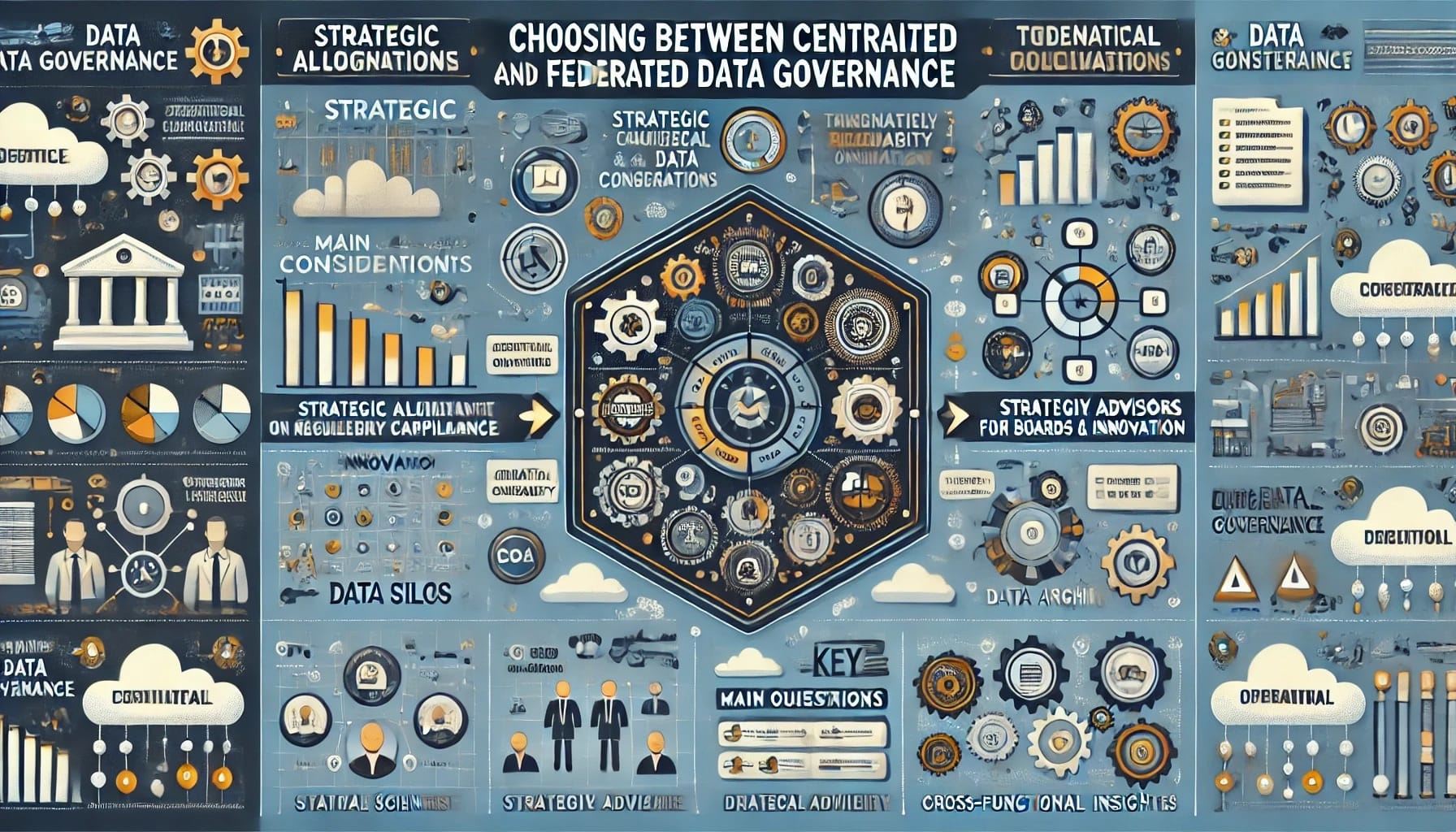 Federated and Centralized Data Governance
Strategic Imperative of Data Governance
Data governance has moved from being a back-office function to a key driver of business strategy. Whether you’re a data scientist looking for consistent, high-quality data, a strategic advisor aiming to align data management with business goals, or a data architect focused on scalable infrastructure, the governance model chosen will directly impact your ability to deliver results.
Centralized vs. Federated: Strategic, Technical, and Operational Considerations
The decision between centralized and federated data governance is complex, involving strategic alignment, technical feasibility, and operational efficiency. Each model presents distinct advantages and challenges that must be evaluated against the backdrop of the organization’s broader objectives.
• Strategic Alignment: For a strategic advisor, the governance model must align with business goals, regulatory requirements, and the organization’s risk profile. Centralized governance often offers better control over compliance and risk management, while federated governance supports innovation by allowing flexibility at the business unit level.
• Technical Feasibility: From a data architect’s perspective, the governance model chosen will impact the scalability of data infrastructure, integration efforts, and the potential for data silos. Centralized governance typically facilitates easier data integration and uniformity, but may struggle with scalability in diverse, multi-platform environments. Conversely, federated governance allows for more tailored infrastructure solutions, though it may require robust mechanisms to avoid silos and ensure data consistency.
• Operational Efficiency: Data scientists require a governance model that supports efficient data access, high-quality data, and the ability to conduct cross-functional analyses. Centralized governance may provide consistent data quality and accessibility across the organization, but might limit the agility and innovation that federated governance offers by enabling localized control over data processes.
Critical Factors for Decision-Making
-
Organizational Structure and Culture: Understanding your organization’s cultural predisposition is fundamental. A hierarchical culture might align more naturally with centralized governance, offering clear lines of authority and control. Conversely, a decentralized culture might resist centralized controls, making a federated approach more suitable.
-
Diversity in Data Needs and Operations: For data scientists and architects, understanding the variability in data needs across business units is crucial. Federated governance allows each unit to tailor their data governance to their specific needs while adhering to overarching corporate standards. However, this comes with the challenge of maintaining data consistency and avoiding silos.
-
Strategic Priorities: The strategic objectives of data governance, whether compliance, innovation, or efficiency, will heavily influence the choice of model. For strategic advisors, centralized governance can drive compliance and risk management, while federated governance supports innovation through localized autonomy.
-
Data Management Maturity: Assessing the maturity of data management practices across departments is essential. Inconsistent maturity levels may necessitate centralized governance to elevate and standardize practices across the organization.
-
Standardization vs. Flexibility: The level of standardization required across the organization is a key consideration. Centralized governance supports uniformity, while federated governance provides the flexibility to meet local requirements without compromising overall standards. Data scientists will appreciate the consistent data quality from centralized models, while strategists may see the value in the flexibility of federated governance to support innovation.
-
Local Autonomy and Flexibility: The importance of local autonomy can’t be overstated. Business units operating in dynamic markets might require the flexibility that federated governance offers, allowing them to respond quickly to changes in their environment.
-
Regulatory and Compliance Requirements: Regulatory requirements can vary significantly by region or industry. For strategic advisors and CIOs, centralized governance might streamline compliance in complex environments, while a federated model allows for tailored approaches that meet local regulations.
-
Departmental Capabilities: The capability of individual departments to manage their own data is a critical consideration. For data architects and data scientists, this impacts the choice of tools, the level of support needed, and the overall effectiveness of the governance model.
-
Budget Considerations: The financial implications of implementing and maintaining a data governance model should not be underestimated. Centralized governance might involve higher initial costs but could offer efficiencies over time. Federated governance may have lower upfront costs but could result in higher long-term expenses due to the need for localized management.
-
Urgency of Cross-Functional Insights: If cross-functional data insights are critical for decision-making, centralized governance might be necessary to ensure that data is integrated and analyzed at the enterprise level.
-
Technology Landscape: The organization’s technology landscape, whether uniform or diverse, will also impact the choice. Centralized governance assumes a homogenous tech environment, while federated governance can accommodate a diverse array of tools and platforms. This is a significant concern for data architects who must ensure that the chosen governance model is technically feasible and scalable.
-
Scalability: Consider how your organization plans to scale its data governance efforts. Centralized governance can provide a uniform, scalable solution, while federated governance allows for more nuanced growth that adapts to the needs of individual business units.
-
Data Security and Privacy: Data security and privacy are paramount. Centralized governance offers tighter control over security measures, but federated governance requires robust local security frameworks to manage risks effectively.
-
Speed of Decision-Making: In dynamic environments where speed is critical, federated governance can enable faster decision-making at the local level, avoiding the delays inherent in a centralized model.
-
Tolerance for Data Inconsistencies: Organizations must assess their tolerance for data inconsistencies. Centralized governance minimizes inconsistencies, but federated governance might tolerate some variability in exchange for greater local responsiveness.
-
Change Management Capability: Implementing a centralized governance model requires strong change management capabilities. Organizations must be prepared to manage the resistance and challenges that can arise during such a transition.
-
In-House Skills and Expertise: The availability of skilled data management professionals within the organization will influence the choice of governance model. Centralized governance can concentrate expertise, while federated governance distributes it across the organization.
-
Avoidance of Data Silos: Data silos can hinder the effectiveness of data governance. Centralized governance inherently reduces the risk of silos, promoting a more integrated data environment across the organization. For data architects, the avoidance of silos is critical in ensuring data integration and consistent data quality.
-
Data Quality Management: Ensuring high data quality is critical. Centralized governance typically provides more consistent data quality management, while federated governance may result in varying levels of quality across different units.
-
Success Measurement: Finally, it is crucial to define clear metrics for success. Centralized governance might focus on enterprise-wide KPIs, while federated governance allows for localized metrics that reflect the performance of individual business units.
Conclusion
Selecting between centralized and federated data governance is not merely a structural decision but a strategic one that must consider the broader implications for the organization’s ability to innovate, manage risks, and operate efficiently. By critically evaluating these.
Deciding Between Federated and Centralized Data Governance.
Dit artikel is exclusief beschikbaar voor nieuwsbrief-abonnees. Schrijf je in voor toegang tot 880+ artikelen.
Geen spam. Uitschrijven op elk moment.
AI & Security Intelligence
Wekelijkse nieuwsbrief met AI updates, security alerts en compliance inzichten, direct in uw inbox.
Security & AI Operating Model
Advisory met executiekracht
Van BIO2 en NIS2 tot EU AI Act, embedded in uw operating model, niet als extern project. Maandelijks opzegbaar, met assessments als bewijsvoering.