6 AI usage frameworks for developing your organizational AI adoption plan
AI adoption is a strategic imperative for organizations looking to enhance efficiency, innovation, and competitiveness. To navigate this transformation, leaders must understand different AI usage frameworks that provide structured approaches to AI integration. These models offer insights into how AI evolves from assisting humans to making autonomous decisions, while also raising ethical considerations such as accountability, bias, and the potential displacement of human roles at each stage of AI adoption. Additionally, organizations must incorporate governance models, risk mitigation strategies, and performance metrics to ensure responsible AI deployment. Below, we explore six widely recognized AI usage frameworks to guide your organization’s AI strategy.
1. Microsoft’s AI Maturity Model
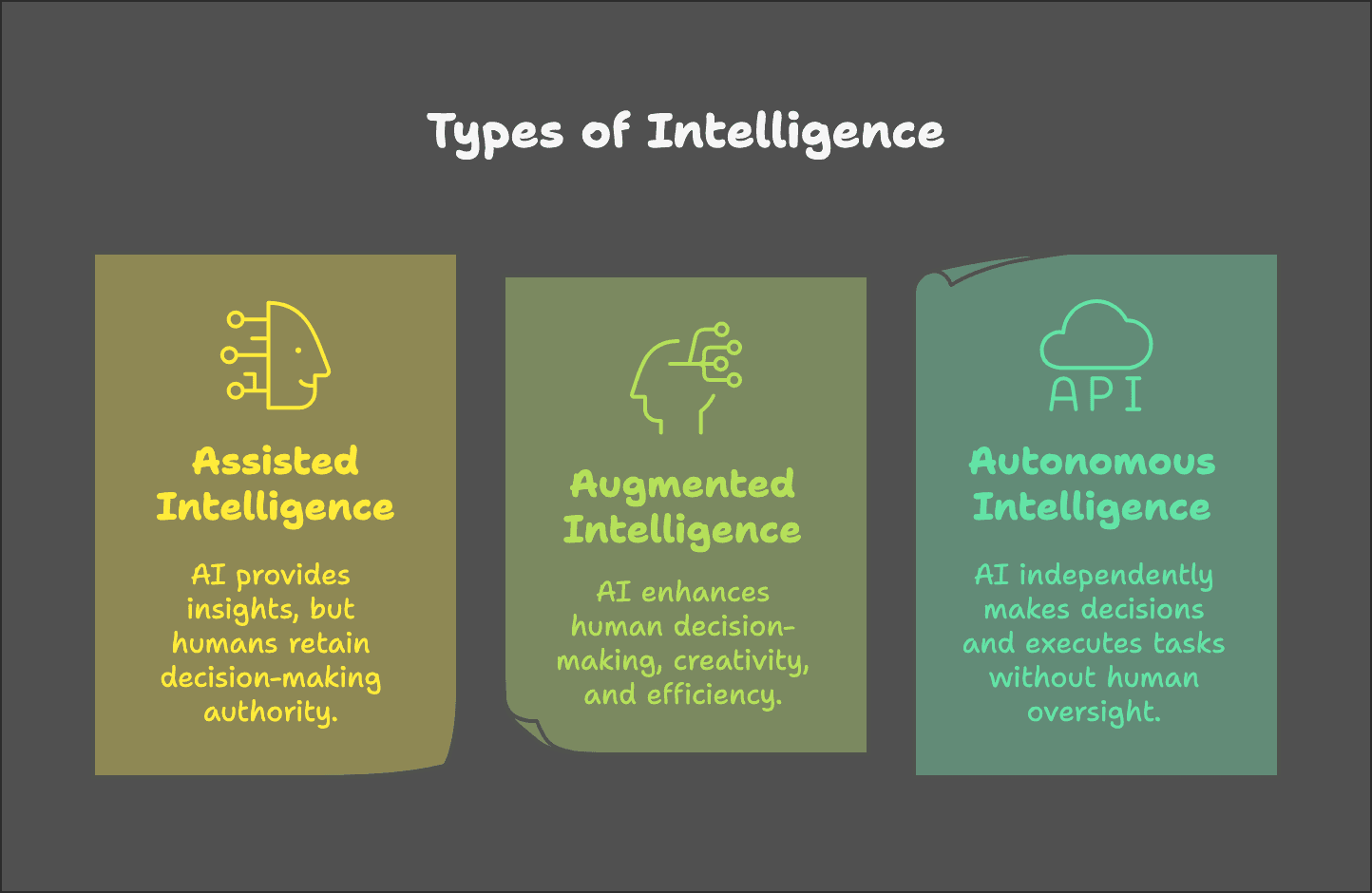
Microsoft’s framework outlines the progressive stages of AI adoption in organizations, highlighting the changing role of human involvement:
-
Assisted Intelligence: AI provides insights, but humans retain decision-making authority.
-
Augmented Intelligence: AI enhances human decision-making, creativity, and efficiency.
-
Autonomous Intelligence: AI independently makes decisions and executes tasks without human oversight.
Key Metrics for Success:
-
Reduction in manual decision-making effort
-
Increase in automation efficiency
-
Compliance with AI governance standards
2. PwC’s AI Augmentation Spectrum
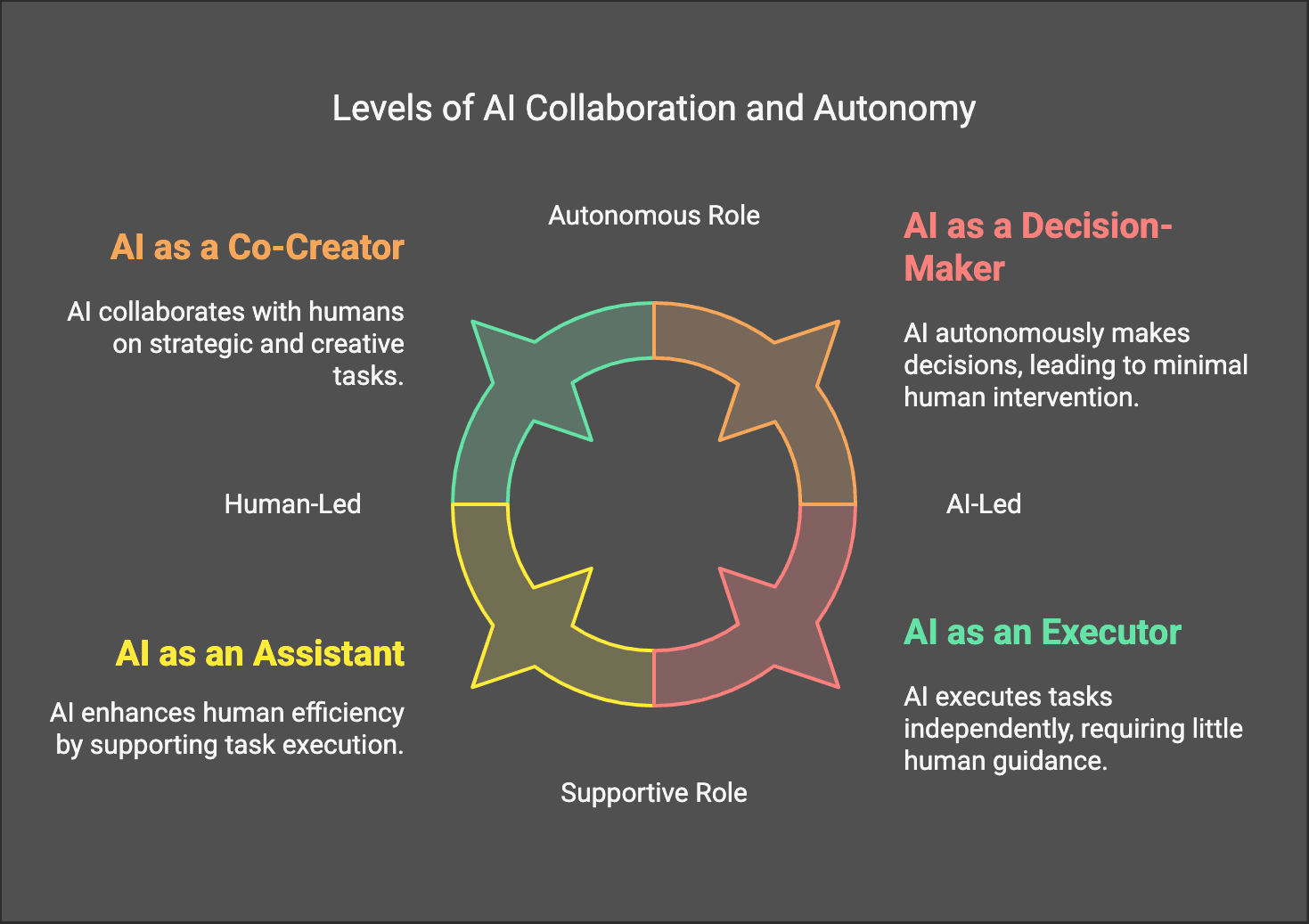
PwC’s AI Augmentation Spectrum categorizes AI usage across six levels of human-AI collaboration:
-
AI as an Advisor: AI provides insights and recommendations for decision-makers.
-
AI as an Assistant: AI supports humans by increasing task efficiency.
-
AI as a Co-Creator: AI and humans collaborate on creative and strategic tasks.
-
AI as an Executor: AI performs specific tasks with minimal human input.
-
AI as a Decision-Maker: AI autonomously makes decisions within predefined guidelines.
-
AI as a Self-Learner: AI continuously improves by learning from past tasks and adapting to new challenges.
Key Metrics for Success:
-
Percentage of AI-generated insights adopted
-
Speed of decision-making improvements
-
AI-driven workflow enhancements
3. Deloitte’s Augmented Intelligence Framework
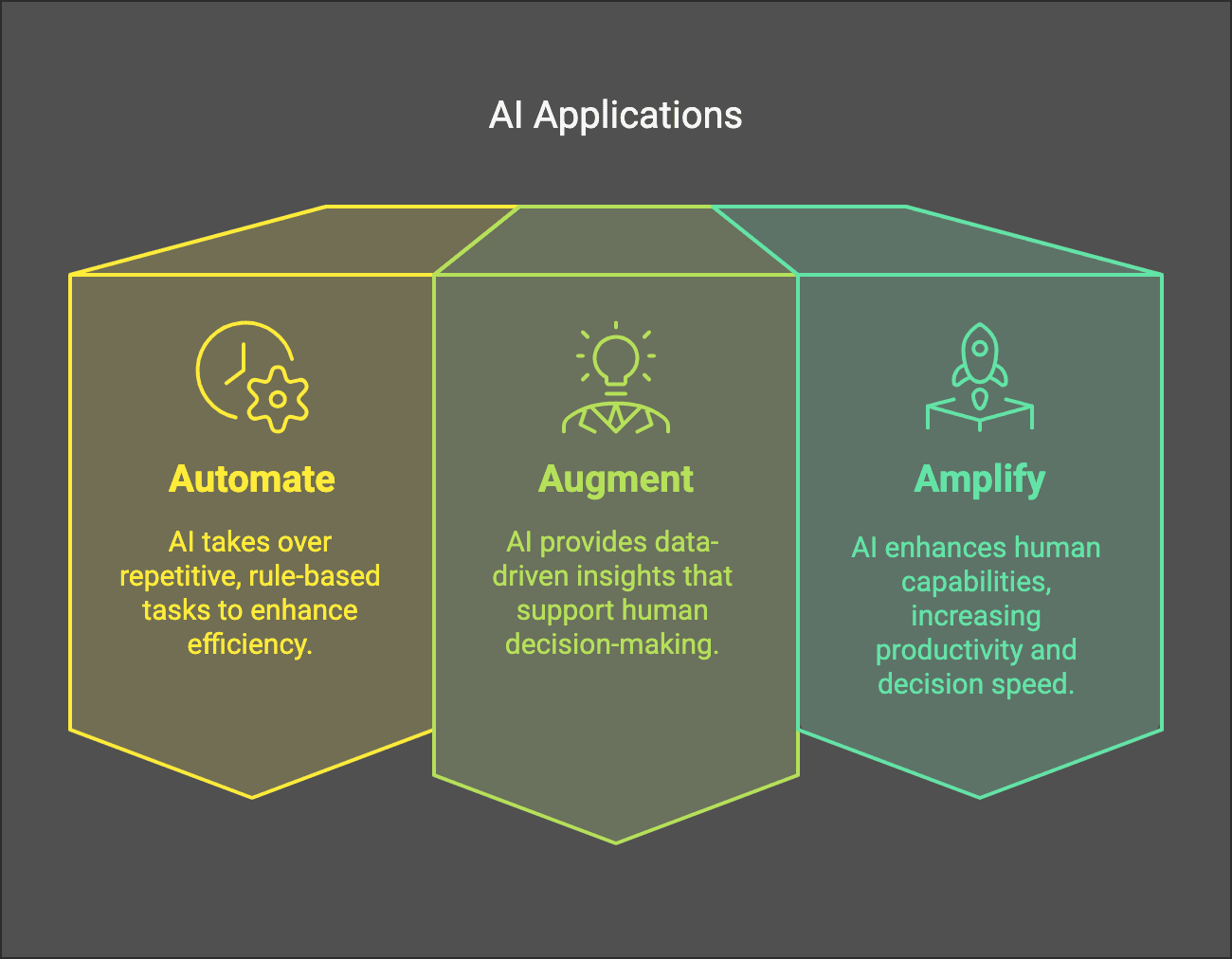
Deloitte emphasizes the collaborative potential of AI in augmenting human work rather than replacing it. The framework consists of three main pillars:
-
Automate: AI takes over repetitive, rule-based tasks to enhance efficiency.
-
Augment: AI provides data-driven insights that support human decision-making.
-
Amplify: AI enhances human capabilities, increasing productivity and decision speed.
Key Metrics for Success:
-
Percentage reduction in repetitive tasks
-
Increase in workforce productivity
-
Adoption rates of AI-augmented workflows
4. Gartner’s Autonomous Systems Framework
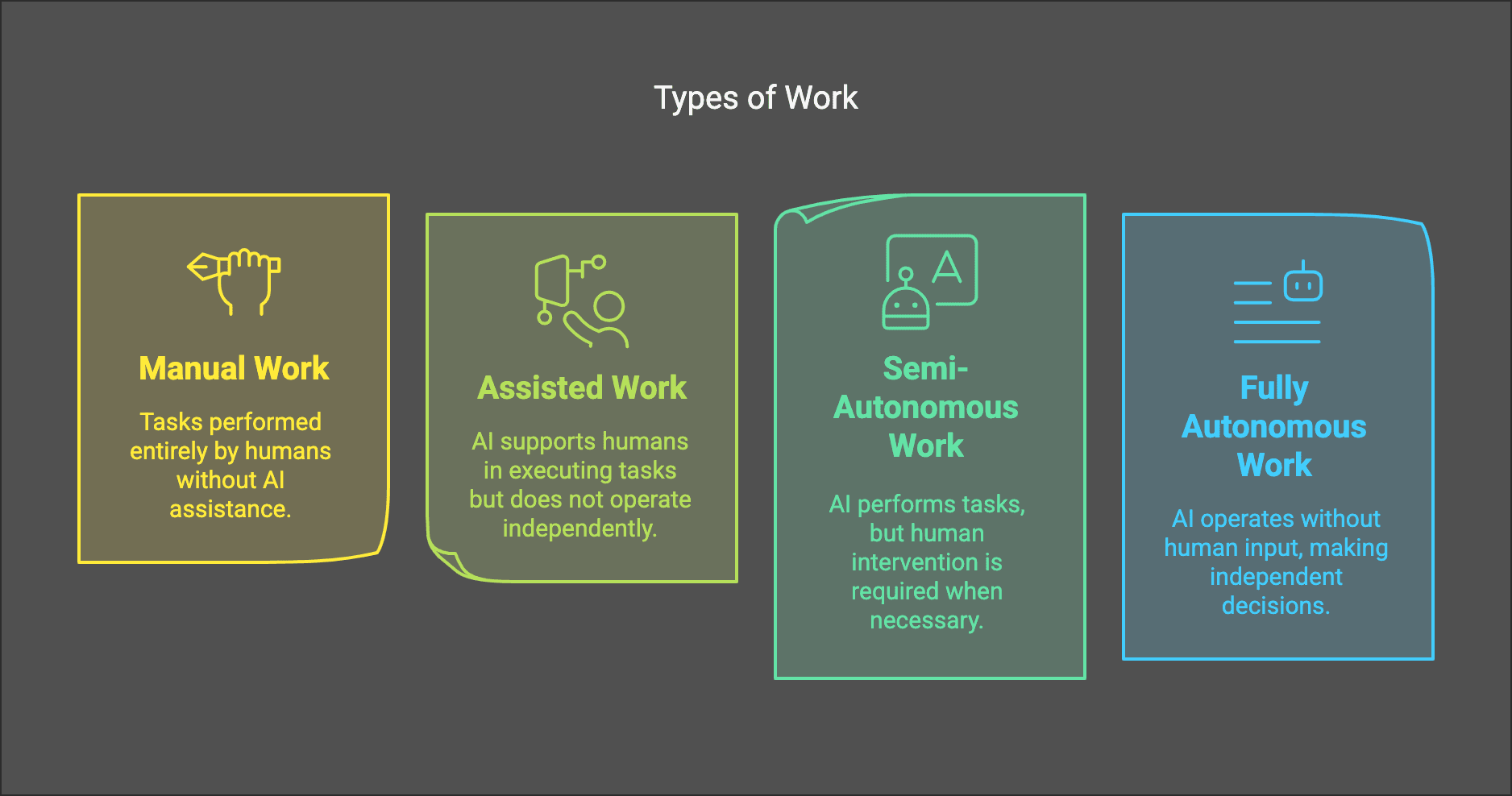
Gartner’s framework categorizes AI usage based on the degree of human involvement and provides key performance indicators (KPIs) to measure success at each level of AI autonomy. These KPIs include efficiency gains, error reduction rates, cost savings, and human intervention frequency, helping organizations evaluate the effectiveness of their AI integration.
-
Manual Work: Tasks performed entirely by humans without AI assistance.
-
Assisted Work: AI supports humans in executing tasks but does not operate independently.
-
Semi-Autonomous Work: AI performs tasks, but human intervention is required when necessary.
-
Fully Autonomous Work: AI operates without human input, making independent decisions.
Key Metrics for Success:
-
Cost savings from automation
-
Error reduction rates
-
Human intervention frequency
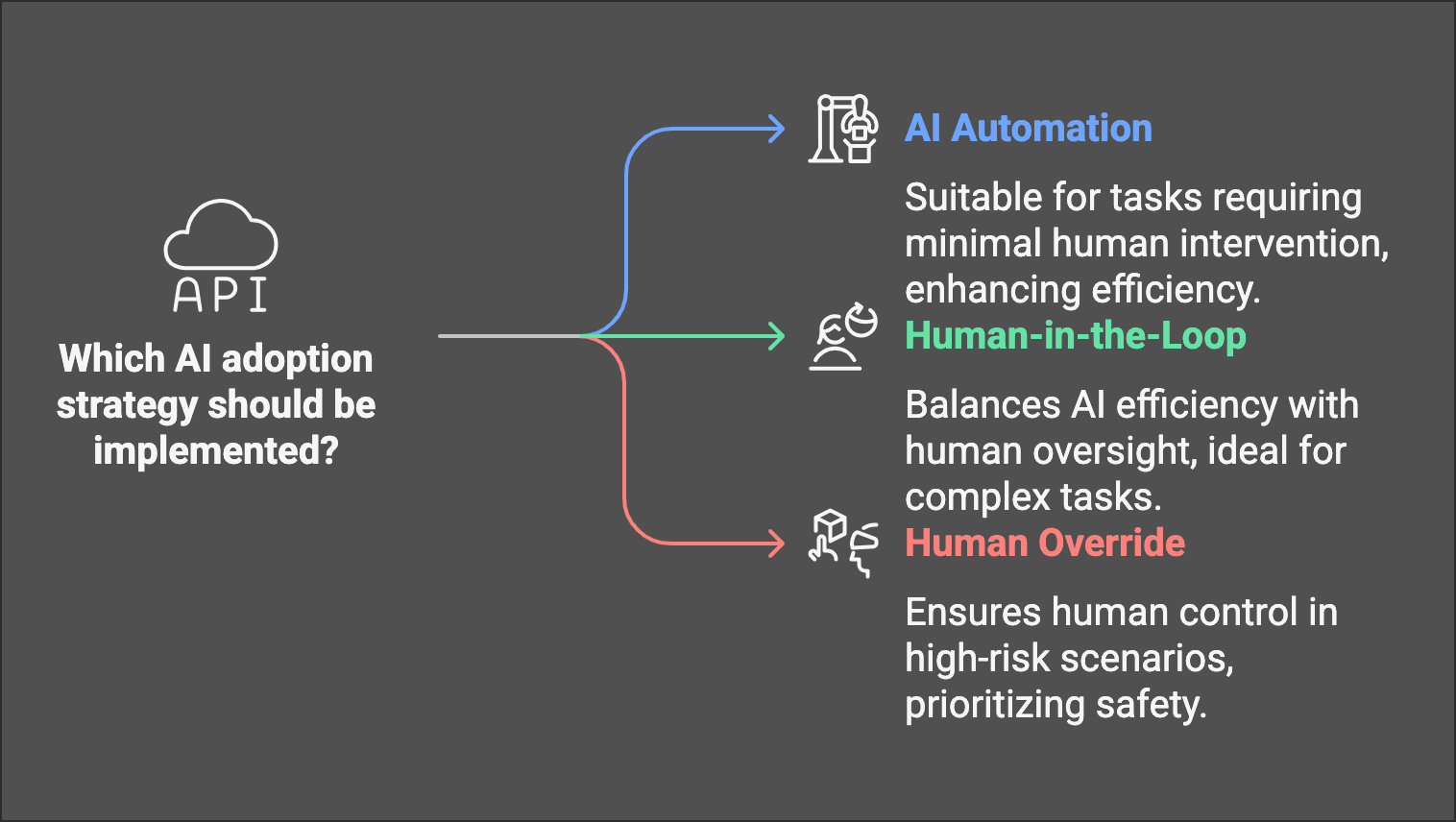
5. MIT’s Human-in-the-Loop (HITL) AI Model
MIT’s HITL framework ensures human oversight in AI processes, particularly in sensitive or complex decision-making scenarios. The model is structured as follows:
-
AI Automation: AI handles tasks independently where human intervention is unnecessary.
-
Human-in-the-Loop: AI performs tasks, but humans review and make critical decisions.
-
Human Override: Humans retain control to override AI decisions in high-risk or ethical situations.
Key Metrics for Success:
-
Number of human overrides required
-
Accuracy of AI-assisted decisions
-
Compliance with ethical AI guidelines
6. Harvard Business Review’s Human-AI Teaming Model
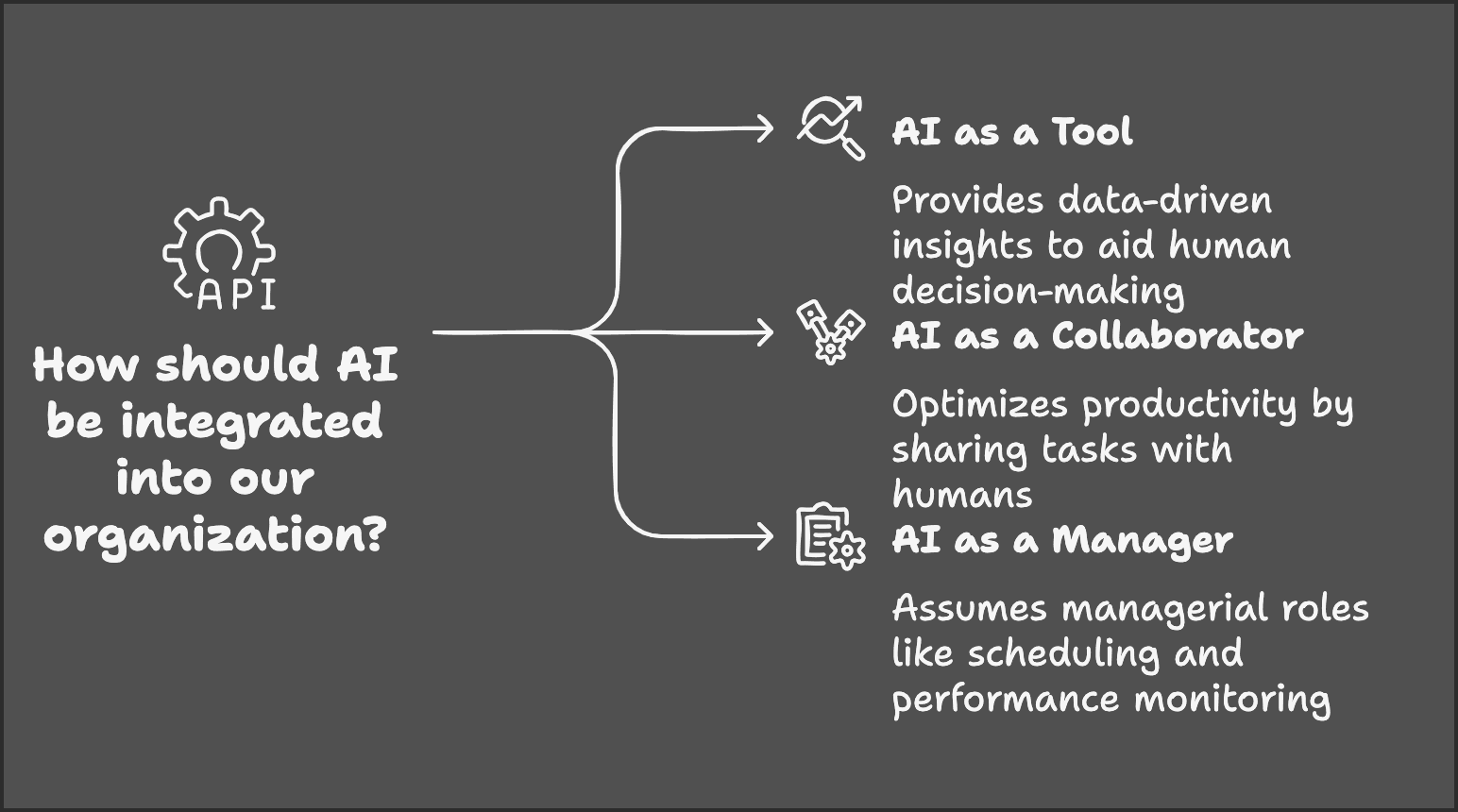
HBR’s framework focuses on the interplay between AI and human collaboration, emphasizing that AI should complement rather than replace human roles. It also highlights the importance of psychological safety in AI adoption, ensuring that employees feel secure in their roles while integrating AI into workflows.
-
AI as a Tool: AI provides data-driven insights to aid human decision-making.
-
AI as a Collaborator: AI and humans share tasks, optimizing productivity.
-
AI as a Manager: AI assumes managerial roles such as scheduling, performance monitoring, and workflow optimization.
Key Metrics for Success:
-
Employee satisfaction with AI integration
-
Increase in collaborative efficiency
-
Reduction in managerial workload through AI
Framework Selection Decision Matrix
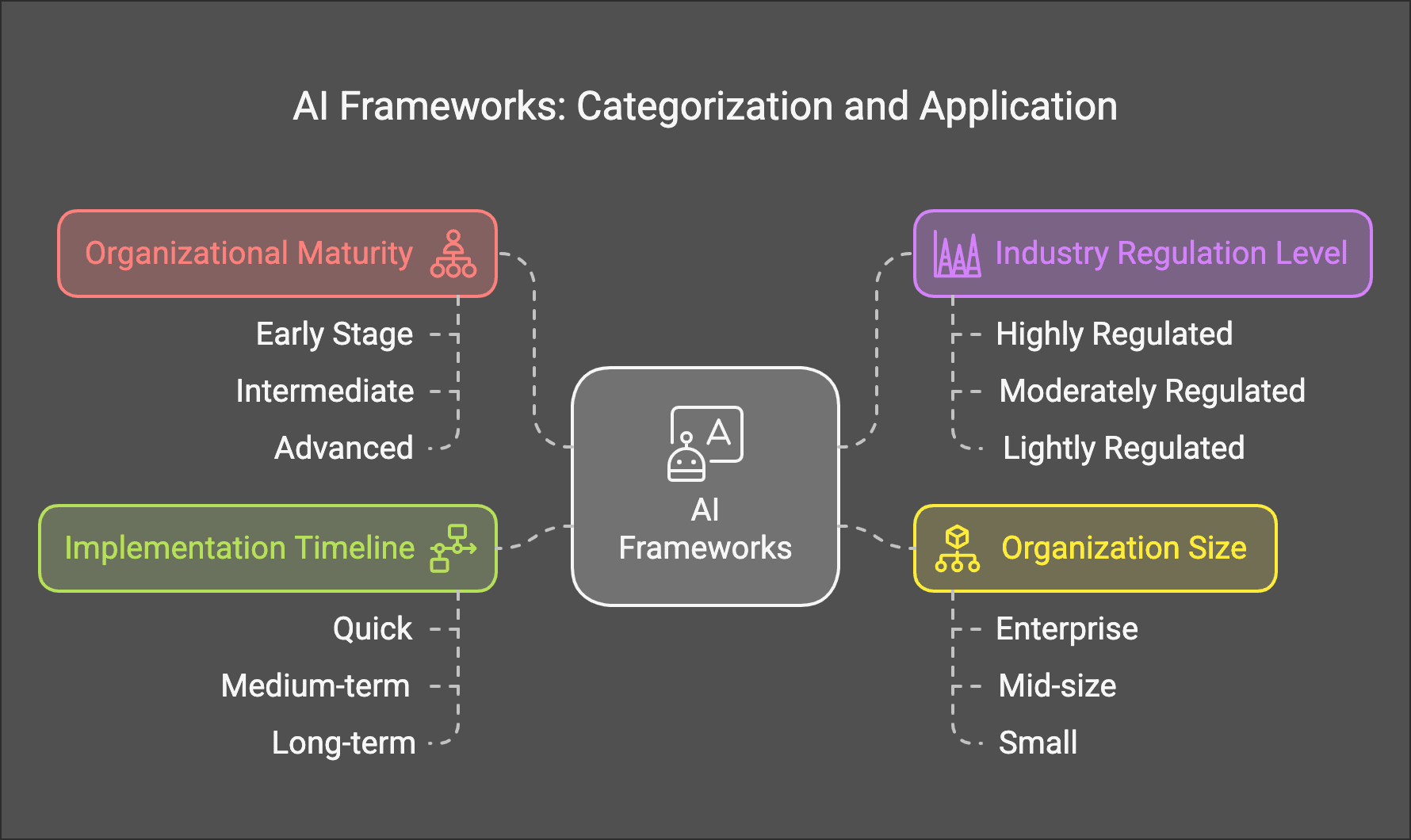
To further support AI framework selection, organizations can utilize the following structured decision matrix:
By Organizational Maturity
-
Early Stage: Microsoft’s AI Maturity Model, Deloitte’s Framework
-
Intermediate: PwC’s Augmentation Spectrum, Gartner’s Autonomous Systems Framework
-
Advanced: MIT’s Human-in-the-Loop, Harvard’s Human-AI Teaming Model
By Industry Regulation Level
-
Highly Regulated: MIT’s Human-in-the-Loop, Gartner’s Autonomous Systems Framework, Microsoft’s AI Maturity Model
-
Moderately Regulated: PwC’s Augmentation Spectrum, Deloitte’s Framework, Harvard’s Human-AI Teaming Model
-
Lightly Regulated: Any framework with appropriate governance overlay
By Organization Size
-
Enterprise (1000+ employees): PwC’s Augmentation Spectrum, Microsoft’s AI Maturity Model, Harvard’s Human-AI Teaming Model
-
Mid-size (100-999 employees): Deloitte’s Framework, Gartner’s Autonomous Systems Framework, MIT’s Human-in-the-Loop
-
Small (<100 employees): Simplified Deloitte’s Framework, Adapted Microsoft Model, Modified Gartner Framework
By Implementation Timeline
-
Quick (<6 months): Deloitte’s Framework, Simplified Gartner Framework, Basic Microsoft Model
-
Medium-term (6-12 months): PwC’s Augmentation Spectrum, Full Gartner Framework, Harvard’s Human-AI Teaming Model
-
Long-term (12+ months): Complete Microsoft AI Maturity Model, MIT’s Human-in-the-Loop, Comprehensive PwC Implementation
Conclusion
By integrating these frameworks, organizations can strategically implement AI, optimize collaboration between humans and machines, and drive sustainable innovation. A data-driven approach, combined with ethical oversight and clear AI governance, ensures a responsible and effective AI strategy tailored to an organization’s unique needs. Organizations should leverage performance metrics, ethical considerations, and change management strategies to successfully navigate their AI adoption journey.
Reference
-
Title: AI Adoption Framework: Definition & Insights | Miquido **Url: **https://www.miquido.com/ai-glossary/ai-adoption-framework/
-
Title: Announcing comprehensive guidance for AI adoption and architecture **Url: **https://techcommunity.microsoft.com/blog/azurearchitectureblog/announcing-comprehensive-guidance-for-ai-adoption-and-architecture/4298569
-
Title: AI adoption, Cloud Adoption Framework | Microsoft Learn **Url: **https://learn.microsoft.com/en-us/azure/cloud-adoption-framework/scenarios/ai/
6 AI usage frameworks for developing your organizational AI adoption plan
Dit artikel is exclusief beschikbaar voor nieuwsbrief-abonnees. Schrijf je in voor toegang tot 880+ artikelen.
Geen spam. Uitschrijven op elk moment.
AI & Security Intelligence
Wekelijkse nieuwsbrief met AI updates, security alerts en compliance inzichten, direct in uw inbox.
Security & AI Operating Model
Advisory met executiekracht
Van BIO2 en NIS2 tot EU AI Act, embedded in uw operating model, niet als extern project. Maandelijks opzegbaar, met assessments als bewijsvoering.