Blueprint of an AI Ecosystem.
1. Introduction: The Anatomy of an AI Environment
An AI environment is a sophisticated synergy between human expertise and technical infrastructure. It is not merely a collection of algorithms but a managed lifecycle where technical components must be robust enough to support critical human decisions. Under the European AI Act, certain applications are classified as High-Risk AI Systems (HRAIS). These systems operate in sectors such as biometrics, education, employment, law enforcement, critical infrastructure management, and access to essential private or public services. Because their operation can profoundly impact health, safety, and fundamental rights, the ecosystem must be designed to mitigate risks to these core values.
Learner’s Objective Understanding these roles and infrastructural blocks is the essential first step in responsible AI management. By mastering the relationship between the human ensemble and the technical stage, you can ensure that AI systems are not only high-performing but also legally compliant and ethically sound.
The necessity of human oversight is paramount in HRAIS; however, for oversight to be effective, the system must be built upon a foundation of data integrity and infrastructural reliability.
https://aesia.digital.gob.es/en/guides
2. The Human Ensemble: Defining the Main Actors
A successful AI ecosystem relies on a diverse team of professionals. Each role provides a specific “Value-Add” that translates abstract safety requirements into operational reality.
| Role | Primary Responsibility | Critical Impact on Risk Management |
|---|---|---|
| Data Owner | Responsible for data organization, including definition, classification, and protection. | Ensures the quality and legal integrity of the information used to teach the system. |
| System Owner | The entity or individual that requests the AI solution and maintains ultimate accountability. | Acts as the primary point of responsibility for the system’s performance and adherence to safety standards. |
| Data Scientists | Apply statistics and machine learning to analyze datasets and solve complex problems. | Mitigates bias and ensures the mathematical models are robust against errors and inadequate generalization. |
| Data Engineers | Focus on the design, management, and optimization of data flows. | Prevents technical failures by preparing computational infrastructure and managing the flow of data across systems. |
| End Users | Those within an organization who use and benefit from the AI’s results. | Provide the human oversight necessary to catch errors in real-world applications and prevent automated harm. |
RolePrimary ResponsibilityCritical Impact on Risk ManagementData OwnerResponsible for data organization, including definition, classification, and protection.Ensures the quality and legal integrity of the information used to teach the system.System OwnerThe entity or individual that requests the AI solution and maintains ultimate accountability.Acts as the primary point of responsibility for the system’s performance and adherence to safety standards.Data ScientistsApply statistics and machine learning to analyze datasets and solve complex problems.Mitigates bias and ensures the mathematical models are robust against errors and inadequate generalization.Data EngineersFocus on the design, management, and optimization of data flows.Prevents technical failures by preparing computational infrastructure and managing the flow of data across systems.End UsersThose within an organization who use and benefit from the AI’s results.Provide the human oversight necessary to catch errors in real-world applications and prevent automated harm.
These human actors require a robust technical stage composed of hardware and software to perform these tasks with the precision required for high-risk environments.
3. The Technical Foundation: Infrastructural Building Blocks
The infrastructure of an AI system provides the “Robustness and Reliability” required to ensure the system functions as intended, especially when safety is at stake.
Data Storage
-
Database Management System (DBMS): Software that manages the storage, retrieval, and updates of information.
-
Distributed File System: A method of storing and accessing files across multiple hosts. This ensures high availability and resilience, preventing the system from failing if a single machine goes offline.
Processing Power
-
Processors: The components that interpret commands and perform calculations. In a high-risk context, such as a system administering insulin to a patient, the reliability of the processor is a critical safety concern; a hardware failure here is a direct threat to life.
-
Operating Systems: Software that manages hardware and resources. A secure and stable OS is required to provide a reliable environment for HRAIS programs, ensuring they are not vulnerable to external exploitation.
Development Platforms
- Machine Learning Platforms: An integrated ecosystem of tools and libraries that support the development of applications. These platforms provide the controlled environment needed to track the model’s evolution and ensure it meets technical requirements for robustness.
4. The Lifecycle of Data: From Ingestion to Intelligence
Data transformation is the most critical phase for ensuring “Data Governance.” These steps are not technical chores; they are the filters that prevent discrimination and system failure.
Data Ingestion
-
The process of transporting data from multiple sources to create multidimensional data points.
-
So What? Inadequate ingestion protocols can lead to data loss or corruption, directly compromising the fairness, security, and robustness of the final AI model.
Data Understanding
-
Gaining knowledge about what data assets represent, their content, and the specific needs they will satisfy.
-
So What? Without a deep understanding of the application domain, a system may suffer from a “lack of representativeness” or a failure to generalize across different regions, leading to incorrect and harmful conclusions.
Data Pre-processing (Cleaning)
-
The act of preparing and cleaning data to remove errors or inconsistencies.
-
So What? Biases often stem from prejudices or erroneous assumptions made during the initial system design process. Rigorous cleaning is the first line of defense in ensuring the system treats all population groups fairly.
Feature Selection
-
Reducing the number of dimensions or features of the input vector to focus on the most significant variables.
-
So What? Effective feature selection prevents the system from focusing on “noise” or irrelevant correlations that could lead to discriminatory or non-robust outcomes.
5. Training vs. Testing: The Fuel and the Filter
Before an AI system is commercialized, it must move from the learning phase to a strict validation phase to ensure it does not pose unacceptable risks.
Training (The Learning Phase)
-
Goal: To allow the system to recognize patterns using training datasets.
-
Risk: This phase is vulnerable to “contamination” by external malicious agents.
-
Mitigation: To counter this, architects must implement an Adverse Data Identification Tool. This tool analyzes training data to determine if information has been modified or entered by an external agent in an unwanted way.
Evaluation (The Validation Phase)
-
Goal: To verify that the system complies with safety requirements and performs accurately in its intended context.
-
Risk Mitigation: Testing must be carried out in real-world conditions before market entry. Critically, any serious incident detected during these tests must be reported to the appropriate authorities immediately to ensure public safety.
6. System Integrity: Maintenance, Tuning, and Monitoring
High-risk systems require ongoing vigilance. Deployment is not the end of the lifecycle, but the beginning of a continuous monitoring process.
Guarantees for Continued Success:
-
System Tuning: Focusing on specific parameters, often called hyperparameters, to optimize performance and prevent the model from becoming overconfident in its predictions.
-
System Maintenance: Regularly monitoring the accuracy of predictions to detect deviations from concepts. If a decline in performance is detected, the system must be retrained with more representative data.
-
Monitoring Tools: Tracking the status of the system in use to alert operators to failures, defects, or fuzzing attacks (where unexpected data is used to manipulate or crash the system).
-
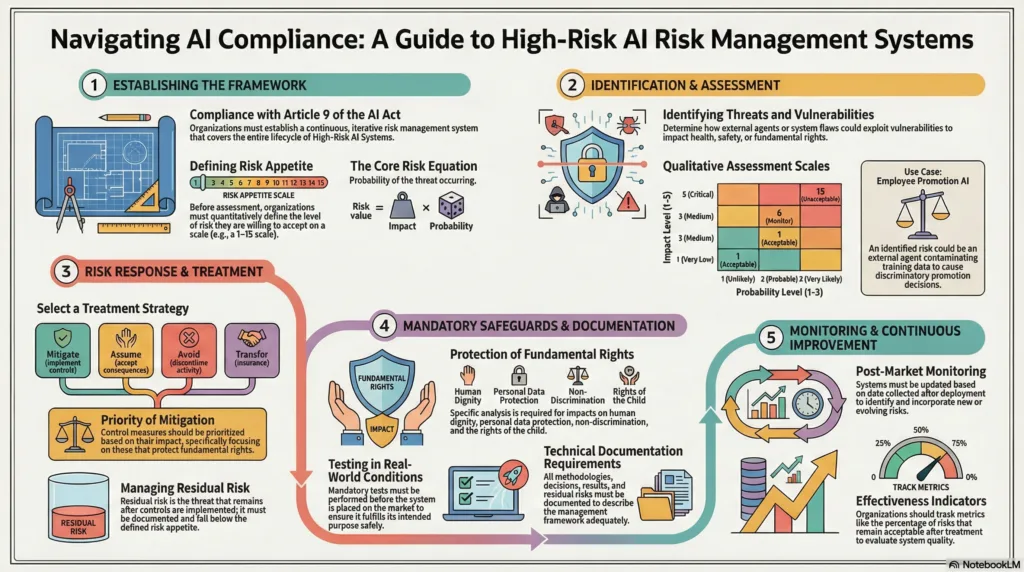
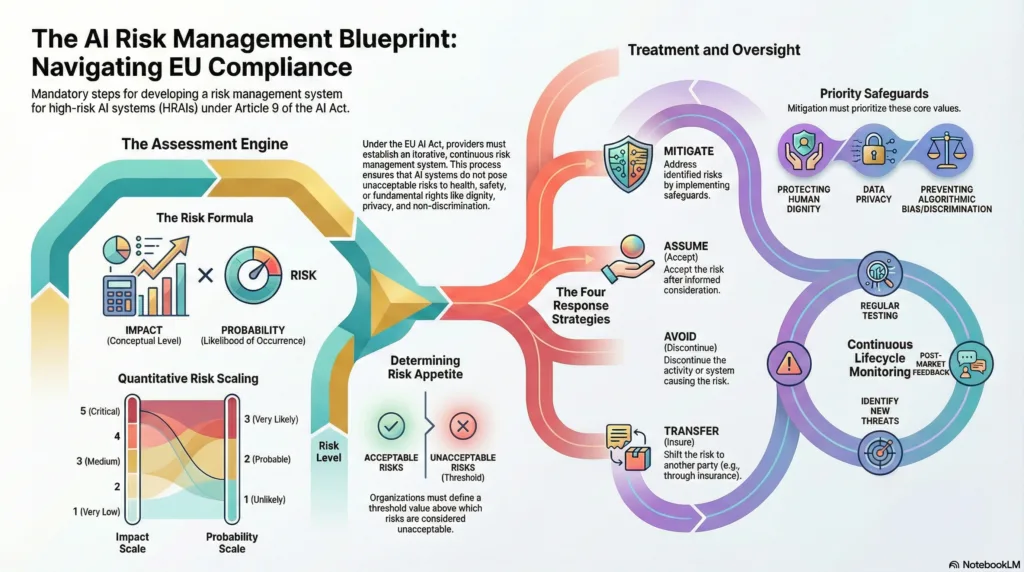
Residual Risk Management: Identifying and documenting Residual Risk, the risk that remains after all controls have been implemented. This residual risk must be quantified, documented, and reported to ensure it stays within the organization’s defined “risk appetite.”
7. Synthesis: The Integrated AI Model
The integrity of a High-Risk AI System is found in the connection between its parts. A Data Engineer manages the computational infrastructure and the Distributed File System where raw data resides. A Data Scientist then leverages a Machine Learning Platform to perform pre-processing, effectively filtering out design prejudices before the data reaches the training phase. Through rigorous System Tuning and the use of an Adverse Data Identification Tool, the team creates a robust HRAIS. Finally, the End User provides human oversight, informed by continuous monitoring and the documentation of residual risks, ensuring the system remains a safe and beneficial tool.
“True AI maturity is achieved when technical building blocks and human roles are synchronized to prioritize the health, safety, and fundamental rights of the people the system serves. This human-centric design is the only way to build trust in a high-risk digital world.”
Presentatie: Blueprint of an AI Ecosystem
Blueprint of an AI Ecosystem
Blueprint of an AI Ecosystem.
Dit artikel is exclusief beschikbaar voor nieuwsbrief-abonnees. Schrijf je in voor toegang tot 880+ artikelen.
Geen spam. Uitschrijven op elk moment.
AI & Security Intelligence
Wekelijkse nieuwsbrief met AI updates, security alerts en compliance inzichten, direct in uw inbox.
Security & AI Operating Model
Advisory met executiekracht
Van BIO2 en NIS2 tot EU AI Act, embedded in uw operating model, niet als extern project. Maandelijks opzegbaar, met assessments als bewijsvoering.