Knowledge Graphs as Decision Infrastructure for Enterprise AI.
This document synthesizes the implementation blueprint for Knowledge Graphs (KGs) as the essential semantic infrastructure for Enterprise AI. It outlines the transition from plausible but unreliable AI outputs to governed, decision-grade intelligence.
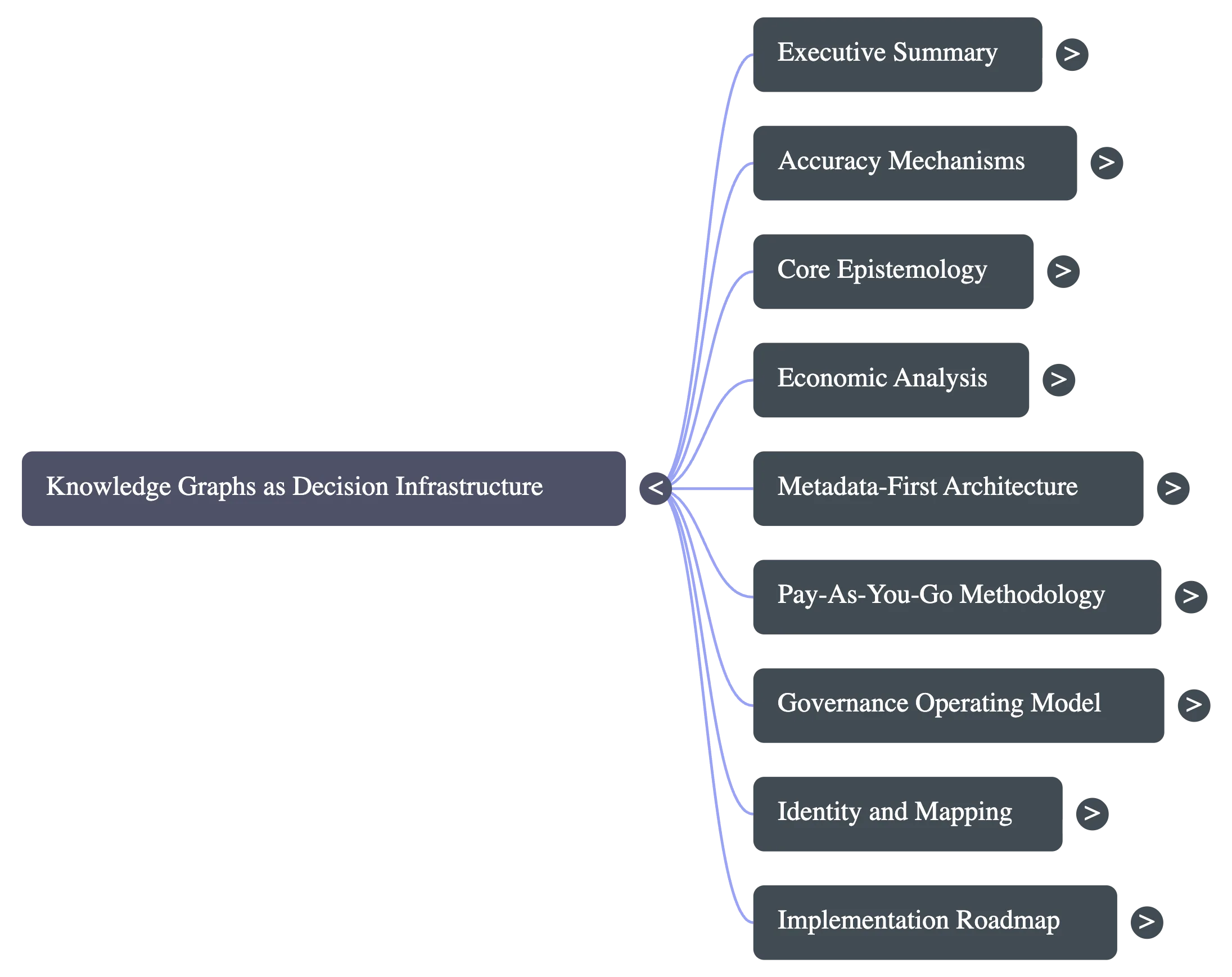
1. Executive Summary
Enterprise AI currently faces a critical “accuracy gap” that prevents it from delivering significant decision-making value. Large Language Models (LLMs) generate plausible responses but lack epistemic guarantees. Without a governed semantic infrastructure, comprised of ontologies, identity management, and executable mappings, AI systems cannot meet the transparency and accountability standards required for enterprise operations and regulatory compliance (e.g., the EU AI Act).
Critical Takeaways
-
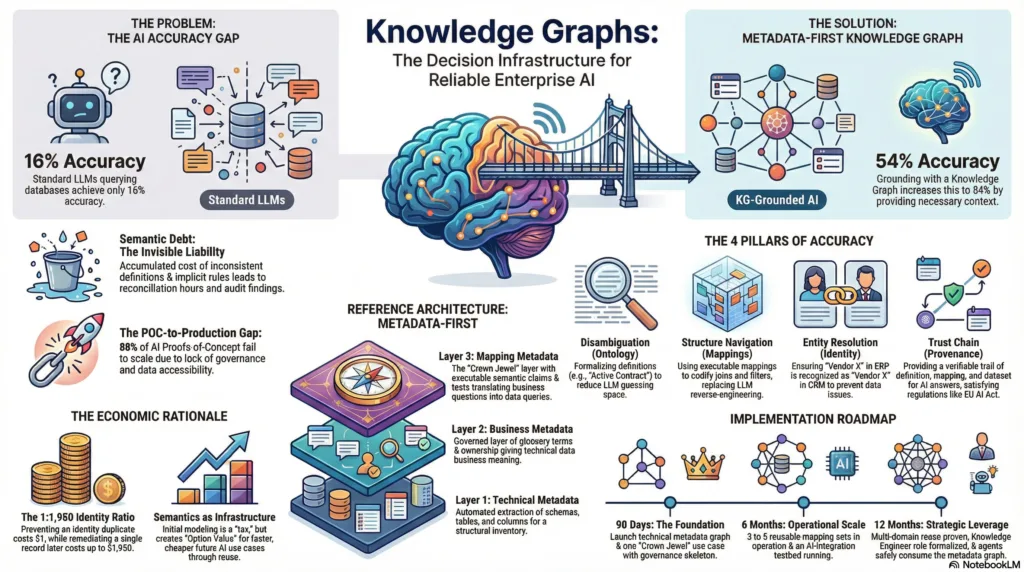
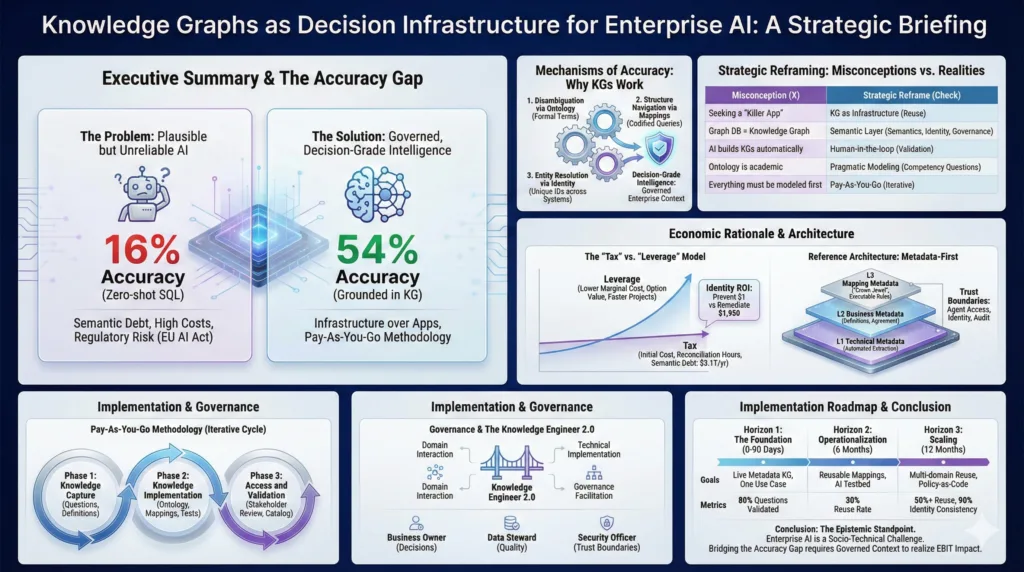
The Accuracy Gap: Direct zero-shot SQL prompts on enterprise databases achieve only 16% accuracy. Grounding AI in a Knowledge Graph representation increases this accuracy to 54%, transforming it from unusable to decision-grade.
-
Semantic Debt: Organizations are accumulating “semantic debt” when business definitions and data interpretations remain implicit. This debt results in high reconciliation costs, audit findings, and a lack of trust in data (67% of organizations currently do not trust their own data for decision-making).
-
Infrastructure over Applications: KGs should not be viewed as “killer apps” or mere graph databases. They are infrastructure layers that connect existing systems through shared semantics, providing compounding value through reuse and lower integration costs.
-
Regulatory Urgency: The EU AI Act (effective August 2026) mandates transparency and traceability for high-risk AI. KGs provide the natural structure for these requirements.
-
Proven Methodology: Success requires a “Pay-As-You-Go” approach, iteratively solving specific business questions rather than attempting to model the entire enterprise at once (“Boil the Ocean”).
2. Evidence Grading System
Every core claim in this synthesis is backed by a specific level of evidence as defined in the source context:
| Code | Level | Significance |
|---|---|---|
| E1 | Formal Standard / Peer-reviewed | Scientific journals, W3C/ISO standards, or legislation. |
| E2 | Independent Replication | Confirmed by multiple independent sources or credible industry cases. |
| E3 | Practitioner Cross-validation | Consistent findings across multiple industry practitioner reports. |
| E4 | Reasoned Extrapolation | Logical deductions explicitly labeled as non-empirical. |
| E5 | Speculation | Hypothetical scenarios. |
CodeLevelSignificanceE1Formal Standard / Peer-reviewedScientific journals, W3C/ISO standards, or legislation.E2Independent ReplicationConfirmed by multiple independent sources or credible industry cases.E3Practitioner Cross-validationConsistent findings across multiple industry practitioner reports.E4Reasoned ExtrapolationLogical deductions explicitly labeled as non-empirical.E5SpeculationHypothetical scenarios.
3. Mechanisms of Accuracy: Why Knowledge Graphs Work
The improvement in AI performance from 16% to 54% accuracy is driven by four specific mechanisms that address the fundamental lack of enterprise context in LLMs:
-
Disambiguation via Ontology: Formalizes terms (e.g., defining exactly what an “active contract” is). This reduces the search space for the LLM by eliminating multiple plausible but incorrect interpretations.
-
Structure Navigation via Mappings: Translates business concepts into concrete queries (SQL/API). This codifies the structural knowledge typically trapped in the heads of data engineers.
-
Entity Resolution via Identity Management: Ensures “Supplier X” in System A is recognized as “Vendor 47” in System B. This prevents under-counting or incorrect joins that lead to biased outputs.
-
Trust Chain via Provenance: Records how an answer was derived (which concept, mapping, and dataset were used). This transforms a “black box” output into a verifiable claim suitable for audit.
4. Strategic Reframing: Misconceptions vs. Realities
The failure of 88% of AI Proof of Concepts (POCs) is often attributed to fundamental misunderstandings of semantic technology:
| Misconception | Strategic Reframe |
|---|---|
| Seeking a “Killer App” | KG as Infrastructure: Value lies in reuse across multiple applications (e.g., Customer 360 used for marketing, fraud, and service). |
| Graph DB = Knowledge Graph | Semantic Layer: A graph database is storage; a KG requires explicit semantics, identity management, and governance. |
| AI builds KGs automatically | Human-in-the-loop: AI can assist in discovery, but human validation is mandatory for decision-relevant claims. |
| Ontology is academic | Pragmatic Modeling: Use “competency questions” to ensure modeling only serves specific business needs. |
| Everything must be modeled first | Pay-As-You-Go: Start with one business question; model and map only what is necessary for that question. |
MisconceptionStrategic Reframe**Seeking a “Killer App”**KG as Infrastructure: Value lies in reuse across multiple applications (e.g., Customer 360 used for marketing, fraud, and service).Graph DB = Knowledge Graph****Semantic Layer: A graph database is storage; a KG requires explicit semantics, identity management, and governance.AI builds KGs automatically****Human-in-the-loop: AI can assist in discovery, but human validation is mandatory for decision-relevant claims.Ontology is academic****Pragmatic Modeling: Use “competency questions” to ensure modeling only serves specific business needs.Everything must be modeled first****Pay-As-You-Go: Start with one business question; model and map only what is necessary for that question.
5. Economic Rationale: The “Tax” vs. “Leverage” Model
KGs follow the pattern of previous infrastructure investments: they are initially seen as a cost (a “tax”) but eventually become a “leverage” that lowers the marginal cost of all future projects.
-
Option Value: Investing in semantic infrastructure creates “real options”, the ability to implement future use cases faster and cheaper.
-
Transaction Costs: Shared semantics reduce “reconciliation hours”, the time spent by teams trying to align conflicting figures.
-
Identity ROI: Preventing a duplicate record costs $1; remediating it later in complex domains can cost up to $1,950 per record.
-
Semantic Debt Quantification: Bad data quality costs the US economy $3.1 trillion annually. KGs mitigate this by making business rules explicit rather than burying them in application code.
6. Reference Architecture: Metadata-First
A successful architecture prioritizes metadata to provide an immediate “context brain” for AI agents.
The Three-Layer Structure
-
Technical Metadata (Layer 1): Automated extraction of schemas, tables, and columns. Provides an inventory and impact analysis.
-
Business Metadata (Layer 2): Glossaries, ontologies, and definitions. Focuses on “meaning as agreement” between stakeholders.
-
Mapping Metadata (Layer 3): The “Crown Jewel.” Executable queries and transformation rules with full lineage and versioning.
Trust Boundaries
To ensure security and compliance, the architecture defines three boundaries:
-
Agent Access Boundary: Restricts AI agents to authorized concepts and query templates.
-
Identity Boundary: Manages the mapping between local IDs and global URIs.
-
Audit Boundary: Provides an immutable log of all changes and query executions.
7. Implementation Methodology: Pay-As-You-Go
To avoid “Pilot Paralysis,” organizations should follow a three-phase iterative cycle for every business question:
-
Phase 1: Knowledge Capture: Interviews with experts to extract definitions, register disagreements, and define “competency questions.”
-
Phase 2: Knowledge Implementation: Building the ontology module, executable mappings, and a five-tier test suite (Definitional, Constraint, Regression, Identity, and Lineage).
-
Phase 3: Access and Validation: Stakeholder review of the output. Publication to the catalog only after explicit approval.
8. Governance and the Knowledge Engineer 2.0
Governance must shift from “gatekeeping” to “enablement.” This requires a new role: the Knowledge Engineer 2.0.
The Knowledge Engineer 2.0 Profile
This role is the socio-technical bridge between four teams:
-
Domain Interaction: Extracting knowledge and facilitating consensus between business owners.
-
Technical Implementation: Writing ontologies, mappings, and test suites.
-
Governance Facilitation: Maintaining change control and provenance.
Decision Rights (RACI Highlights)
-
Business Owner: Final decision on definitions and prioritiziation.
-
Data Steward: Accountable for the technical quality of mappings and identity rules.
-
Security Officer: Accountable for trust boundaries and access policies.
9. Implementation Roadmap
Horizon 1: The Foundation (0-90 Days)
-
Goal: Live Metadata KG baseline and one “Crown Jewel” use case.
-
Deliverables: Technical metadata graph, Business Glossary v1, 3-5 executable mappings, and a governance skeleton.
-
Success Metric: 80% of competency questions validated by the Business Owner.
Horizon 2: Operationalization (6 Months)
-
Goal: 3-5 reusable mapping sets and a functional AI-integration testbed.
-
Deliverables: Automated identity consistency scoring, incentive pilots for reuse, and audit-ready lineage for core metrics.
-
Success Metric: Reuse rate of at least 30% for new use cases.
Horizon 3: Scaling (12 Months)
-
Goal: Multi-domain reuse and formalized Knowledge Engineer roles.
-
Deliverables: Policy-as-code enforcement, automated regression tests for schema changes, and a full economic dashboard showing reduced reconciliation costs.
-
Success Metric: 50%+ reuse rate and 90%+ identity consistency for core entities.
10. Conclusion: The Epistemic Standpoint
Enterprise AI success is not a technical problem to be solved by better models, but a socio-technical challenge requiring governed context. Truth in an enterprise is contextual and negotiated. By treating semantics as a capital good and implementing an infrastructure of Knowledge Graphs and mappings, organizations can bridge the accuracy gap, meet regulatory mandates, and finally realize the EBIT impact of their AI investments.
Presentatie: Knowledge Graphs as Decision Infrastructure
Knowledge Graphs as Decision Infrastructure
Knowledge Graphs as Decision Infrastructure for Enterprise AI.
Dit artikel is exclusief beschikbaar voor nieuwsbrief-abonnees. Schrijf je in voor toegang tot 880+ artikelen.
Geen spam. Uitschrijven op elk moment.
AI & Security Intelligence
Wekelijkse nieuwsbrief met AI updates, security alerts en compliance inzichten, direct in uw inbox.
Security & AI Operating Model
Advisory met executiekracht
Van BIO2 en NIS2 tot EU AI Act, embedded in uw operating model, niet als extern project. Maandelijks opzegbaar, met assessments als bewijsvoering.