Modern prompt engineering frameworks
by Djimit
Purpose and Scope
This report provides a comprehensive analysis of modern prompt engineering frameworks, their orchestration into complex multi-agent systems, and the critical governance required for secure, compliant, and effective enterprise deployment. The analysis covers a spectrum of techniques, from foundational methods to advanced reasoning frameworks, including ReAct, Tree of Thoughts (ToT), Atom of Thoughts (AoT), and Self-Consistency. It further examines the practical implementation of these frameworks using leading orchestration tools and provides a blueprint for aligning their use with stringent security and regulatory standards, including the OWASP Top 10 for LLMs, the NIST AI Risk Management Framework (AI RMF), ISO 27001/42001, and GDPR.
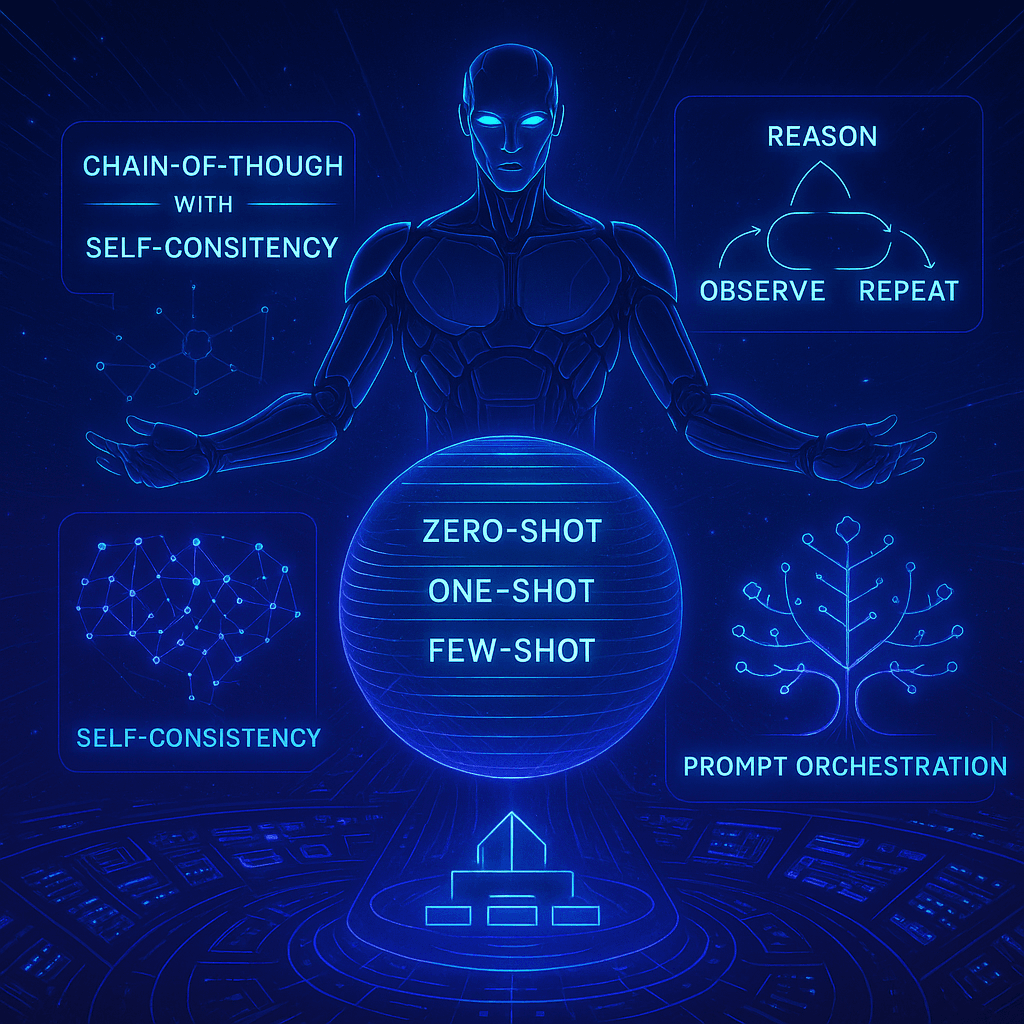
Key Findings
The investigation yields several critical findings for organizational leaders and AI strategists. First, there is no single “best” prompting framework; instead, a portfolio approach is necessary. The optimal choice is contingent on the specific use case, risk tolerance, and computational budget. Frameworks like ReAct excel at tasks requiring external tool interaction and grounding 1, while Tree of Thoughts (ToT) and Atom of Thoughts (AoT) are designed for complex, multi-step reasoning problems where exploration or decomposition is key.3
Self-Consistency serves as a powerful method to enhance the reliability of any reasoning-based task, albeit at a higher computational cost.5
Second, the field suffers from significant terminological ambiguity. Terms queried such as “Z-Prompt,” “SPEAR,” and “RAPTOR-X” do not correspond to formally defined, structured prompting frameworks within the provided academic and technical literature. “Z-Prompt” refers to the fundamental technique of zero-shot prompting 7, while research on “SPEAR” and “RAPTOR-X” points to either unrelated business methodologies or specific fine-tuned models, not prompting frameworks with the specified components.9 This report clarifies these ambiguities to prevent misallocation of development resources.
Third, prompt engineering is rapidly maturing into a formal engineering discipline. This evolution necessitates the adoption of robust MLOps and DevOps practices, including systematic version control for prompts, automated testing (backtesting, regression testing), and CI/CD pipelines for deploying, monitoring, and iterating on prompt-driven applications.11 Treating prompts as ephemeral text strings is a primary cause of unreliability and security vulnerabilities in production systems.
Fourth, the true power of these frameworks is unlocked through orchestration. Frameworks like LangGraph and CrewAI are essential for building scalable, multi-agent systems. LangGraph offers low-level, granular control for custom, complex workflows 14, whereas CrewAI provides a high-level, role-based abstraction for rapid development of more standardized collaborative agent patterns.16
Finally, security and compliance are not optional add-ons but foundational design requirements. The integration of AI systems into business processes introduces new risk vectors, as outlined by the OWASP Top 10 for LLMs.18 Adherence to structured risk management methodologies like the NIST AI RMF and certifiable standards like ISO 42001 is becoming the benchmark for responsible AI deployment.20 For any system processing personal data, compliance with GDPR, including the mandate for Data Protection Impact Assessments (DPIAs) for high-risk AI, is non-negotiable.22
Strategic Recommendations
Based on these findings, the following strategic actions are recommended:
-
Adopt a Portfolio Approach to Prompting: Organizations should avoid standardizing on a single prompting technique. Instead, they must build a portfolio of solutions and train teams to select the appropriate framework based on a clear analysis of the task’s complexity, need for external tools, reasoning depth, and acceptable cost.
-
Invest in Centralized Prompt Management and Orchestration: To move beyond ad-hoc development, investment in a centralized platform for prompt versioning, testing, and orchestration is critical. This platform should support both low-level (LangGraph-style) and high-level (CrewAI-style) orchestration to match diverse project needs.
-
Establish Cross-Functional AI Governance: Form a dedicated AI governance committee that integrates legal, risk, compliance, and engineering expertise. This body must be empowered to enforce security and compliance standards from the project outset, ensuring that frameworks like NIST AI RMF and ISO 42001 are not merely checklists but are embedded into the development lifecycle.
Future Outlook Synopsis
Looking toward 2025-2027, the field of prompt engineering will continue its rapid evolution. Key trends include the rise of multimodal prompting (combining text, image, and audio), adaptive prompting where AI systems dynamically refine their own prompts, and the maturation of Explainable AI (XAI) as a regulatory and user-trust requirement.24 The market is projected to experience explosive growth, and the “Prompt Engineer” role will become increasingly specialized and integral to business success.24 Organizations that build a strong foundation today in structured prompting, robust orchestration, and proactive governance will be best positioned to capitalize on these future advancements.
Detailed Comparative Framework Analysis
Introduction
The efficacy of Large Language Models (LLMs) is not solely a function of model size or training data; it is profoundly influenced by the methods used to instruct them. Prompt engineering has evolved from a simple art of crafting text inputs into a sophisticated discipline encompassing a range of structured frameworks. These frameworks provide systematic approaches to guide LLM reasoning, enhance reliability, and enable complex problem-solving.
This section provides a detailed comparative analysis of prominent modern prompt engineering frameworks. The analysis is structured to evaluate each framework against a consistent set of criteria:
-
Core Concept: The fundamental idea or principle behind the framework.
-
Mechanism: The step-by-step process through which the framework operates.
-
Computational Profile: An assessment of the framework’s typical resource consumption, including latency and cost.
-
Key Strengths: The primary advantages and demonstrated benefits.
-
Identified Limitations: The known weaknesses, challenges, and potential points of failure.
-
Ideal Use Cases: The types of tasks or applications for which the framework is best suited.
To properly contextualize these frameworks, it is useful to envision a “prompting stack.” At the base is the Model (e.g., GPT-4, Llama 3). The Framework (e.g., ReAct, ToT) is the layer of logic that structures the interaction with the model. The Orchestrator (e.g., LangGraph, CrewAI) manages the execution of one or more frameworks in a multi-step or multi-agent workflow. Finally, the Application is the end-user product that consumes the output. This analysis focuses on the Framework layer, providing the foundational knowledge required to make informed architectural decisions at the Orchestrator and Application layers.
A significant challenge in this domain is the prevalence of ambiguous or overloaded terminology. This analysis will explicitly clarify instances where a queried term does not correspond to a formal, academically-backed framework, instead analyzing the concept or technology the term most accurately represents based on the available evidence.
ReAct (Reasoning and Acting)
Core Concept: ReAct is a paradigm that synergizes reasoning and acting within an LLM. It prompts the model to generate both verbal reasoning traces and task-specific actions in an interleaved manner. This allows the model to create, maintain, and adjust plans dynamically while interacting with external environments to gather information or perform tasks.1 The synergy is bidirectional: reasoning helps inform actions, and the results of actions (observations) ground subsequent reasoning.
Mechanism: The ReAct framework operates on an iterative cycle of Thought -> Action -> Observation.
-
Thought: The LLM first generates a reasoning trace. This internal monologue serves to decompose the problem, assess the current situation, and formulate a plan for the next step.30 For example: “I need to find the capital of France. I should use a search tool.”
-
Action: Based on the thought, the LLM generates a specific, executable action, typically a call to an external tool like a search engine API or a database query.1 For example:Action: search(“capital of France”).
-
Observation: The external tool executes the action and returns a result. This result is fed back to the LLM as an observation.2 For example:Observation: “The capital of France is Paris.”This cycle repeats, with each observation informing the next thought, until the model determines it has sufficient information to generate a final answer.29 The process is typically guided by providing a few-shot prompt containing examples of these trajectories.30
Computational Profile: Moderate. ReAct introduces higher latency compared to a single, direct prompt because it involves multiple sequential calls to both the LLM and external tools. However, it is generally less computationally intensive than frameworks that rely on generating a large number of parallel reasoning paths, such as Tree of Thoughts or high-sample Self-Consistency. The overall cost is a function of the number of thought-action-observation cycles required to solve the task.30
Key Strengths:
-
Reduced Hallucination: By grounding the model’s reasoning in factual information retrieved from external tools (e.g., a Wikipedia API), ReAct significantly mitigates the risk of hallucination and error propagation common in purely internal reasoning methods like Chain-of-Thought.1
-
High Interpretability and Trustworthiness: The explicit reasoning traces provide a clear, human-readable audit trail of the model’s decision-making process. This makes it easier to debug failures, understand why a particular action was taken, and build trust in the system’s outputs.1
-
Effectiveness in Interactive Environments: ReAct has demonstrated state-of-the-art performance on tasks requiring dynamic interaction, such as question answering (HotpotQA), fact verification (Fever), task-oriented dialogue systems, and even simulated web navigation and shopping tasks (ALFWorld, WebShop).1
Identified Limitations:
-
Brittleness and Inconsistency: The reasoning process is not always robust. Models can fail to generate a correct plan, struggle with maintaining dialogue state, or produce inconsistent reasoning from one turn to the next.30
-
Dependency on Prompt Quality: The performance of a ReAct agent is highly sensitive to the quality and relevance of the few-shot examples provided in the initial prompt. Poor examples can lead to poor performance.30
-
Error Propagation: The sequential nature of the framework creates a risk of error propagation. A single faulty action or a misinterpretation of an observation can derail the entire subsequent reasoning process, leading to an incorrect final answer.1
Ideal Use Cases: ReAct is ideally suited for building tool-augmented agents, sophisticated question-answering systems that require external knowledge, task-oriented chatbots for applications like booking or customer support, and any system where grounding responses in verifiable facts and providing a transparent, interpretable reasoning process are critical requirements.1
Tree of Thoughts (ToT)
Core Concept: Tree of Thoughts (ToT) generalizes the linear, sequential nature of Chain-of-Thought (CoT) prompting by enabling the LLM to explore multiple, divergent reasoning paths simultaneously. It structures the problem-solving process as a tree, where each node represents a partial solution or “thought.” This allows the model to perform more deliberate decision-making, including strategic lookahead, comparison of alternatives, and backtracking from unpromising paths.3
Mechanism: The ToT framework operates through a four-stage process:
-
Decomposition: The problem is broken down into a series of intermediate steps or “thoughts.” The granularity of these thoughts is critical; they must be substantial enough to be evaluated but small enough to be manageable.35
-
Generation: At each step, the LLM is prompted to generate multiple potential next thoughts, creating several branches extending from the current node in the tree. This can be done by sampling multiple completions from the same prompt or by sequentially proposing new ideas.3
-
Evaluation: A crucial component of ToT is the deliberate evaluation of the generated thoughts. This can be performed by the LLM itself, prompted to act as an evaluator. The evaluation can be a quantitative “value” (e.g., a score from 1-10 on progress) or a qualitative “vote” (e.g., classifying a thought as “sure/likely/impossible”). This step determines which branches are worth exploring further.36
-
Search: The framework employs a search algorithm, such as Breadth-First Search (BFS) or Depth-First Search (DFS), to navigate the tree. BFS explores all thoughts at a given depth before moving deeper, while DFS follows a single path to its conclusion before backtracking. The search algorithm uses the evaluations to prune unpromising branches and systematically guide the exploration toward a final solution.35
Computational Profile: High. The parallel exploration of multiple reasoning paths makes ToT significantly more computationally intensive than linear methods. Generating and evaluating numerous thoughts at each step leads to increased latency and API costs, representing a direct trade-off between problem-solving capability and resource consumption.34
Key Strengths:
-
Enhanced Problem-Solving: ToT dramatically improves performance on complex tasks that require non-trivial planning, search, or strategic lookahead, where early decisions have a significant impact on the final outcome.3
-
Superior Performance on Specific Benchmarks: In experiments, ToT enabled GPT-4 to solve 74% of tasks in the “Game of 24” benchmark, compared to just 4% using standard CoT. It also shows strong performance in creative writing and solving logic puzzles like Sudoku.3
-
Systematic Exploration and Self-Correction: Unlike linear methods that are locked into their initial reasoning path, ToT’s ability to explore alternatives and backtrack from dead ends mimics a more robust, human-like problem-solving process. This mitigates the risk of early mistakes derailing the entire solution.35
Identified Limitations:
-
High Computational Cost: The primary drawback is the significant computational overhead and associated latency, which may make it unsuitable for real-time applications.34
-
Overfitting-like Behavior: There is a risk that the model becomes overly focused on a specific branch of reasoning, losing sight of the broader problem context and potentially leading to suboptimal solutions.34
-
Implementation Complexity: The framework requires implementing not just the prompting logic but also the thought generation, evaluation heuristics, and search algorithms, adding considerable engineering complexity compared to simpler prompting techniques.38
Ideal Use Cases: ToT is best suited for complex, non-linear problems where the solution is not obvious and exploration is beneficial. This includes mathematical and logic puzzles (Game of 24, Sudoku), strategic planning tasks, and creative writing scenarios that benefit from brainstorming and evaluating multiple narrative paths.3
Atom of Thoughts (AoT)
Core Concept: Atom of Thoughts (AoT) is a reasoning framework designed for efficiency and parallelism. It reframes complex problem-solving as a Markov process, where the problem is decomposed into a dependency-based Directed Acyclic Graph (DAG) of independent, self-contained “atomic questions.” Each atomic question can be solved without reference to the accumulated history of previous steps, thus optimizing computational resource allocation.4
Mechanism: AoT operates through an iterative decomposition-contraction cycle.
-
Decomposition: The current problem is first analyzed and decomposed into a DAG of subquestions, where edges represent dependencies. For example, the question “Who was the president of the US when the director of ‘Jaws’ was born?” would be decomposed into two independent subquestions: “When was the director of ‘Jaws’ born?” and “Who was the US president during that time?”
-
Resolution: The LLM solves the “atomic” subquestions, those with no unresolved dependencies. Because they are self-contained, these can be processed in parallel.
-
Contraction: The answers to the resolved subquestions are then integrated back into the main problem description, effectively simplifying it and creating a new, self-contained problem state. This new state is then decomposed again.This process repeats, with each state transition depending only on the current simplified question, until the final answer is reached.4
Computational Profile: Low to Moderate. AoT is designed for computational efficiency. By eliminating the need to re-process the entire reasoning history at each step and by enabling the parallel processing of independent subquestions, it significantly reduces computational waste and can be faster than sequential reasoning methods like CoT or exploratory ones like ToT.4
Key Strengths:
-
Computational Efficiency: The Markovian, memoryless approach dedicates all computational resources to solving the current, simplified problem state, avoiding the redundant computation inherent in methods that carry forward a long history.4
-
Parallelism: The DAG structure naturally allows for independent subproblems to be solved concurrently, which can dramatically reduce overall inference time on suitable hardware.42
-
Plug-in Enhancement: AoT can be used as a standalone framework or as a powerful pre-processing module. It can simplify a complex problem before passing the simplified state to another reasoning framework like ToT or Self-Consistency, enhancing their performance and cost-efficiency.4
-
Performance with Smaller Models: AoT has been shown to enable smaller, more cost-effective models (like gpt-4o-mini) to achieve performance comparable to or even surpassing larger, more expensive models on complex reasoning benchmarks like HotpotQA.4
Identified Limitations:
-
Task Suitability: The framework is less effective for tasks that are inherently sequential or not easily decomposable into independent sub-problems, such as creative writing, open-ended conversation, or tasks requiring a continuous narrative flow.42
-
Decomposition as a Failure Point: The entire process hinges on the LLM’s ability to correctly decompose the initial problem into a valid and logical DAG. An error in this initial decomposition step can lead to an unsolvable or incorrect final result.
-
Ideal Use Cases: AoT excels in highly structured reasoning domains. This includes multi-hop question answering (e.g., HotpotQA), solving mathematical proofs, generating programming code, and any other complex task where the problem can be logically broken down into verifiable, independent components.42
Self-Consistency
Core Concept: Self-Consistency is a decoding strategy that enhances the accuracy of reasoning tasks by moving beyond a single, greedy answer. It involves prompting the model to generate multiple, diverse reasoning paths for the same problem and then selecting the most consistent final answer through a process of aggregation, typically a majority vote.5 The underlying intuition is that while there may be many ways to think about a problem, correct reasoning paths are more likely to converge on the same answer.
Mechanism: The Self-Consistency process involves three key steps:
-
Elicit Reasoning: The process begins with a prompt designed to elicit a chain of reasoning, typically using a Chain-of-Thought (CoT) or few-shot prompting structure.46
-
Sample Diverse Paths: Instead of using greedy decoding (which always picks the most probable next token), Self-Consistency employs stochastic decoding. This is achieved by setting a non-zero temperature parameter, which introduces randomness into the token selection process. This encourages the model to generate a diverse set of reasoning paths and outcomes for the identical initial prompt.48
-
Aggregate and Vote: The final answers from all the generated paths are extracted and aggregated. The answer that appears most frequently is chosen as the final, most reliable output.5
Computational Profile: High. The primary drawback of Self-Consistency is its computational cost. It requires running the full inference process multiple times for a single input, making its cost and latency directly proportional to the number of paths sampled. For example, sampling 10 paths is roughly 10 times more expensive than a single greedy decoding pass.5
Key Strengths:
-
Improved Accuracy: Self-Consistency has been shown to significantly improve performance on a range of arithmetic, commonsense, and symbolic reasoning benchmarks compared to standard CoT prompting.6
-
Robustness: The method is robust to different reasoning styles. By exploring multiple valid ways to solve a problem, it increases the probability of finding the correct answer.46
Enhancements and Extensions:
-
Confidence-Informed Self-Consistency (CISC): This enhancement improves efficiency by using the model’s own confidence scores to perform a weighted majority vote. High-confidence paths are given more weight, allowing CISC to achieve higher accuracy than standard Self-Consistency with over 40% fewer samples.5
-
Universal Self-Consistency (USC): This extension adapts the technique for free-form text generation tasks (like summarization or code generation) where exact answer matching is impossible. In USC, after generating multiple responses, the LLM itself is prompted to analyze the set and select the most internally consistent or highest-quality option, removing the need for programmatic voting.49
Identified Limitations:
-
High Computational Cost: The need for multiple generations makes it one of the more expensive prompting techniques, potentially prohibitive for real-time or budget-constrained applications.5
-
Ineffective for Simple Problems: For problems with only one straightforward solution path, the diversity introduced by stochastic sampling offers no benefit and can even introduce errors.46
-
Dependency on Model Capability: The effectiveness relies on the underlying model’s ability to produce genuinely diverse yet plausible reasoning paths. A model that produces low-quality or repetitive “diverse” paths will not benefit from this technique.46
Ideal Use Cases: Self-Consistency is best applied to complex reasoning tasks that have a definite, verifiable answer but can be reached through multiple valid approaches. This includes arithmetic word problems, logic puzzles, and code generation. It is particularly valuable in high-stakes scenarios where accuracy and reliability are paramount, and the additional computational expense is justified.46
Z-Prompt (Analysis of Zero-Shot Prompting)
Clarification: Extensive review of the provided research material confirms that “Z-Prompt” is not a distinct, named framework. The term is a synonym for Zero-Shot Prompting, a foundational technique in prompt engineering. The paper on zero-shot LLM-based rankers investigates the impact of prompt variations but does not propose a new framework called “Z-Prompt”.50 This analysis therefore focuses on the characteristics of the zero-shot prompting technique itself.
Core Concept: Zero-shot prompting is the practice of instructing an LLM to perform a task without providing any in-context examples (or “shots”). The model’s ability to perform the task relies entirely on the knowledge and instruction-following capabilities acquired during its pre-training and fine-tuning phases.7
Mechanism: The mechanism is direct instruction. A prompt is constructed that clearly states the task to be performed on a given input. For example: Classify the sentiment of the following text as positive, negative, or neutral. Text: “I think the vacation was okay.” The model is expected to understand the concept of “sentiment classification” and apply it directly.8
Computational Profile: Lowest. As the most direct form of prompting, involving a single model pass without the overhead of processing examples, it is the most computationally efficient and lowest-latency method available.
Key Strengths:
-
Simplicity and Efficiency: Zero-shot prompts are the easiest to construct and the fastest and most cost-effective to execute, making them an excellent starting point for many applications.7
-
Broad Applicability: The technique is effective for a wide range of simple tasks or for tasks that are well-represented in the model’s training data, such as basic summarization, translation, or simple classification.8
-
Foundation for Advanced Techniques: Zero-shot prompting serves as the base for more complex methods. For instance, the “Zero-Shot CoT” technique simply appends the phrase “Let’s think step by step” to a standard zero-shot prompt to elicit a reasoning process.51
Identified Limitations:
-
High Sensitivity to Phrasing: Performance is extremely sensitive to the specific wording, structure, and nuances of the prompt. Minor, seemingly insignificant changes in the prompt can lead to dramatically different outputs.50
-
Insufficient for Complex Tasks: For novel, complex, or multi-step tasks, the lack of examples can leave the model guessing about the desired format, style, or reasoning process, leading to unpredictable or incorrect results.7
-
Inconsistent Performance: Without the guidance of examples, the model’s performance can be inconsistent across similar inputs, making it less reliable for production systems that require high precision.7
Ideal Use Cases: Zero-shot prompting is ideal for simple, well-defined tasks; for rapid prototyping; and as a performance baseline against which more sophisticated techniques like few-shot prompting, ReAct, or ToT can be measured. It is the default approach for straightforward applications like simple Q&A, text classification, and summarization.7
SPEAR
Clarification: The user query specifies a SPEAR framework with the components “Spec, Plan, Execute, Audit, Reflect.” INSUFFICIENT DATA: The provided research material does not contain any reference to a prompt engineering framework with this structure. The term “SPEAR” appears in the context of business management frameworks with different acronyms, such as “Strategy, Planning, Execution, and Reporting” 53 or “Surveillance, Performance, Excellence, AI/Automation, and Requirements”.54 The only definition directly relevant to prompt engineering is provided by AI consultant Britney Muller.10 This analysis will proceed based on Muller’s definition, as it is the only one applicable to the domain of prompt creation.
Core Concept (Muller’s SPEAR): SPEAR is a mnemonic and a human-centric heuristic for structuring the process of writing effective prompts. It provides five simple steps to guide a user in communicating their needs clearly to an AI. The acronym stands for: Start, Provide, Explain, Ask, and Rinse & Repeat.10
Mechanism: SPEAR is a design pattern for human-AI interaction, not an automated process. The steps are as follows:
-
Start: Clearly define the problem, task, or goal you want the AI to address.
-
Provide: Include specific examples of the desired output or guidance on the format to shape the AI’s response.
-
Explain: Describe the necessary context, background information, or constraints, much like one would explain the situation to a human collaborator.
-
Ask: Formulate the precise, focused question or main request for the AI to execute.
-
Rinse & Repeat: Review the AI’s output and iteratively refine the prompt based on the results to achieve the desired outcome.
Computational Profile: Low. The framework itself has no computational cost as it is a mental model for the user. The cost is associated with the number of iterations a user performs while refining their prompt.
Key Strengths:
-
Simplicity and Accessibility: Its five-step sequence is easy to remember and apply, making it an excellent tool for beginners or non-technical users to improve their prompt engineering skills without over-complicating the process.10
-
Focus on Essentials: The framework forces the user to consider the most critical pieces of information an AI needs: a clear goal, examples, context, and a specific request.
-
Promotes Iteration: The “Rinse & Repeat” step formalizes the best practice of iterative refinement, which is crucial for achieving high-quality results from any LLM.10
Identified Limitations:
-
Heuristic, Not a Formal Framework: SPEAR is a guideline for human behavior, not a formal, automated reasoning framework like ReAct or ToT. It describes how a person should write a prompt, not how a machine should process it to solve a problem.
-
Lacks Advanced Capabilities: It does not inherently include mechanisms for complex reasoning, multi-path exploration, or external tool use. These would need to be implemented via other frameworks within the prompt created using the SPEAR methodology.
Ideal Use Cases: The SPEAR framework is ideal for training individuals in the fundamentals of good prompt design. It is highly effective for crafting prompts for tasks like content strategy development, market research, customer support responses, and other scenarios where a clear, well-structured, human-authored prompt is required.10
RAPTOR-X
Clarification: The user query asks for an analysis of a RAPTOR-X prompting framework with the components “Role, Assumptions, Plan, Tasks, Observe, Reflect, Execute.” INSUFFICIENT DATA: A thorough review of the provided research material reveals no evidence of a prompting framework with this name and structure. The term “RAPTOR” is found in the title of a book on prompt engineering, but its specific framework components are not detailed.55 The term “Raptor-X” is explicitly and consistently used to refer to a family of fine-tuned Large Language Models available on the Hugging Face model hub.9 Therefore, this analysis will focus on the Raptor-X models as described in the research, as this is the only data-supported interpretation of the term.
Core Concept (Raptor-X Models): The Raptor-X series (e.g., Raptor-X1, Raptor-X4) are specialized LLMs, not prompting frameworks. They are based on the Qwen 2.5 14B model architecture and have been specifically fine-tuned to enhance their reasoning capabilities, with a strong focus on advanced coding tasks and User Interface (UI) development.9
Mechanism: These are fine-tuned models, meaning their enhanced capabilities are a result of additional training on specialized datasets, not a specific prompting mechanism. They are trained using long chain-of-thought reasoning examples from datasets like reasoning-machines/gsm-hard (for math reasoning) and smirki/UI_Reasoning_Dataset (for UI coding). This training process ingrains the desired reasoning patterns into the model’s weights, improving its performance on similar tasks without requiring complex prompts.9
Key Strengths:
-
Specialized Expertise: The models are highly optimized for coding-related tasks, including reasoning about complex code, generating and refining front-end code (React, Vue), and general-purpose software development across multiple languages.9
-
Long-Context and Multilingual Support: They support large context windows (up to 128,000 tokens) and are proficient in over 29 languages, making them versatile for complex, long-form content generation and global applications.9
Identified Limitations:
-
High Hardware Requirements: Due to their large parameter size (14.8B) and long-context support, running these models requires significant computational resources, such as high-memory GPUs or TPUs.9
-
Standard LLM Weaknesses: Despite fine-tuning, they are still subject to common LLM limitations, including the potential for biased responses reflecting the training data, error propagation in long-form outputs, and performance sensitivity to the structure of the input prompt.9
-
Limited Real-World Awareness: Their knowledge is limited to the data they were trained on and does not include real-time events beyond their training cutoff date.9
Ideal Use Cases: Raptor-X models are ideally used as the core engine for applications that require expert-level coding assistance. This includes developer tools for code generation and optimization, AI-powered UI design assistants, automated technical documentation writers, and educational platforms for teaching programming and debugging.9
Synthesis and Comparative Matrix
The analysis of these frameworks reveals a clear spectrum of complexity, capability, and cost. At one end, Zero-Shot Prompting and heuristics like SPEAR offer simplicity and efficiency for straightforward tasks and user guidance. In the middle, ReAct provides a powerful, interpretable method for grounding LLMs in external reality through tool use. At the most complex end, ToT, AoT, and Self-Consistency offer sophisticated mechanisms to tackle deep reasoning problems, each with a unique trade-off between exploratory breadth (ToT), parallel efficiency (AoT), and statistical reliability (Self-Consistency).
The terminological confusion surrounding terms like Z-Prompt, SPEAR, and RAPTOR-X underscores a critical challenge in the rapidly evolving AI landscape: the need for precise, evidence-based definitions to distinguish between formal techniques, human-centric heuristics, and specific model implementations. An organization’s ability to navigate this landscape and select the right tool for the job is a key determinant of success in deploying AI solutions. A portfolio-based approach, where teams are equipped with a range of these techniques and the knowledge of when to apply them, is far more effective than attempting to find a single, one-size-fits-all solution.
The following table provides a consolidated comparison to aid in this strategic selection process.
| Framework/Technique | Core Concept | Problem-Solving Approach | Computational Profile | Key Strength | Key Limitation | Ideal Use Cases |
|---|---|---|---|---|---|---|
| ReAct | Synergize reasoning and acting in an interleaved loop. | Sequential & Interactive (Thought->Action->Observation) | Moderate | Reduces hallucination via tool use; highly interpretable. | Can be brittle; prone to error propagation. | Tool-augmented agents, fact-based Q&A, task-oriented dialogue.^1 |
| Tree of Thoughts (ToT) | Explore multiple reasoning paths in a tree structure. | Exploratory & Non-Linear (Generate, Evaluate, Search) | High | Solves complex problems requiring lookahead and backtracking. | High computational cost; complex implementation. | Strategic planning, logic puzzles, creative writing.^3 |
| Atom of Thoughts (AoT) | Decompose problems into a DAG of independent “atomic” questions. | Parallel & Markovian (Decompose, Contract) | Low-to-Moderate | Highly efficient; enables parallelism; works well with smaller models. | Only suitable for decomposable problems. | Structured reasoning, math proofs, code generation.^4 |
| Self-Consistency | Sample multiple reasoning paths and take a majority vote on the answer. | Ensemble & Stochastic | High | Significantly improves accuracy and reliability for reasoning tasks. | High computational cost; ineffective for simple problems. | High-stakes reasoning tasks (math, logic), code generation.^5 |
| Zero-Shot Prompting | Instruct a model to perform a task without any examples. | Direct Instruction | Lowest | Simple, fast, and cost-effective. | Inconsistent; insufficient for complex tasks; sensitive to phrasing. | Simple classification, summarization, baseline testing.^7 |
| SPEAR (Muller’s) | A 5-step heuristic for users to write clear prompts. | Human-Centric & Iterative (S-P-E-A-R) | Low (Human Effort) | Simple and accessible for non-technical users. | A guideline for humans, not an automated framework. | Training new users, crafting prompts for content or research.^10 |
Framework/TechniqueCore ConceptProblem-Solving ApproachComputational ProfileKey StrengthKey LimitationIdeal Use CasesReActSynergize reasoning and acting in an interleaved loop.Sequential & Interactive (Thought->Action->Observation)ModerateReduces hallucination via tool use; highly interpretable.Can be brittle; prone to error propagation.Tool-augmented agents, fact-based Q&A, task-oriented dialogue.1Tree of Thoughts (ToT)Explore multiple reasoning paths in a tree structure.Exploratory & Non-Linear (Generate, Evaluate, Search)HighSolves complex problems requiring lookahead and backtracking.High computational cost; complex implementation.Strategic planning, logic puzzles, creative writing.3Atom of Thoughts (AoT)Decompose problems into a DAG of independent “atomic” questions.Parallel & Markovian (Decompose, Contract)Low-to-ModerateHighly efficient; enables parallelism; works well with smaller models.Only suitable for decomposable problems.Structured reasoning, math proofs, code generation.4Self-ConsistencySample multiple reasoning paths and take a majority vote on the answer.Ensemble & StochasticHighSignificantly improves accuracy and reliability for reasoning tasks.High computational cost; ineffective for simple problems.High-stakes reasoning tasks (math, logic), code generation.5Zero-Shot PromptingInstruct a model to perform a task without any examples.Direct InstructionLowestSimple, fast, and cost-effective.Inconsistent; insufficient for complex tasks; sensitive to phrasing.Simple classification, summarization, baseline testing.7**SPEAR (Muller’s)**A 5-step heuristic for users to write clear prompts.Human-Centric & Iterative (S-P-E-A-R)Low (Human Effort)Simple and accessible for non-technical users.A guideline for humans, not an automated framework.Training new users, crafting prompts for content or research.10
Integration Blueprint for MCP Orchestration
The Need for Orchestration
While individual prompting frameworks enhance the capabilities of a single LLM call, complex, real-world applications require more than a single interaction. They demand multi-step workflows, the coordination of multiple specialized skills, and persistent memory. This is where Multi-Agent Collaboration and orchestration frameworks become essential. An orchestrator acts as the conductor for a “crew” of AI agents, managing their state, directing the flow of control, and enabling them to use tools and communicate effectively to solve problems that are beyond the scope of any single agent.17 This section provides a blueprint for building such systems, comparing the two dominant philosophies of orchestration, LangGraph and CrewAI, and demonstrating how to productionize an agentic workflow.
Orchestration Philosophies: A Tale of Two Frameworks
The choice of an orchestration framework represents a fundamental architectural decision, reflecting a trade-off between granular control and ease of abstraction. LangGraph and CrewAI embody the two poles of this spectrum.
LangGraph: The Low-Level Engineer’s Toolkit
-
Concept: LangGraph is a library for building stateful, multi-agent applications by explicitly defining them as cyclical graphs. It is designed to provide developers with maximum control, flexibility, and extensibility, eschewing rigid, high-level abstractions.14 It is more low-level and controllable than standard LangChain agents.61
-
Mechanism: The core of LangGraph is the StateGraph. Developers define a central State object (often a TypedDict) that holds all relevant information for the workflow. The graph is then constructed by adding Nodes, which are Python functions or LangChain Expression Language (LCEL) runnables that operate on and update the state. The control flow is explicitly defined by adding Edges between these nodes. These edges can be normal (Node A always goes to Node B) or conditional (the output of Node A determines the next node to visit), which allows for the creation of complex, looping, and agentic behaviors.14
-
Use Case: LangGraph is the ideal choice for building bespoke agent architectures, such as supervisor-worker models or complex swarms where agents hand off control dynamically.58 It excels in scenarios that require fine-grained state management, custom cycles, and the integration of human-in-the-loop checkpoints, where an agent’s execution can be paused for human review and intervention.15
CrewAI: The High-Level Abstraction Layer
-
Concept: CrewAI is a framework designed to orchestrate role-playing, autonomous AI agents so they can collaborate as a cohesive team. It prioritizes an intuitive, high-level, and declarative approach, abstracting away much of the underlying complexity of state management and control flow.16
-
Mechanism: In CrewAI, the primary building blocks are Agents, Tasks, and the Crew.
-
Agents are defined with a specific role (e.g., “Senior Market Researcher”), goal (e.g., “Find relevant market data”), and backstory (which shapes their behavior). They can be equipped with Tools.16
-
Tasks are assignments given to agents, including a description of the work and the expected_output. Tasks can be configured to depend on the output of other tasks.16
-
The Crew is the orchestrator that takes the defined agents and tasks and executes them, typically in a sequential or hierarchical process.63 Much of this configuration can be defined in human-readable YAML files (agents.yaml, tasks.yaml), which separates the agent logic from the execution code.16
-
Use Case: CrewAI is exceptionally well-suited for rapid prototyping and deployment of multi-agent systems where the interaction pattern is relatively standard (e.g., an assembly line of specialists).69 It allows developers to focus on defining the capabilities and roles of their agents rather than the intricacies of the control flow graph, making it ideal for use cases like automated report generation, marketing campaign creation, and other collaborative workflows.70
The choice between them is strategic: for complex, cyclical, production systems where control is paramount, LangGraph is superior; for intuitive, role-based systems where development speed is key, CrewAI is often the better starting point.69
Architectural Patterns for Multi-Agent Systems
Orchestration frameworks enable the implementation of established patterns for agent collaboration.
-
Supervisor Pattern: This is a common hierarchical architecture where a central “manager” or “supervisor” agent orchestrates the workflow. The supervisor receives an initial query, decomposes it into sub-tasks, and dispatches each sub-task to the appropriate specialized “worker” agent. After the workers complete their tasks, they report back to the supervisor, who then synthesizes their outputs into a final response. This pattern provides clear control flow and is well-supported by both LangGraph (by defining a supervisor node with conditional edges to worker nodes) and CrewAI (implicitly, by setting up a sequential process managed by the crew).58
-
Collaborative Swarm/Network: In this decentralized pattern, there is no single supervisor. Instead, agents are empowered to communicate and hand off tasks to one another dynamically based on their specialization and the evolving context of the problem. For example, a “Researcher” agent might determine it needs financial data and directly hand off control to a “FinancialAnalyst” agent. This allows for more flexible and emergent behaviors but requires more complex logic to manage control flow. LangGraph’s explicit edge and handoff mechanisms are particularly well-suited for implementing this pattern.58
-
Example Application (Financial Analysis): A powerful financial analysis system can be built using the supervisor pattern.
-
Input: A user provides a company’s stock ticker (e.g., “AAPL”).
-
Supervisor Agent: Receives the ticker and initiates the workflow.
-
Dispatch: The supervisor dispatches two parallel tasks:
-
To an SECAnalyst agent: This agent uses a Retrieval-Augmented Generation (RAG) tool to query a vector database of the company’s 10-K filings.75
-
To a MarketSearch agent: This agent uses a web search tool (e.g., Serper, Tavily) to find recent news and analyst reports about the company.74
-
Synthesize: Both worker agents return their findings to the supervisor.
-
Report: The supervisor passes the combined information to a final Reporting agent, which generates a comprehensive analysis for the user.
Productionizing with FastAPI: Exposing an Agentic Workflow
An agentic system running locally is an experiment; to be useful, it must be deployed as a robust and scalable service. FastAPI is a modern, high-performance Python web framework ideal for this purpose, providing a stable API endpoint that other applications can consume.76
Below is a high-level guide to wrapping a multi-agent system with FastAPI.
-
Define the Agentic System: First, build the agentic workflow using either LangGraph or CrewAI. For this example, assume a financial_crew object is created and configured.
-
Run the Server: Use an ASGI server like Uvicorn to run the application: uvicorn main:app -reload. This exposes the agentic workflow at a secure, stable, and scalable endpoint, ready for integration into a larger microservices architecture.77
Best-Practice Templates
The Principle of Prompt Abstraction
A foundational practice for building production-grade LLM applications is the decoupling of prompts from application code. When prompts are hardcoded as strings within the business logic, they become difficult to manage, test, and iterate upon. Abstracting prompts into external configuration files (e.g., YAML or JSON) treats them as first-class assets, enabling a more robust and scalable development workflow.13 This approach allows for:
-
Independent Version Control: Prompts can be versioned in Git, tracked, and rolled back independently of the application code.
-
A/B Testing: Different prompt variations can be managed and tested without requiring a full code redeployment.
-
Centralized Management: A centralized repository of prompts simplifies maintenance and ensures consistency across an organization.
-
Structured Fine-Tuning Data: Storing prompts and their input variables in a structured format creates a clean dataset for future model fine-tuning.79
YAML/JSON Prompt Schemas for Reusability
Using a standardized schema for defining prompts brings structure and predictability to prompt management. Frameworks like Microsoft’s Semantic Kernel and PromptFlow provide excellent models for this.81 A well-defined YAML schema turns a simple text prompt into a rich, configurable object.
YAML Schema Example (Semantic Kernel Style)
This YAML template defines a reusable function for generating a story. It specifies metadata, input variables with descriptions and validation rules, and model-specific execution settings.
YAML
JSON Schema for Input Validation
This JSON schema can be used within an application (e.g., with FastAPI and Pydantic) to validate the inputs before they are passed to the prompt template, ensuring data integrity.
JSON
Framework-Specific Implementation Templates
ReAct Agent Template (Zero-Shot)
This Python string template provides a set of instructions for an LLM to act as a ReAct agent. It is designed for a zero-shot scenario, where the detailed instructions, rather than examples, guide the model’s behavior. This approach is effective for instruction-tuned models.29
Python
ToT Problem-Solving Template (Multi-Prompt Sequence)
This template demonstrates how to guide an LLM through a Tree of Thoughts process for a creative writing task using a sequence of prompts. Each prompt corresponds to a stage in the ToT framework.35
Prompt 1: Generate Thoughts (Decomposition)
Prompt 2: Evaluate Thoughts
You are a discerning literary critic. Below are three plot outlines for a short story.Your task is to evaluate these outlines based on three criteria: originality, emotional impact, and narrative potential.Provide a brief analysis for each outline and then declare which one is the most promising to develop into a full story. Justify your choice.[Insert the 3 generated outlines from Prompt 1 here]
Prompt 3: Expand on the Best Path
You are the author again. Based on the critic’s choice of the best plot outline, your task is to begin writing the story.Chosen Outline:[Insert the chosen outline from Prompt 2 here]Write the opening two paragraphs of the story. Your writing should establish the tone, introduce the main character, and hint at the central conflict.
CrewAI Configuration Template (agents.yaml & tasks.yaml)
These YAML files provide a complete, declarative configuration for a multi-agent crew designed to create a marketing campaign. This approach separates the agent and task definitions from the Python execution code, improving maintainability.16
agents.yaml
YAML
tasks.yaml
YAML
Security & Compliance Guidelines
Introduction
Transitioning AI systems from experimental prototypes to enterprise-grade production applications necessitates a fundamental shift in focus towards security, compliance, and governance. Failure to embed these principles into the AI development lifecycle from the outset is a leading cause of project failure, reputational damage, and significant legal and financial risk.83 Prompt engineering frameworks, while powerful, introduce new and complex risk vectors that must be proactively managed. This section provides a comprehensive guide for aligning the use of these frameworks with established security and regulatory standards, creating a blueprint for responsible AI deployment. The analysis demonstrates that these standards are not isolated requirements but form a complementary, layered defense for building trustworthy AI.
OWASP Top 10 for LLM Applications: A Practical Mapping
The Open Web Application Security Project (OWASP) has identified the top ten most critical security vulnerabilities in LLM applications. Understanding how these risks manifest within prompt engineering frameworks is the first step toward mitigation.
LLM01: Prompt Injection
-
Risk: This is the most prevalent threat, where an attacker crafts input to manipulate the LLM, causing it to bypass its safety instructions, reveal sensitive information, or perform unauthorized actions.18 This can be adirect injection (e.g., a user telling a chatbot to “ignore previous instructions”) or an indirect injection, where the malicious prompt is hidden in an external data source (e.g., a webpage or document) that an agent processes via a RAG tool.18
-
Mitigation:
-
Privilege Control: Enforce the principle of least privilege. An agent’s tools should have the minimum permissions necessary to function. For example, a tool for reading documents should not have write or delete permissions.84
-
Segregation of Trust: Clearly separate trusted system prompts from untrusted user inputs and external data. Use formatting or specific roles to denote the source of information to the model.84
-
Input/Output Filtering: Implement semantic filters to scan for and block known injection patterns (e.g., “ignore your instructions”) before they reach the model.84
-
Human-in-the-Loop: For high-risk actions (e.g., sending an email, modifying a database), require explicit human approval before the agent can proceed.18
LLM02: Insecure Output Handling
-
Risk: This occurs when downstream systems implicitly trust the output generated by an LLM. If an attacker can trick the model into generating malicious code (e.g., JavaScript, SQL), and that output is rendered in a browser or executed by a backend system, it can lead to severe vulnerabilities like Cross-Site Scripting (XSS), Cross-Site Request Forgery (CSRF), or Remote Code Execution (RCE).18
-
Mitigation: Treat the LLM as an untrusted user. All output from the model must be rigorously sanitized and validated according to its expected format before being processed by any other component or displayed to a user. Follow established web security standards like the OWASP Application Security Verification Standard (ASVS) for output encoding.18
LLM04: Training Data Poisoning / LLM04: Supply Chain Vulnerabilities
-
Risk: These related risks involve the manipulation of the data or components an LLM relies on. Attackers can poison the data used for pre-training or fine-tuning to introduce biases or backdoors. Similarly, they can compromise third-party components, such as pre-trained models from public hubs or external libraries, to inject vulnerabilities.18 For prompt engineering, this is especially relevant for RAG systems that pull from untrusted data sources.
-
Mitigation:
-
Verify Data Supply Chain: Rigorously vet all data sources used for fine-tuning or RAG. Maintain a Machine Learning Bill of Materials (ML-BOM) to track data provenance.19
-
Security Scanning: Conduct security testing and red teaming on pre-trained models and third-party libraries to detect vulnerabilities before integration.87
-
Restrict Data Access: For RAG-enabled agents, enforce strict access controls to limit them to approved, trusted data sources only.87
LLM06: Excessive Agency
-
Risk: This vulnerability arises when an LLM-based agent is granted excessive permissions or overly powerful tools. A ReAct agent with a tool that can execute arbitrary shell commands, or a tool designed to read a user’s files that has access to all users’ files, poses a massive security risk.18
-
Mitigation:
-
Principle of Least Privilege: This is the most critical defense. Grant tools the absolute minimum functionality and permissions required for their intended task.87
-
Granular Tool Design: Avoid creating open-ended, powerful tools. Instead, design multiple, granular tools with limited scope. For example, instead of one file_management tool, create separate read_file, write_file, and delete_file tools with distinct permissions.87
-
Authorization: Ensure all actions are executed within the context and authorization level of the specific user who initiated the request.87
NIST AI Risk Management Framework (AI RMF) Alignment
The NIST AI RMF provides a voluntary, structured process for managing AI-related risks throughout the system lifecycle. It is not a checklist but a continuous cycle of four core functions: Govern, Map, Measure, and Manage.20 Applying this framework to prompt engineering creates a robust governance structure.
A practical implementation checklist for prompt engineering:
Govern:
- Establish an AI Governance Committee: Form a cross-functional team with representatives from legal, compliance, security, and engineering. This committee is responsible for setting AI policies and overseeing risk management.20
Define Risk Tolerance: Formally document the organization’s risk tolerance for AI applications. This will guide decisions on which prompting frameworks are acceptable for which use cases (e.g., high-cost ToT may be acceptable for R&D but not for a public-facing chatbot).88
- Assign Roles and Responsibilities: Clearly define who is responsible for designing, testing, approving, deploying, and monitoring prompts and agentic systems.89
Map:
-
Create a Prompt/Agent Inventory: Maintain a comprehensive inventory of all prompt-driven applications and agents in use across the organization.88
-
Context Establishment: For each inventoried item, document its intended purpose, the data it processes, the tools it uses, and its operational context.90
-
Risk Identification: Systematically identify potential risks for each application, covering bias, fairness, security vulnerabilities, privacy violations, and potential for harmful outputs. Use AI risk heatmaps to visualize and prioritize high-risk systems.88
Measure:
-
Develop Performance Metrics: Establish and track key metrics for each prompt/agent, including accuracy, latency, and cost. For reasoning tasks, this could include task success rates.88
-
Implement Fairness and Bias Audits: Use tools (e.g., IBM AI Fairness 360) and diverse datasets to regularly test for and measure biases in model outputs.89
-
Conduct Adversarial Testing: Regularly perform penetration testing and red-teaming exercises to measure the system’s resilience against adversarial attacks like prompt injection.89
Manage:
-
Implement Mitigation Strategies: For each risk identified in the Map and Measure phases, implement specific mitigation controls. This includes refining prompts, tightening tool permissions, and implementing data sanitization.88
-
Establish Human Oversight: Implement human-in-the-loop workflows for high-risk or sensitive decisions, ensuring a human has the final say.89
-
Maintain an Incident Response Plan: Develop and test a specific plan for responding to AI system failures, unexpected behavior, or security incidents.90
ISO 27001 & ISO 42001 Integration
ISO standards provide internationally recognized, certifiable frameworks for management systems. Integrating prompt engineering practices into these frameworks demonstrates a mature and systematic approach to security and governance.
ISO 27001 (Information Security Management System, ISMS): For organizations with an existing ISO 27001 certification, AI and prompt engineering can be incorporated by extending existing controls:
-
Asset Management (Annex A.5): Prompts, prompt templates, and the logs of agent interactions should be treated as valuable information assets. They must be inventoried, and an owner must be assigned.93
-
Information Classification (A.5.12): Prompts and related data must be classified based on sensitivity. A prompt for a public chatbot has a different classification than one used to query sensitive internal financial data.93
-
Access Control (A.5.15): Strict access controls must be implemented to manage who can create, review, approve, and deploy prompts into production environments. This is a critical control against unauthorized or malicious prompt changes.93
-
Security in Supplier Relationships (A.5.19): The security posture of third-party LLM providers and orchestration platforms must be assessed as part of the supplier risk management process.93
ISO 42001 (Artificial Intelligence Management System, AIMS): This new standard, published in December 2023, is specifically designed for AI governance. It provides a framework for building a dedicated AIMS and is a significant step up from simply extending an ISMS.21 Key requirements that go beyond traditional information security include:
-
Expanded Risk Definition: ISO 42001 moves beyond the classic Confidentiality, Integrity, and Availability (CIA) triad. It requires organizations to assess and manage AI-specific risks such as fairness, bias, transparency, explainability, safety, and broader societal impact.21
-
AI System Impact Assessment: The standard mandates a formal assessment of the potential consequences of an AI system on individuals, groups, and society. This is a more comprehensive and ethically focused evaluation than a standard technical risk assessment.83
-
AI Lifecycle Governance: ISO 42001 requires the implementation of governance processes and controls across the entire AI system lifecycle, from data acquisition and model design to deployment, continuous monitoring, and decommissioning. This aligns perfectly with the need for a “Prompt-as-Code” culture with robust versioning and testing.97
-
Transparency and Explainability: The standard mandates that organizations document AI decision-making processes and ensure that models can produce understandable and interpretable outputs, which directly supports the need for Explainable AI (XAI).97
Adopting ISO 42001 serves as a proactive measure to build trust, gain a competitive advantage, and align with emerging regulations like the EU AI Act.83
GDPR Compliance in AI Systems
For any organization processing the personal data of individuals in the EU, the General Data Protection Regulation (GDPR) is a strict legal requirement. AI systems, including those driven by prompts, introduce unique challenges to GDPR compliance.
Lawful Basis for Processing (Article 6): Any processing of personal data, whether it’s user input in a prompt, data retrieved by a RAG tool, or data used to fine-tune a model, must have a valid lawful basis. The two most common for AI are:
-
Consent: Must be freely given, specific, informed, and unambiguous.
-
Legitimate Interest: Requires a careful balancing test to ensure the organization’s interests do not override the fundamental rights and freedoms of the data subject. The European Data Protection Board (EDPB) has provided guidance that developing a conversational agent or an AI for fraud detection could be considered a legitimate interest, but this must be assessed on a case-by-case basis.22
Data Protection Impact Assessment (DPIA) (Article 35): A DPIA is a formal, mandatory process required for any data processing that is “likely to result in a high risk to the rights and freedoms of natural persons.” The use of AI, especially with “new technologies,” for tasks like systematic profiling or processing large-scale sensitive data, almost always triggers the need for a DPIA.22 The DPIA must be conductedbefore the processing begins and should identify risks and the measures to mitigate them. It is a critical tool for ensuring data protection by design.23
Data Minimization and Purpose Limitation (Article 5):
-
Data Minimization: Only personal data that is adequate, relevant, and limited to what is necessary for the specified purpose should be processed. This poses a challenge for LLMs trained on vast datasets, but for specific applications, it means prompts and RAG systems should be designed to avoid processing unnecessary personal data.99
-
Purpose Limitation: Data collected for one purpose cannot be used for another incompatible purpose without a new lawful basis. This is crucial when considering the reuse of datasets for model training.99
Data Subject Rights (Chapter III): AI systems must be designed to facilitate the rights of individuals. This includes:
-
Right of Access (Article 15): Individuals have the right to know what data is being processed about them.
-
Right to Erasure / “Right to be Forgotten” (Article 17): Individuals can request the deletion of their personal data.
-
Rights Related to Automated Decision-Making (Article 22): This includes the right to obtain human intervention, to express their point of view, and to receive an explanation of the decision reached after an automated assessment (often called the “right to explanation”).99 Prompting frameworks that produce interpretable reasoning traces, like ReAct and ToT, are better positioned to help fulfill this right.
Compliance with GDPR is not just a legal obligation carrying heavy fines (up to 4% of global annual turnover) 22; it is a foundational requirement for building user trust in AI systems.
Risk Analysis & Mitigation
While the preceding section detailed the alignment of prompt engineering with major governance frameworks, this section synthesizes those principles into a practical risk management tool. A proactive approach to risk management, where potential issues are identified and mitigated before deployment, is essential for building resilient and trustworthy AI systems. The following matrix consolidates the most significant risks associated with the analyzed prompting frameworks and provides specific, actionable mitigation controls. This tool is designed for risk managers, compliance officers, and technical leads to prioritize security and operational hardening efforts.
| Risk Category | Specific Risk Scenario | Affected Frameworks | Likelihood / Impact | Mitigation Controls (Technical & Procedural) |
|---|---|---|---|---|
| Security | Indirect Prompt Injection via RAG Sources: An attacker poisons a public document (e.g., a Wikipedia page) that a ReAct agent later ingests, causing the agent to execute malicious instructions or leak data. | ReAct, ToT, any framework using RAG | High / High | Technical: Sanitize all retrieved documents for known injection patterns. Implement a two-stage process: use a separate, sandboxed prompt to summarize retrieved content, then use that clean summary in the main reasoning prompt. Procedural: Maintain a strict allowlist of vetted and trusted data sources for all RAG operations. ^18 |
| Security | System Prompt Leakage: A user crafts a prompt that tricks the model into revealing its own system prompt, which may contain proprietary instructions, sensitive logic, or examples. | All Frameworks | High / Medium | Technical: Implement output filtering to detect and block responses that contain fragments of the system prompt. Procedural: Do not embed sensitive information (e.g., API keys, internal logic) directly in the prompt. Externalize sensitive operations and configurations in the application code. ^85 |
| Operational | High Latency & Cost Overruns: Unconstrained use of computationally expensive frameworks for public-facing, real-time applications leads to poor user experience and excessive operational costs. | ToT, Self-Consistency | High / High | Technical: Implement strict API rate limiting per user. Set circuit breakers for long-running queries. Enforce hard limits on the number of samples (Self-Consistency) or tree depth/breadth (ToT). Procedural: Reserve these frameworks for high-value, non-real-time, or internal-facing tasks where the cost is justified. ^18 |
| Operational | Tool Failure & Error Propagation: In a ReAct agent’s sequential workflow, a single tool call fails (e.g., API timeout) or returns an unexpected format, causing the agent’s reasoning to derail and the entire task to fail. | ReAct | High / Medium | Technical: Implement robust error handling and retry logic for all tool calls. Validate the structure and content of tool outputs before passing them back to the LLM as an observation. Procedural: Design prompts that instruct the agent on how to handle exceptions and tool failures gracefully. |
| Compliance | PII Leakage in Reasoning Logs: Intermediate “thought” steps generated by reasoning frameworks contain Personally Identifiable Information (PII), which is then stored in logs, violating GDPR and creating a data spill risk. | ReAct, ToT, AoT | Medium / High | Technical: Implement automated PII detection and redaction filters that process all inputs, intermediate thoughts, and final outputs before they are written to any log or database. Procedural: Conduct a DPIA specifically on logging practices to ensure they are GDPR-compliant and that data is retained only as long as necessary. ^23 |
| Compliance | Inability to Fulfill “Right to Explanation”: An organization uses a complex, black-box prompting approach and cannot provide a clear explanation for an automated decision when requested by a user under GDPR Article 22. | Zero-Shot, or any framework without clear logging | Medium / High | Technical: Prioritize the use of interpretable frameworks like ReAct or ToT that generate explicit reasoning traces. Ensure all agentic decisions and their justifications are logged in a human-readable format. Procedural: Train customer support staff on how to access and interpret these logs to provide explanations to users. ^99 |
| Ethical | Amplification of Algorithmic Bias: The chosen few-shot examples in a prompt, or the data in a RAG system, contain societal biases, causing the LLM to generate discriminatory or unfair outputs. | All Frameworks (especially Few-Shot & RAG-based) | High / High | Technical: Use diverse and representative datasets for few-shot examples and RAG sources. Implement fairness monitoring tools to continuously measure and detect bias in outputs against different demographic groups. Procedural: Establish a formal bias audit process. Implement a human-in-the-loop review process for all high-risk or ethically sensitive use cases. ^20 |
Risk CategorySpecific Risk ScenarioAffected FrameworksLikelihood / ImpactMitigation Controls (Technical & Procedural)Security****Indirect Prompt Injection via RAG Sources: An attacker poisons a public document (e.g., a Wikipedia page) that a ReAct agent later ingests, causing the agent to execute malicious instructions or leak data.ReAct, ToT, any framework using RAGHigh / HighTechnical: Sanitize all retrieved documents for known injection patterns. Implement a two-stage process: use a separate, sandboxed prompt to summarize retrieved content, then use that clean summary in the main reasoning prompt. Procedural: Maintain a strict allowlist of vetted and trusted data sources for all RAG operations. 18Security****System Prompt Leakage: A user crafts a prompt that tricks the model into revealing its own system prompt, which may contain proprietary instructions, sensitive logic, or examples.All FrameworksHigh / MediumTechnical: Implement output filtering to detect and block responses that contain fragments of the system prompt. Procedural: Do not embed sensitive information (e.g., API keys, internal logic) directly in the prompt. Externalize sensitive operations and configurations in the application code. 85Operational****High Latency & Cost Overruns: Unconstrained use of computationally expensive frameworks for public-facing, real-time applications leads to poor user experience and excessive operational costs.ToT, Self-ConsistencyHigh / HighTechnical: Implement strict API rate limiting per user. Set circuit breakers for long-running queries. Enforce hard limits on the number of samples (Self-Consistency) or tree depth/breadth (ToT). Procedural: Reserve these frameworks for high-value, non-real-time, or internal-facing tasks where the cost is justified. 18Operational****Tool Failure & Error Propagation: In a ReAct agent’s sequential workflow, a single tool call fails (e.g., API timeout) or returns an unexpected format, causing the agent’s reasoning to derail and the entire task to fail.ReActHigh / MediumTechnical: Implement robust error handling and retry logic for all tool calls. Validate the structure and content of tool outputs before passing them back to the LLM as an observation. Procedural: Design prompts that instruct the agent on how to handle exceptions and tool failures gracefully.Compliance****PII Leakage in Reasoning Logs: Intermediate “thought” steps generated by reasoning frameworks contain Personally Identifiable Information (PII), which is then stored in logs, violating GDPR and creating a data spill risk.ReAct, ToT, AoTMedium / HighTechnical: Implement automated PII detection and redaction filters that process all inputs, intermediate thoughts, and final outputs before they are written to any log or database. Procedural: Conduct a DPIA specifically on logging practices to ensure they are GDPR-compliant and that data is retained only as long as necessary. 23Compliance****Inability to Fulfill “Right to Explanation”: An organization uses a complex, black-box prompting approach and cannot provide a clear explanation for an automated decision when requested by a user under GDPR Article 22.Zero-Shot, or any framework without clear loggingMedium / HighTechnical: Prioritize the use of interpretable frameworks like ReAct or ToT that generate explicit reasoning traces. Ensure all agentic decisions and their justifications are logged in a human-readable format. Procedural: Train customer support staff on how to access and interpret these logs to provide explanations to users. 99Ethical****Amplification of Algorithmic Bias: The chosen few-shot examples in a prompt, or the data in a RAG system, contain societal biases, causing the LLM to generate discriminatory or unfair outputs.All Frameworks (especially Few-Shot & RAG-based)High / HighTechnical: Use diverse and representative datasets for few-shot examples and RAG sources. Implement fairness monitoring tools to continuously measure and detect bias in outputs against different demographic groups. Procedural: Establish a formal bias audit process. Implement a human-in-the-loop review process for all high-risk or ethically sensitive use cases. 20
Future Outlook (2025-2027)
The Evolution of Prompting Paradigms
The field of prompt engineering is in a state of rapid and continuous evolution. While the frameworks analyzed in this report represent the current state-of-the-art, the strategic horizon from 2025 to 2027 will be defined by a shift towards more dynamic, intelligent, and integrated methods of AI interaction. Organizations must anticipate and prepare for three key trends:
-
Automated and Adaptive Prompting: The reliance on static, human-authored prompts will diminish. The future lies in systems where the AI itself plays a role in crafting and refining its own instructions. This includes meta-prompting, where a model is first asked to generate an optimal prompt for a task before executing it, and adaptive prompting, where the system dynamically adjusts its prompts based on the ongoing conversational context, user feedback, or task performance.25 This trend points towards a future of more autonomous and self-optimizing AI systems.
-
Multimodal Prompting: The paradigm of text-only interaction is already becoming obsolete. Leading AI models are now inherently multimodal, capable of processing and generating combinations of text, images, audio, and video. Consequently, prompting will become a multimodal discipline. Users will be able to provide an image and instruct the model to “generate marketing copy in the tone of this audio clip for the product shown here.” This will enable richer, more nuanced, and more human-like interactions, unlocking new applications in design, e-commerce, education, and entertainment.24
-
The Rise of “Mega-Prompts” and Structured Inputs: As model context windows continue to expand (with some models already supporting context lengths of 200,000 tokens or more 67), the practice of crafting long, highly-detailed “mega-prompts” will become more common. These prompts will be packed with extensive context, multiple examples, detailed constraints, and complex formatting instructions, effectively turning the prompt itself into a form of in-context programming. This will be complemented by a move towards more structured inputs (e.g., JSON, XML) to reduce ambiguity and improve reliability for complex tasks.25
Market & Professional Landscape
The evolution of prompting paradigms will be mirrored by a dramatic transformation in the market and professional landscape.
Explosive Market Growth: The prompt engineering market is on a trajectory of exponential growth. Projections indicate the market size will grow from approximately $380 billion in 2024 to over $505 billion in 2025, expanding at a Compound Annual Growth Rate (CAGR) of nearly 33% to reach an estimated $6.5 trillion by 2034.27 This massive influx of investment signals that prompt engineering is moving from a niche skill to a core component of the global technology economy, with significant demand across all sectors, including healthcare, finance, and entertainment.27
Professionalization and Specialization of the Role: The “Prompt Engineer” role is maturing from a generalist title into a specialized profession. LinkedIn has reported a 434% increase in job postings mentioning the skill since 2023, and certified prompt engineers are commanding salary premiums of around 27%.24 The role will increasingly demand a hybrid skill set, blending deep expertise in Natural Language Processing (NLP), strong data analysis capabilities, critical thinking, and specific domain knowledge.11 We will see the emergence of specialized roles like “AI Interaction Designer,” “LLM Security Analyst,” and “AI Governance Specialist.”
Maturation of the Tooling Ecosystem: The ad-hoc methods of managing prompts in text files will be replaced by sophisticated, enterprise-grade platforms. The market for tools that provide prompt versioning, automated A/B and regression testing, performance monitoring, and orchestration will mature significantly. Platforms like PromptLayer, LangSmith, and various no-code/low-code prompt builders will become indispensable components of the enterprise AI stack, enabling the systematic and scalable management of prompt-driven applications.12
Strategic Recommendations for Future-Readiness
To navigate this evolving landscape and maintain a competitive advantage, organizations must adopt a forward-looking and proactive strategy.
-
Invest in Continuous Learning and Upskilling: The pace of change in AI is relentless. Organizations must establish a culture of continuous learning, investing in regular training programs, workshops, and access to industry experts to keep their technical teams current with the latest frameworks, tools, and best practices.25
-
Build a “Prompt-as-Code” Culture: The most critical strategic shift is to treat prompts not as simple text but as mission-critical software artifacts. This means embedding prompt management into the core of the software development lifecycle (SDLC). Organizations must implement CI/CD (Continuous Integration/Continuous Deployment) pipelines specifically for prompts, which include automated testing (backtesting against historical data, regression testing against known edge cases), version control, and staged rollouts (e.g., canary releases). This is the only way to ensure the quality, reliability, and security of AI applications at scale.11
-
Prepare for the Primacy of Explainable AI (XAI): As AI systems become more autonomous and make more high-stakes decisions, the demand for transparency from regulators and users will intensify. The ability to explain why an AI made a particular decision will shift from a “nice-to-have” feature to a fundamental legal and ethical requirement. Organizations should prioritize prompting frameworks that generate interpretable reasoning traces (like ReAct and ToT) and invest in XAI techniques (like LIME and SHAP) to build systems that are not just accurate, but also transparent and auditable.26
-
Adopt a Proactive Governance Stance: In a landscape of evolving regulations (like the EU AI Act), a reactive approach to compliance is a recipe for failure. Organizations should proactively adopt comprehensive governance frameworks like the NIST AI RMF and pursue certification under standards like ISO 42001. This not only mitigates future legal and financial risks but also builds invaluable trust with customers and stakeholders, turning responsible AI practices into a significant competitive differentiator.83
Geciteerd werk
-
ReAct: Synergizing Reasoning and Acting in Language Models, arXiv, geopend op juni 14, 2025, https://arxiv.org/pdf/2210.03629
-
ReAct: Synergizing Reasoning and Acting in Language Models, geopend op juni 14, 2025, https://react-lm.github.io/
-
Tree of thoughts: Deliberate problem solving with large language models, arXiv, geopend op juni 14, 2025, https://arxiv.org/pdf/2305.10601
-
Atom of Thoughts for Markov LLM Test-Time Scaling, arXiv, geopend op juni 14, 2025, https://arxiv.org/html/2502.12018v1
-
Confidence Improves Self-Consistency in LLMs, arXiv, geopend op juni 14, 2025, https://arxiv.org/html/2502.06233v1
-
Self-Consistency Prompting: Enhancing AI Accuracy, geopend op juni 14, 2025, https://learnprompting.org/docs/intermediate/self_consistency
-
Shot-Based Prompting: Zero-Shot, One-Shot, and Few-Shot Prompting, geopend op juni 14, 2025, https://learnprompting.org/docs/basics/few_shot
-
Zero-Shot Prompting, Prompt Engineering Guide, geopend op juni 14, 2025, https://www.promptingguide.ai/techniques/zeroshot
-
prithivMLmods/Raptor-X4, Hugging Face, geopend op juni 14, 2025, https://huggingface.co/prithivMLmods/Raptor-X4
-
AI Prompt Engineering with the SPEAR Framework, Juuzt AI, geopend op juni 14, 2025, https://juuzt.ai/knowledge-base/prompt-frameworks/the-spear-framework/
-
Prompt engineering: A guide to improving LLM performance, CircleCI, geopend op juni 14, 2025, https://circleci.com/blog/prompt-engineering/
-
Continuous Integration, PromptLayer, geopend op juni 14, 2025, https://docs.promptlayer.com/features/evaluations/continuous-integration
-
Prompt Versioning & Management Guide for Building AI Features, LaunchDarkly, geopend op juni 14, 2025, https://launchdarkly.com/blog/prompt-versioning-and-management/
-
LangGraph, LangChain Blog, geopend op juni 14, 2025, https://blog.langchain.dev/langgraph/
-
LangGraph, geopend op juni 14, 2025, https://langchain-ai.github.io/langgraph/
-
Installation, CrewAI, geopend op juni 14, 2025, https://docs.crewai.com/installation
-
What is crewAI?, IBM, geopend op juni 14, 2025, https://www.ibm.com/think/topics/crew-ai
-
What are the OWASP Top 10 risks for LLMs?, Cloudflare, geopend op juni 14, 2025, https://www.cloudflare.com/learning/ai/owasp-top-10-risks-for-llms/
-
Quick Guide to OWASP Top 10 LLM: Threats, Examples & Prevention, Tigera.io, geopend op juni 14, 2025, https://www.tigera.io/learn/guides/llm-security/owasp-top-10-llm/
-
NIST AI Risk Management Framework: A tl;dr, Wiz, geopend op juni 14, 2025, https://www.wiz.io/academy/nist-ai-risk-management-framework
-
ISO/IEC 42001: a new standard for AI governance, KPMG International, geopend op juni 14, 2025, https://kpmg.com/ch/en/insights/artificial-intelligence/iso-iec-42001.html
-
GDPR and generative AI: how companies protect their data, amberSearch, geopend op juni 14, 2025, https://ambersearch.de/en/gdpr-generative-ai-data-protection/
-
Conducting a DPIA: Best Practices for AI Systems, GDPR Local, geopend op juni 14, 2025, https://gdprlocal.com/conducting-a-dpia-best-practices-for-ai-systems/
-
Prompt Engineering in 2025: Trends, Best Practices & ProfileTree’s Expertise, geopend op juni 14, 2025, https://profiletree.com/prompt-engineering-in-2025-trends-best-practices-profiletrees-expertise/
-
Prompt Engineering Evolution: Adapting to 2025 Changes, AI Tools, geopend op juni 14, 2025, https://www.godofprompt.ai/blog/prompt-engineering-evolution-adapting-to-2025-changes
-
What is Explainable AI (XAI)?, IBM, geopend op juni 14, 2025, https://www.ibm.com/think/topics/explainable-ai
-
Prompt Engineering Market Size, Share and Trends 2025 to 2034, Precedence Research, geopend op juni 14, 2025, https://www.precedenceresearch.com/prompt-engineering-market
-
ReAct: Synergizing Reasoning and Acting in Language Models (Conference Paper), geopend op juni 14, 2025, https://par.nsf.gov/biblio/10451467-react-synergizing-reasoning-acting-language-models
-
Comprehensive Guide to ReAct Prompting and ReAct based Agentic Systems, Mercity AI, geopend op juni 14, 2025, https://www.mercity.ai/blog-post/react-prompting-and-react-based-agentic-systems
-
Exploring ReAct Prompting for Task-Oriented Dialogue: Insights and Shortcomings, arXiv, geopend op juni 14, 2025, https://arxiv.org/html/2412.01262v2
-
ReAct Prompting | Phoenix, Arize AI, geopend op juni 14, 2025, https://arize.com/docs/phoenix/cookbook/prompt-engineering/react-prompting
-
Implement ReAct Prompting to Solve Complex Problems, Relevance AI, geopend op juni 14, 2025, https://relevanceai.com/prompt-engineering/implement-react-prompting-to-solve-complex-problems
-
Tree of Thoughts: Deliberate Problem Solving with Large Language Models, geopend op juni 14, 2025, https://proceedings.neurips.cc/paper_files/paper/2023/file/271db9922b8d1f4dd7aaef84ed5ac703-Paper-Conference.pdf
-
Tree of Thoughts Prompting (ToT), Humanloop, geopend op juni 14, 2025, https://humanloop.com/blog/tree-of-thoughts-prompting
-
Beginner’s Guide To Tree Of Thoughts Prompting (With Examples) | Zero To Mastery, geopend op juni 14, 2025, https://zerotomastery.io/blog/tree-of-thought-prompting/
-
What is tree-of-thoughts? | IBM, geopend op juni 14, 2025, https://www.ibm.com/think/topics/tree-of-thoughts
-
iToT: An Interactive System for Customized Tree-of-Thought Generation, arXiv, geopend op juni 14, 2025, https://arxiv.org/html/2409.00413v1
-
Large Language Model Guided Tree-of-Thought | OpenReview, geopend op juni 14, 2025, https://openreview.net/forum?id=a648X9AoL4
-
[2502.12018] Atom of Thoughts for Markov LLM Test-Time Scaling, arXiv, geopend op juni 14, 2025, https://arxiv.org/abs/2502.12018
-
bestofai.com, geopend op juni 14, 2025, https://bestofai.com/article/prompt-engineering-launches-atom-of-thoughts-as-newest-prompting-technique#:~:text=Atom%2Dof%2Dthoughts%20(AoT)%20is%20a%20new%20prompting,and%20enhance%20parallel%20processing%20capabilities.
-
arXiv:2502.12018v1 [cs.CL] 17 Feb 2025, geopend op juni 14, 2025, https://arxiv.org/pdf/2502.12018
-
New prompting techniques tackle model bloat, IBM, geopend op juni 14, 2025, https://www.ibm.com/think/news/new-ai-prompting-techniques
-
Prompt Engineering Launches Atom-Of-Thoughts As Newest Prompting Technique, geopend op juni 14, 2025, https://bestofai.com/article/prompt-engineering-launches-atom-of-thoughts-as-newest-prompting-technique
-
Atom of Thoughts for Markov LLM Test-Time Scaling | Papers With Code, geopend op juni 14, 2025, https://paperswithcode.com/paper/atom-of-thoughts-for-markov-llm-test-time
-
www.digital-adoption.com, geopend op juni 14, 2025, https://www.digital-adoption.com/self-consistency-prompting/#:~:text=Self%2Dconsistency%20prompting%20is%20a,accuracy%20of%20the%20model’s%20responses.
-
What is Self-Consistency Prompting?, Digital Adoption, geopend op juni 14, 2025, https://www.digital-adoption.com/self-consistency-prompting/
-
Self-Consistency and Universal Self-Consistency Prompting, PromptHub, geopend op juni 14, 2025, https://www.prompthub.us/blog/self-consistency-and-universal-self-consistency-prompting
-
Enhance performance of generative language models with self-consistency prompting on Amazon Bedrock | AWS Machine Learning Blog, geopend op juni 14, 2025, https://aws.amazon.com/blogs/machine-learning/enhance-performance-of-generative-language-models-with-self-consistency-prompting-on-amazon-bedrock/
-
Universal Self-Consistency, Learn Prompting, geopend op juni 14, 2025, https://learnprompting.org/docs/advanced/ensembling/universal_self_consistency
-
An Investigation of Prompt Variations for Zero-shot LLM-based Rankers, arXiv, geopend op juni 14, 2025, https://arxiv.org/html/2406.14117v2
-
Mastering LLM Prompts: How to Structure Your Queries for Better AI Responses, Codesmith, geopend op juni 14, 2025, https://www.codesmith.io/blog/mastering-llm-prompts
-
Prompt Engineering Techniques | IBM, geopend op juni 14, 2025, https://www.ibm.com/think/topics/prompt-engineering-techniques
-
SPEAR: Strategy, Planning, Execution and Reporting, Business Intelligence and Analytics, geopend op juni 14, 2025, https://www.cipherbsc.com/spear/
-
Transform Your Business with the SPEAR Framework, Dynamic Consultants Group, geopend op juni 14, 2025, https://dynamicconsultantsgroup.com/our-approach/spear-framework
-
RAPTOR: AI Prompt Engineering Framework: A Practical Guide to Writing Prompts for Large Language Models : Stockdale, Warren, Amazon.sg, geopend op juni 14, 2025, https://www.amazon.sg/RAPTOR-Engineering-Framework-Practical-Language/dp/1036919269
-
prithivMLmods/Raptor-X1, Hugging Face, geopend op juni 14, 2025, https://huggingface.co/prithivMLmods/Raptor-X1
-
Build a Multi-Agent System with LangGraph and Mistral on AWS, geopend op juni 14, 2025, https://aws.amazon.com/blogs/machine-learning/build-a-multi-agent-system-with-langgraph-and-mistral-on-aws/
-
LangGraph Multi-Agent Systems, Overview, geopend op juni 14, 2025, https://langchain-ai.github.io/langgraph/concepts/multi_agent/
-
Learn LangGraph basics, Overview, geopend op juni 14, 2025, https://langchain-ai.github.io/langgraph/concepts/why-langgraph/
-
Introduction to LangGraph, LangChain Academy, geopend op juni 14, 2025, https://academy.langchain.com/courses/intro-to-langgraph
-
LangGraph Platform, LangChain, geopend op juni 14, 2025, https://www.langchain.com/langgraph-platform
-
Build multi-agent systems, geopend op juni 14, 2025, https://langchain-ai.github.io/langgraph/how-tos/multi_agent/
-
CrewAI + Groq: High-Speed Agent Orchestration, GroqDocs, geopend op juni 14, 2025, https://console.groq.com/docs/crewai
-
CrewAI Review 2025: Is It Really Worth Your Money?, Lindy, geopend op juni 14, 2025, https://www.lindy.ai/blog/crew-ai
-
Tools, CrewAI, geopend op juni 14, 2025, https://docs.crewai.com/concepts/tools
-
Build Your First Crew, CrewAI, geopend op juni 14, 2025, https://docs.crewai.com/guides/crews/first-crew
-
LLMs, CrewAI, geopend op juni 14, 2025, https://docs.crewai.com/concepts/llms
-
Quickstart, CrewAI, geopend op juni 14, 2025, https://docs.crewai.com/quickstart
-
OpenAI Agents SDK vs LangGraph vs Autogen vs CrewAI, Composio, geopend op juni 14, 2025, https://composio.dev/blog/openai-agents-sdk-vs-langgraph-vs-autogen-vs-crewai/
-
CrewAI for Marketing Research: Building a Multi-Agent Collaboration System, geopend op juni 14, 2025, https://dev.to/jamesli/building-an-intelligent-marketing-research-system-creating-a-multi-agent-collaboration-framework-h66
-
Crew AI, geopend op juni 14, 2025, https://www.crewai.com/
-
composio.dev, geopend op juni 14, 2025, https://composio.dev/blog/openai-agents-sdk-vs-langgraph-vs-autogen-vs-crewai/#:~:text=LangGraph%3A%20Excels%20in%20communication%20via,structure%20makes%20parallel%20execution%20smoother.&text=CrewAI%3A%20Uses%20an%20intuitive%20%E2%80%9Ccrew,management%20helps%20with%20parallel%20execution.
-
LangGraph vs CrewAI vs OpenAI Swarm: Which AI Agent Framework, geopend op juni 14, 2025, https://oyelabs.com/langgraph-vs-crewai-vs-openai-swarm-ai-agent-framework/
-
Building a Multi-Agent AI System for Financial Market Analysis, Analytics Vidhya, geopend op juni 14, 2025, https://www.analyticsvidhya.com/blog/2025/02/financial-market-analysis-ai-agent/
-
Creating and Registering LangGraph based Financial Analysis Agent, geopend op juni 14, 2025, https://innovationlab.fetch.ai/resources/docs/next/examples/other-frameworks/financial-analysis-ai-agent
-
Streamlit vs FastAPI, Health Universe, geopend op juni 14, 2025, https://docs.healthuniverse.com/overview/building-apps-in-health-universe/developing-your-health-universe-app/streamlit-vs-fastapi
-
Serving an LLM application as an API endpoint using FastAPI in Python, DataCamp, geopend op juni 14, 2025, https://www.datacamp.com/tutorial/serving-an-llm-application-as-an-api-endpoint-using-fastapi-in-python
-
NicholasGoh/fastapi-mcp-langgraph-template, GitHub, geopend op juni 14, 2025, https://github.com/NicholasGoh/fastapi-mcp-langgraph-template
-
Prompt Templates & Schemas | TensorZero Docs, geopend op juni 14, 2025, https://www.tensorzero.com/docs/gateway/guides/prompt-templates-schemas/
-
10 Best Practices for Production-Grade LLM Prompt Engineering, Ghost, geopend op juni 14, 2025, https://latitude-blog.ghost.io/blog/10-best-practices-for-production-grade-llm-prompt-engineering/
-
YAML schema reference for Semantic Kernel prompts, Learn Microsoft, geopend op juni 14, 2025, https://learn.microsoft.com/en-us/semantic-kernel/concepts/prompts/yaml-schema
-
Flow YAML Schema, Prompt flow documentation, Microsoft Open Source, geopend op juni 14, 2025, https://microsoft.github.io/promptflow/reference/flow-yaml-schema-reference.html
-
ISO/IEC 42001: A Handbook To Avoid AI Governance Failures, Forbes, geopend op juni 14, 2025, https://www.forbes.com/councils/forbestechcouncil/2025/04/03/isoiec-42001-a-handbook-to-avoid-ai-governance-failures/
-
LLM01:2025 Prompt Injection, OWASP Gen AI Security Project, geopend op juni 14, 2025, https://genai.owasp.org/llmrisk/llm01-prompt-injection/
-
2025 OWASP Top 10 for LLM Applications: A Quick Guide, Mend.io, geopend op juni 14, 2025, https://www.mend.io/blog/2025-owasp-top-10-for-llm-applications-a-quick-guide/
-
Prompt Injection: A Deep Dive into OWASP’s #1 LLM Risk, FireTail blog posts, geopend op juni 14, 2025, https://www.firetail.ai/blog/owasp-llm-1-prompt-injection-a-deep-dive
-
OWASP Top 10 LLM Applications 2025 | Indusface Blog, geopend op juni 14, 2025, https://www.indusface.com/blog/owasp-top-10-llm/
-
NIST AI Risk Management Framework 1.0: Meaning, challenges, implementation, geopend op juni 14, 2025, https://www.scrut.io/post/nist-ai-risk-management-framework
-
Understanding NIST’s AI Risk Management Framework: A Practical Implementation Guide, geopend op juni 14, 2025, https://blog.cognitiveview.com/understanding-nists-ai-risk-management-framework-a-practical-implementation-guide/
-
Safeguard the Future of AI: The Core Functions of the NIST AI RMF, AuditBoard, geopend op juni 14, 2025, https://auditboard.com/blog/nist-ai-rmf
-
NIST AI RMF Compliance Checklist for AI Governance, Neumetric, geopend op juni 14, 2025, https://www.neumetric.com/journal/nist-ai-rmf-compliance-checklist-1426/
-
NIST AI Risk Management Framework (AI RMF), Palo Alto Networks, geopend op juni 14, 2025, https://www.paloaltonetworks.com/cyberpedia/nist-ai-risk-management-framework
-
How to handle artificial intelligence threats using ISO 27001, Advisera, geopend op juni 14, 2025, https://advisera.com/articles/how-to-handle-artificial-intelligence-threats-using-iso-27001/
-
Are You Missing Out on Pivoting from ISO 27001 to ISO 42001?, Accorian, geopend op juni 14, 2025, https://www.accorian.com/how-iso-42001-enhances-ai-risk-governance-over-iso-27001/
-
ISO 42001 Standard for AI Governance and Risk Management | Deloitte US, geopend op juni 14, 2025, https://www2.deloitte.com/us/en/pages/financial-advisory/articles/iso-42001-standard-ai-governance-risk-management.html
-
ISO 42001: Paving the Way Forward for AI Governance, Hyperproof, geopend op juni 14, 2025, https://hyperproof.io/iso-42001-paving-the-way-forward-for-ai-governance/
-
Step by Step Guide to Achieve ISO 42001 Compliance, RSI Security, geopend op juni 14, 2025, https://blog.rsisecurity.com/step-by-step-guide-to-achieve-iso-42001-compliance/
-
Understanding ISO 42001: The World’s First AI Management System Standard | A-LIGN, geopend op juni 14, 2025, https://www.a-lign.com/articles/understanding-iso-42001
-
The Intersection of GDPR and AI and 6 Compliance Best Practices | Exabeam, geopend op juni 14, 2025, https://www.exabeam.com/explainers/gdpr-compliance/the-intersection-of-gdpr-and-ai-and-6-compliance-best-practices/
-
The European Data Protection Board Shares Opinion on How to Use AI in Compliance with GDPR, Orrick, Herrington & Sutcliffe LLP, geopend op juni 14, 2025, https://www.orrick.com/en/Insights/2025/03/The-European-Data-Protection-Board-Shares-Opinion-on-How-to-Use-AI-in-Compliance-with-GDPR
-
AI and GDPR Monthly Update Special Edition AI Implementation, Dentons, geopend op juni 14, 2025, https://www.dentons.com/en/insights/articles/2025/january/28/ai-and-gdpr-monthly-update-special-edition-ai-implementation
-
AI and GDPR: the CNIL publishes new recommendations to support responsible innovation, geopend op juni 14, 2025, https://www.cnil.fr/en/ai-and-gdpr-cnil-publishes-new-recommendations-support-responsible-innovation
-
GDPR and AI Act: similarities and differences, activeMind.legal, geopend op juni 14, 2025, https://www.activemind.legal/guides/gdpr-ai-act/
-
Exploring Chain of Thought Prompting & Explainable AI, GigaSpaces, geopend op juni 14, 2025, https://www.gigaspaces.com/blog/chain-of-thought-prompting-and-explainable-ai
-
CI/CD Pipeline Best Practices | Blog, Digital.ai, geopend op juni 14, 2025, https://digital.ai/catalyst-blog/cicd-pipeline-best-practices/
-
What is Explainable AI?, PromptLayer, geopend op juni 14, 2025, https://www.promptlayer.com/glossary/explainable-ai
Modern prompt engineering frameworks
Dit artikel is exclusief beschikbaar voor nieuwsbrief-abonnees. Schrijf je in voor toegang tot 880+ artikelen.
Geen spam. Uitschrijven op elk moment.
AI & Security Intelligence
Wekelijkse nieuwsbrief met AI updates, security alerts en compliance inzichten, direct in uw inbox.
Security & AI Operating Model
Advisory met executiekracht
Van BIO2 en NIS2 tot EU AI Act, embedded in uw operating model, niet als extern project. Maandelijks opzegbaar, met assessments als bewijsvoering.