The data architecture imperative.
The Strategic Prerequisite for Enterprise AI at Scale by Djimit
Executive Summary
This report establishes that a modern data architecture is not merely a technical upgrade but a foundational strategic prerequisite for any enterprise seeking to successfully deploy and scale Artificial Intelligence (AI). As organizations pivot to AI-driven operations, they face mounting pressures from operational failures, regulatory mandates, and intense compute constraints. Traditional, siloed data infrastructures are fundamentally incompatible with the demands of modern AI, predisposing such initiatives to poor performance, non-compliance, and unsustainable costs. The core assertion of this analysis is that without a robust, modern data foundation, the promised return on investment from AI will remain elusive.
The research demonstrates that architectures such as the data lakehouse and the data mesh are critical for unlocking AI’s potential. These paradigms address the primary inhibitors of AI success by eliminating data silos, embedding governance, enabling real-time data processing, and ensuring the quality and security of data at scale. By treating data as a product and decentralizing ownership, as exemplified by the data mesh, organizations can foster the agility and scalability necessary for rapid AI innovation. The successes of industry leaders like Netflix and Walmart, which have built their AI dominance on sophisticated, modern data platforms, serve as powerful evidence of this architectural imperative. Conversely, high-profile failures, from algorithmic bias scandals to financially ruinous model inaccuracies, can almost invariably be traced back to weaknesses in the underlying data architecture.
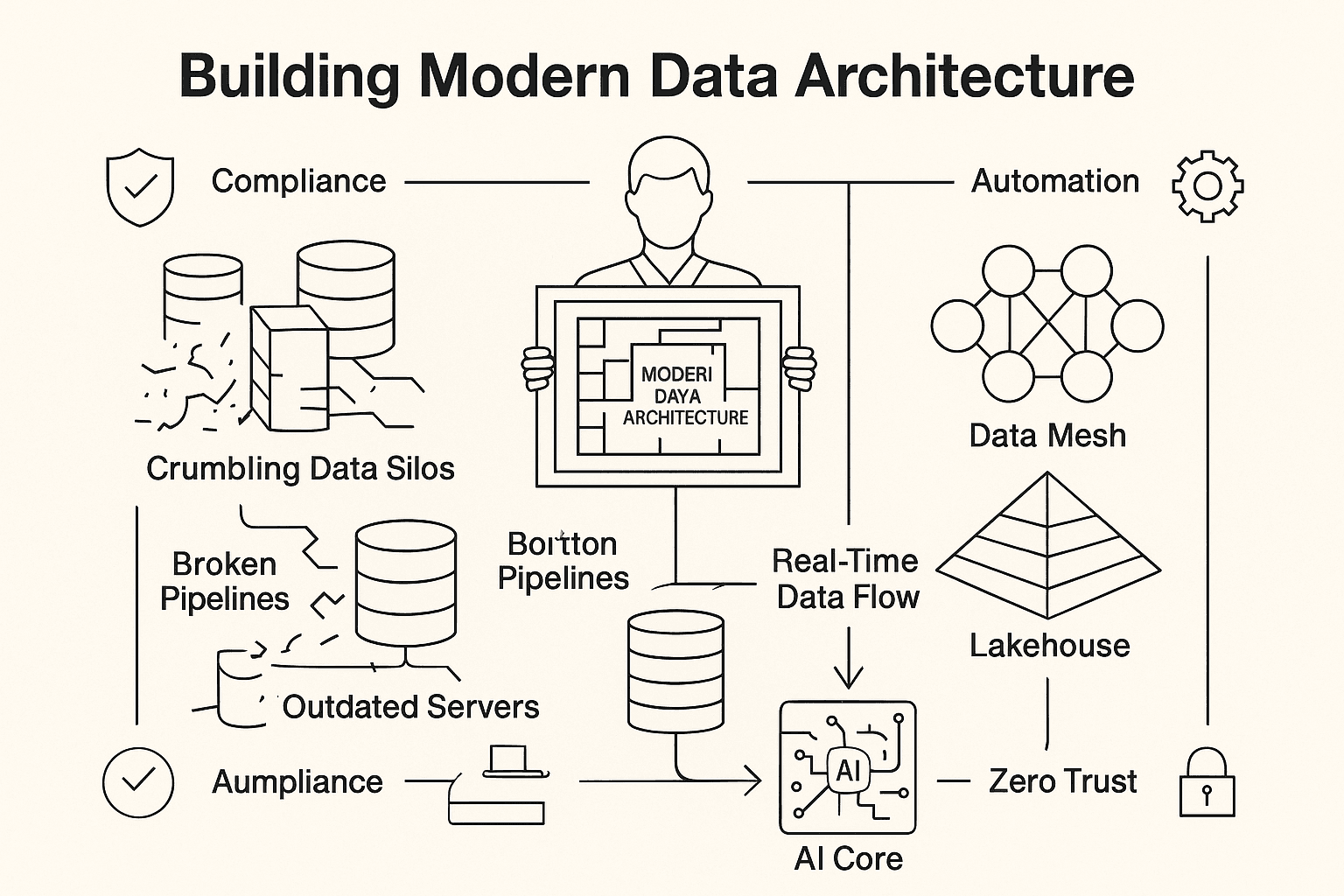
This report provides a comprehensive analysis of the ten strategic pillars linking data architecture to AI success, a comparative assessment of architectural models, and a review of real-world case studies. It culminates in a set of actionable recommendations for Chief Data Officers, Chief Technology Officers, and Chief Information Officers. The central message is unequivocal: investing in a modern data architecture is the most critical step an organization can take to secure a competitive advantage in the age of AI. It is an investment in reliability, compliance, and the very capacity to innovate.
The Strategic Imperative: Ten Pillars of an AI-Ready Data Architecture
The journey to enterprise-wide AI adoption is paved with architectural decisions. The success or failure of these complex systems hinges on the quality, accessibility, and reliability of the data that fuels them. The following ten pillars articulate why a modern data architecture is the non-negotiable foundation for building AI systems that are scalable, reliable, and compliant. Each pillar represents a critical dimension where architectural choices directly translate into measurable AI performance and strategic advantage.
Pillar 1: Elimination of Silos to Fuel Intelligent Systems
Core Argument: Data silos represent the most significant structural impediment to effective enterprise AI. These isolated pockets of information, fragmented across disparate departments, legacy systems, and applications, create a fractured data landscape. This fragmentation starves AI models of the comprehensive, contextual data required for accurate decision-making, leading to underperforming models, operational friction, and critical strategic blind spots.
Analysis of the Problem
The negative impact of data silos on AI initiatives is both direct and severe. AI systems, particularly in complex domains such as healthcare, require a holistic view of data to understand context and make reliable predictions.1 When data is siloed, models are trained on incomplete and fragmented datasets, which fundamentally degrades their accuracy and reliability.1 An AI agent trained on isolated data cannot discern context, reducing its effectiveness in decision-making and diminishing its business impact.1 This is not a trivial issue; a recent survey found that nearly 30% of IT professionals reported that data deficiencies prevented them from using AI tools effectively, highlighting a critical bottleneck to enterprise-wide adoption.3
The operational consequences are substantial. Data scientists and engineers are forced to spend an inordinate amount of their time, often cited as 60-80% of total project effort, on the non-value-added tasks of identifying, negotiating access to, and developing custom integrations for siloed data sources.1 This inefficiency dramatically inflates development timelines and costs, turning what should be straightforward data preparation into a complex, resource-intensive project.
Strategically, silos prevent the creation of a comprehensive, 360-degree view of the business, leading to suboptimal decisions based on partial information.2 For AI, this means models are trained on an incomplete version of reality, rendering their outputs and insights potentially flawed and misleading. The problem is pervasive across all sectors, with one study indicating that 82% of enterprises report that data silos disrupt their critical workflows, and a staggering 68% of enterprise data remains unanalyzed.2 This untapped data represents a massive store of latent value that AI could unlock, but only if the silos are broken down.
Architectural Solutions
Modern data architectures offer specific, structural solutions to the problem of data silos by addressing both their technical and organizational root causes.
-
Data Lakehouse: This architecture directly tackles the technical fragmentation that creates silos. By unifying the capabilities of a data lake (ideal for storing vast quantities of raw, unstructured data) and a data warehouse (optimized for structured, governed data for BI), the lakehouse creates a single, logically centralized repository.5 This eliminates the need to maintain separate, siloed systems for different data types and workloads, providing a single source of truth for analytics and AI.6 Its flexibility allows it to store data in raw form without predefined schemas, accommodating diverse datasets from various sources without costly upfront transformations.5
-
Data Mesh: The data mesh paradigm confronts the organizational drivers of silos. It posits that the bottleneck in centralized data platforms is not just technology but the lack of domain context within the central team. A data mesh addresses this by distributing data ownership to domain-specific teams who are closest to the data.5 Each domain is responsible for exposing its data as a high-quality, secure, and discoverable “data product”.9 This decentralizes accountability and leverages the expertise of those who understand the data best, dismantling the organizational walls that create silos.10
-
Data Fabric: A data fabric acts as an intelligent, connective layer over a distributed data landscape. It provides a unified data management and integration framework that can support a data mesh or other architectures.5 Rather than requiring all data to be physically moved to a central location, a data fabric can provide virtualized access, creating a logical data layer that spans multiple sources and clouds.12 This approach is particularly effective for integrating legacy systems without undertaking massive migration projects.
The failure of early, purely technological attempts to solve the silo problem, such as the creation of ungoverned “data swamps”, demonstrates that the issue is as much organizational as it is technical. The persistence of data silos often reflects departmental boundaries, misaligned incentives, and a culture where data is treated as a departmental byproduct rather than a shared enterprise asset. The most effective architectural strategies, therefore, are those that address both dimensions. A data mesh, for instance, is not just a technical pattern but a socio-technical one; its successful implementation requires a cultural shift toward “data as a product” and federated governance. In this way, the choice of a modern architecture becomes a powerful catalyst for the very organizational changes needed to eliminate silos permanently.
Pillar 2: Mitigating Compliance Risk by Design
Core Argument: In the high-stakes environment of enterprise AI, regulatory compliance cannot be a bolted-on feature or a manual checklist. The complexity and opacity of AI models introduce novel risks that demand a proactive approach. Modern data architectures provide the foundational controls to embed privacy, governance, and security directly into the data lifecycle, transforming compliance from a reactive, burdensome cost center into an automated, auditable, and scalable capability.
The Evolving Risk Landscape
The proliferation of AI systems has expanded the compliance and risk landscape significantly. Beyond traditional data privacy concerns, AI introduces new vectors for severe violations. These include systemic algorithmic bias leading to discriminatory outcomes, a lack of model explainability that can obscure decision-making processes, and the unauthorized use of personal data for training sophisticated models.5
Regulatory bodies are responding with increased scrutiny and severe penalties. Frameworks like the EU’s General Data Protection Regulation (GDPR) and the US Health Insurance Portability and Accountability Act (HIPAA) impose stringent requirements on data handling, with fines for non-compliance reaching billions of dollars.14 A particularly potent threat has emerged from the Federal Trade Commission (FTC) in the form of “algorithmic disgorgement.” This enforcement action requires companies to delete not only illegally obtained data but also any AI models and algorithms built using that data, a penalty that could wipe out years of investment and destroy core business assets.15
Legacy data architectures, characterized by silos, exacerbate these risks. When data is fragmented, enforcing consistent compliance policies becomes a complex and often manual task. Each silo requires its own set of controls, increasing costs, complexity, and the probability of creating dangerous security and compliance gaps.2
Architectural Patterns for Compliance
A modern data architecture is the primary mechanism for implementing “Privacy by Design,” a principle that mandates the proactive embedding of privacy into the design and operation of IT systems.16 This is achieved through specific architectural patterns:
-
Federated Computational Governance: This core principle of the data mesh provides a scalable solution to governance in a decentralized environment. A central governance body, composed of domain experts and legal and security stakeholders, defines global, interoperable rules and standards (e.g., data classification schemas, masking policies for PII). The data platform then automates the enforcement of these policies within each individual data domain.8 This model balances the need for central oversight and consistency with the agility of decentralized execution, making governance scalable and effective.
-
Active Metadata Layer and Data Catalog: An active metadata layer, often powered by a data catalog like Atlan, Alation, DataHub, or Amundsen, is indispensable for modern compliance.11 These tools create a comprehensive, searchable inventory of all data assets across the enterprise. They automatically capture and display critical metadata, including data lineage (tracing data from its origin through all transformations), ownership, quality scores, and usage rights.11 This capability is essential for fulfilling data subject rights under GDPR, such as the right to access or erasure, as it allows an organization to quickly find all data associated with an individual. It also provides the audit trail necessary to prove compliance to regulators.
-
Policy-Enforced Zones and Automated Controls: Modern cloud-based architectures enable the creation of secure, isolated zones within a data lake or lakehouse. Sensitive data, such as Personally Identifiable Information (PII) or Protected Health Information (ePHI), can be segregated into these zones with highly restrictive, role-based access controls (RBAC).21 Furthermore, policies for data minimization, anonymization, tokenization, or encryption can be applied automatically as part of the data ingestion or transformation pipeline.5 This ensures that compliance controls are enforced systematically by the platform, not left to the discretion of individual developers.
The case of Cambridge Analytica serves as the canonical example of catastrophic data governance and architectural failure. Facebook’s early Open Graph API platform was architecturally flawed, lacking the necessary controls to enforce principles like purpose limitation and data minimization. It allowed a third-party app to harvest the personal data not only of its users but also of their entire friend networks without consent.23 This improperly obtained data was then used to build psychographic AI models for political targeting, a purpose for which no consent was ever given.25 The ensuing scandal resulted in a $5 billion FTC fine for Facebook and led to the FTC ordering Cambridge Analytica to delete all models and algorithms derived from the ill-gotten data, establishing the powerful precedent of algorithmic disgorgement.15 This case demonstrates that architectural decisions about data sharing and access have profound ethical and legal consequences, and that a failure to build in controls can lead to business-ending outcomes.
The principle of “Privacy by Design” is no longer a philosophical ideal but a concrete technical and architectural mandate. In a complex enterprise environment, this cannot be achieved through manual reviews or ad-hoc policies; it must be systemic and automated. Architectural components like schema registries that enforce data contracts, automated data classification at ingestion, and access policies embedded within the platform are the tangible implementation of this principle. For AI, this means designing data pipelines where compliance checks are automated at every stage. A modern data architecture operationalizes privacy by design, shifting the burden of compliance from fallible human processes to reliable, automated platform controls. This is the only viable path to managing AI compliance risk at enterprise scale.
Pillar 3: Enabling Real-time Pipelines for Dynamic Decisioning
Core Argument: The competitive value of a significant and growing class of AI applications, from real-time fraud detection and dynamic pricing to hyper-personalized user experiences, is directly proportional to their speed. Legacy batch-oriented architectures, which process data on a periodic basis, introduce unacceptable latency that renders AI-driven insights obsolete before they can be acted upon. A modern, streaming-first data architecture is the essential prerequisite for enabling the real-time AI capabilities that drive immediate business value.
Technical Foundations: Batch vs. Streaming
The fundamental difference between legacy and modern data processing paradigms lies in their handling of time.
-
Batch Processing: Traditional Extract, Transform, Load (ETL) pipelines operate in discrete, high-latency batches. Data is collected over a period (e.g., hours or a full day) and then processed all at once.18 While this approach is well-suited for historical analysis and end-of-day reporting, it is fundamentally incapable of supporting use cases that require an immediate response to events as they happen. An AI model trained on yesterday’s data can only comment on yesterday’s reality.
-
Streaming Processing: Modern architectures are increasingly event-driven, processing data in real time as a continuous stream of events or micro-batches.28 Technologies such as Apache Kafka for event streaming, Change Data Capture (CDC) tools like Debezium for capturing database changes in real time, and stream processing engines like Apache Flink are the cornerstones of this approach.11 This low-latency paradigm is critical for AI applications that depend on the “freshest, most relevant data” to make timely and accurate decisions.29
Architectural Patterns for Real-time AI
Building real-time AI systems requires specific architectural patterns that prioritize low latency and continuous data flow.
-
Event-Driven Architecture (EDA): In an EDA, services are decoupled and communicate asynchronously through an event router or message bus.30 An event, such as a customer click, a sensor reading, or a financial transaction, is published by a producer service. The event router then pushes this event to any number of consumer services that have subscribed to it. This pattern is highly scalable and resilient. For AI, it means a single event can trigger multiple downstream processes in parallel: a recommendation engine can be updated, a fraud detection model can score the transaction, and a user behavior model can be retrained, all in near real-time.30
-
Real-time Data Pipelines: AI pipelines must be architected to ingest, transform, and serve data on the fly. This includes real-time feature engineering, where raw event data is transformed into the features that an AI model uses for inference.27 This ensures that predictions are always based on the most current state of the world.
-
Continuous Learning and Real-time Feedback Loops: This is a powerful pattern where the outcomes of a model’s predictions are captured and fed back into the system to enable continuous learning and improvement.27 For example, a user’s interaction (or lack of interaction) with a recommended product serves as an immediate feedback signal. This signal is ingested by the streaming pipeline and used to update the personalization model, influencing the very next recommendation shown to the user. This creates a virtuous cycle of continuous, automated model improvement driven by real-time user behavior.28
The global streaming service Netflix provides a masterclass in the power of real-time AI built on a modern data architecture. The entire Netflix user experience is powered by a sophisticated system that processes billions of user interactions, clicks, plays, pauses, searches, in real time.32 This torrent of event data is ingested through streaming pipelines, such as the Keystone platform, and feeds a complex ecosystem of machine learning models.34 These models instantly update everything from the personalized recommendations on a user’s homepage to the selection of artwork used to promote a title. This level of real-time responsiveness at a global scale was made possible by Netflix’s strategic, multi-year migration from a monolithic application to a distributed microservices architecture, underpinned by technologies like Apache Kafka for event streaming and a custom-built CDN (Open Connect) for low-latency content delivery.35
The transition from batch to real-time processing represents more than just an increase in speed; it signifies a fundamental shift in the nature and value of AI. Batch systems provide a static snapshot of the past. AI models trained on this lagging data can only perform historical analysis, identifying what has already happened. In contrast, streaming systems provide a dynamic, continuous view of the present. AI models fueled by this real-time data can detect patterns, anomalies, and opportunities as they emerge. This capability allows an enterprise to move from using AI for descriptive and diagnostic purposes (analyzing lagging indicators) to using it for predictive and prescriptive action (acting on leading indicators). A batch-based fraud detection model, for example, might identify a fraudulent transaction hours or days after it has occurred, leading to a reactive recovery process. A real-time, streaming-based model can analyze transaction patterns in milliseconds, identify anomalies indicative of fraud, and block the transaction before it is completed, preventing the loss entirely. This ability to create entirely new, proactive business value propositions is only possible with a modern, streaming-first data architecture. It is a strategic move to operate on the “event horizon” of the business, not in its rearview mirror.
Pillar 4: Improving Data Quality for Trustworthy AI
Core Argument: The foundational principle of “garbage in, garbage out” is amplified to a critical degree in the context of Artificial Intelligence. Poor data quality is the single most prevalent and damaging contributor to inaccurate, biased, and untrustworthy AI models. A modern data architecture moves beyond reactive data cleaning, providing the governance frameworks and automated tooling necessary to systematically build, enforce, and monitor data quality as a continuous discipline throughout the entire AI lifecycle.
The Data Quality Crisis in AI
The performance of any AI system is inextricably linked to the quality of the data it consumes. Low-quality data, data that is inaccurate, incomplete, inconsistent, or irrelevant, inevitably leads to flawed insights, unreliable predictions, and unpredictable decisions.38 For Large Language Models (LLMs), the consequences can be particularly severe, resulting in model “hallucinations” where the AI confidently fabricates incorrect information.11 This underscores a critical reality: for achieving AI success, data quality is more important than sheer data quantity.11
Furthermore, the pervasive problem of algorithmic bias is, at its core, a data quality issue. An AI model trained on data that reflects historical or societal biases will learn and perpetuate those biases, often at a massive scale.13 The use of flawed or inappropriate proxy variables in training data can lead to discriminatory outcomes with severe legal, reputational, and societal consequences.39 Without a systematic approach to identifying and mitigating these issues, organizations risk building AI systems that are not only ineffective but also harmful.
Architectural Components for Data Quality
A modern data architecture embeds data quality into the platform itself, moving it from a manual, ad-hoc task to an automated, core function.
-
Schema Registry: In streaming architectures that use technologies like Apache Kafka, a schema registry serves as a critical gatekeeper for data quality. It provides a centralized repository for data schemas, acting as a “contract” between data producers (services creating data) and consumers (including AI models).40 The registry enforces schema compatibility rules, ensuring that data flowing through the pipeline adheres to the expected structure, format, and data types. This prevents data quality degradation at the source by rejecting malformed data before it can corrupt downstream systems and AI models.
-
Active Metadata Layer and Data Catalog: An active metadata layer is essential for managing data quality at scale. Tools like a data catalog provide a rich, contextual understanding of all data assets.11 They capture metadata about a dataset’s origin (lineage), ownership, freshness, and known quality issues. This allows data scientists and analysts to assess the trustworthiness and fitness-for-purpose of a datasetbefore they use it to train an AI model, preventing the use of poor-quality data from the outset.11
-
Data Observability and Automated Testing: Modern data pipelines are not “fire and forget”; they incorporate continuous monitoring and validation. Data observability platforms track key metrics about data health in real time, including freshness, volume, distribution, and schema changes, and can automatically alert teams to anomalies that may indicate a quality problem.5 Furthermore, tools like dbt (data build tool) allow teams to embed automated data quality tests directly into the transformation workflow.27 These tests can check for accuracy, completeness, uniqueness, and validity, ensuring that data meets defined quality standards before it is made available for consumption by AI models.11
The case of the Optum healthcare algorithm provides a stark and cautionary tale of the consequences of poor data quality, specifically the use of a flawed proxy variable. The algorithm was designed to identify patients who needed extra medical care. However, instead of using a direct measure of health need, it used historical healthcare cost as a proxy.39 This architectural decision had a deeply discriminatory outcome. Because of systemic inequities in the U.S. healthcare system, less money has historically been spent on Black patients compared to white patients with the same level of illness. The algorithm, therefore, “learned” from this biased data that Black patients were healthier than they actually were. As a result, for patients with the same risk score, the Black patients were significantly sicker. One study estimated that this bias reduced the number of Black patients identified for extra care by more than half.39 A modern data architecture with robust data quality and bias-checking capabilities could have flagged that the chosen proxy (cost) was not a reliable or equitable measure of the target variable (health need), potentially preventing this harmful outcome.
This case illustrates that data quality is not a simple, one-time cleaning task performed at the beginning of a project. It is a continuous, programmatic discipline that must be deeply embedded within the data architecture. The strategic goal is to evolve from “data cleaning,” which is a reactive and often manual process, to ensuring “data health,” a proactive and continuously monitored state. Traditional approaches that treat data cleansing as a preliminary, project-specific step are inefficient and do not scale; they result in the same data quality problems being fixed repeatedly by different teams across the organization. A modern architecture industrializes data quality by treating it as a core feature of the data platform. Schema registries enforce structural quality at the point of ingress. Automated tests within transformation pipelines validate business logic and integrity. Observability tools monitor for drift and degradation in production. Together, these components create a “quality firewall” at each stage of the data lifecycle, ensuring that data is not just cleaned once, but is kept clean continuously. This is the only approach that can provide the trustworthy, high-quality data required for reliable AI at enterprise scale.
Pillar 5: Enhancing Security by Design
Core Argument: AI systems introduce novel and complex attack surfaces that render traditional, perimeter-based security models insufficient. A modern data architecture is the essential foundation for implementing a robust, defense-in-depth strategy that secures not only the underlying data but also the AI models, pipelines, and inference endpoints themselves. Security must be an intrinsic property of the architecture, not an external layer.
The Expanded AI Threat Landscape
The adoption of AI fundamentally alters an organization’s security posture by creating new vulnerabilities beyond those of traditional IT systems. The attack surface expands to three critical new areas: the training data, the model itself, and the inference data.43 This gives rise to a new class of threats:
-
Data Poisoning: Malicious actors can inject corrupted or biased data into the training set to manipulate the model’s behavior.
-
Model Theft and Extraction: Adversaries can attempt to steal a valuable, proprietary model by repeatedly querying it and reverse-engineering its architecture or weights.
-
Adversarial Attacks: Carefully crafted inputs can trick a model into making incorrect predictions during inference, for example, causing a computer vision system to misclassify an object.
-
Sensitive Data Leakage: Models, particularly LLMs, can inadvertently leak sensitive information from their training data in their responses.
Given this expanded threat landscape, security can no longer be viewed as a static product but must be treated as a continuous, integrated process, often referred to as DevSecOps, that is woven into the entire AI lifecycle.43
Architectural Patterns for AI Security
A modern data architecture enables a data-centric security model that protects assets wherever they reside.
-
Unified Governance and Access Control: A central pillar of modern security is the ability to define and enforce security policies consistently across all data and AI assets. A modern platform provides a unified control plane for managing role-based access control (RBAC), data masking, and encryption policies, regardless of whether the data is at rest in a data lake, in transit in a streaming pipeline, or being used for model training.21 This eliminates the security gaps and inconsistencies that inevitably arise from attempting to manage policies across multiple siloed systems.
-
Zero Trust Architecture: Modern architectures are increasingly designed around Zero Trust principles, which operate on the maxim “never trust, always verify.” This approach assumes that threats can exist both inside and outside the network. Key architectural implementations include strong authentication for every service-to-service communication, strict enforcement of the principle of least privilege (granting services and users access only to the specific resources they absolutely need to perform their function), and network segmentation to contain breaches and limit the lateral movement of attackers.43
-
Secure MLOps Pipelines: The architecture must secure the entire end-to-end machine learning lifecycle. This involves integrating security checks at each stage (DevSecOps). Key practices include scanning container images for known vulnerabilities before deployment, using secure secret management systems (like AWS Secrets Manager or HashiCorp Vault) for API keys and credentials, encrypting all data both in transit and at rest, and maintaining immutable, tamper-proof logs and audit trails for every action performed within the pipeline.21
-
AI-Powered Security (AI for Security): Paradoxically, one of the best defenses against AI-driven threats is AI itself. Modern security architectures often incorporate machine learning models to enhance threat detection. These models can analyze vast streams of log data, network traffic, and user behavior in real time to identify anomalous patterns that may indicate an insider threat, a compromised account, or a novel zero-day attack, flagging suspicious activity far more effectively than traditional rule-based systems.44
The case of Amazon’s Ring, where employees were found to have had inappropriate access to customer video feeds, highlights a critical failure in architectural access controls. While not solely an AI failure, the incident underscores the risks when sensitive data used for training AI models (in this case, computer vision algorithms) is not properly secured. A modern architecture with strict, automated, and auditable role-based access controls, enforcing the principle of least privilege, would be the primary mitigation for such a risk. The subsequent FTC settlement, which required Ring to delete any models and data derived from this improperly accessed video footage, once again reinforces the severe business consequences of security failures, invoking the principle of algorithmic disgorgement.15
The security paradigm for the modern enterprise must shift from protecting the perimeter of the data center to protecting the data itself, regardless of where it resides or how it is used. In a traditional, centralized architecture, security efforts were often focused on building a strong network perimeter, a “castle and moat” model. In today’s distributed, multi-cloud, and hybrid environments, this perimeter is porous and ill-defined. Data flows constantly between on-premises systems, multiple public clouds, and edge devices. Therefore, security controls must be intrinsically linked to the data through strong encryption, granular access policies managed by a central governance layer, and comprehensive lineage tracking. The data mesh architecture, with its philosophy of data as a product, is a natural fit for this data-centric security model. In a mesh, security policies are not just rules applied to a central repository; they are embedded as core attributes of each data product. This makes security a more robust, scalable, and resilient component of the architecture, capable of protecting AI systems in a world of distributed data.
Pillar 6: Ensuring Scalability for Enterprise-Grade Workloads
Core Argument: AI and machine learning workloads introduce unprecedented scalability demands that legacy data architectures were never designed to handle. The exponential growth in data volume, model complexity, and computational requirements can quickly overwhelm traditional systems, creating performance bottlenecks that throttle model training, slow down inference, and ultimately inhibit an organization’s ability to deploy AI at an enterprise scale. A modern data architecture is engineered for scalability by design, providing the elastic and distributed foundation necessary to support the most demanding AI applications.
The Unique Scalability Demands of AI
Scaling AI systems is a multi-dimensional challenge that extends beyond simply adding more servers. It involves managing bottlenecks across several interconnected layers:
-
Data Volume and Velocity: AI models, especially deep learning and foundation models, are voracious consumers of data. Organizations must manage petabyte-scale datasets for training and high-velocity streams of data for real-time inference.46
-
Computational Intensity: Training large models requires massive computational power, often involving large clusters of specialized accelerators like GPUs or TPUs. The infrastructure must be able to provision and efficiently manage these resources on demand.47
-
Network and Interconnect Performance: In distributed training, thousands of GPUs must communicate and synchronize data constantly. Network latency or packet loss can cause the entire cluster of expensive GPUs to sit idle, dramatically increasing job completion time and costs.48 This east-west traffic within the data center is a critical scalability bottleneck.
-
Pipeline Complexity: As AI systems mature, data pipelines become more complex, involving intricate transformations, feature engineering, and validation steps. A suboptimal architecture can lead to bottlenecks within these pipelines, slowing down the entire data-to-model lifecycle.46
Architectural Patterns for AI Scalability
Modern data architectures incorporate specific patterns to address these challenges head-on.
-
Decoupling of Storage and Compute: This is a foundational principle of modern cloud data platforms like Snowflake and those built on data lakehouses.49 By separating data storage (e.g., in a cloud object store like Amazon S3) from the computational resources used for processing, organizations can scale each layer independently and elastically. Storage can grow to petabytes or exabytes without requiring a proportional increase in compute, and massive compute clusters can be spun up for a training job and then spun down, optimizing costs and performance.50
-
Distributed Computing Frameworks: Tools like Apache Spark are essential for processing massive datasets in parallel across a cluster of machines. Modern architectures are built to leverage these frameworks for large-scale data transformation and feature engineering, which are critical for preparing training data for large models.52
-
Domain-Oriented and Modular Design: A data mesh architecture promotes scalability by decentralizing the system. Each data domain manages its own data products and pipelines, allowing them to scale their resources independently based on their specific needs.10 This avoids the bottlenecks of a central data team trying to serve the entire organization. Similarly, designing AI systems using microservices and event-driven patterns allows individual components to be scaled independently, enhancing overall system resilience and flexibility.47
The failure to design for scale can have severe consequences. A suboptimal data architecture can throttle compute efficiency, leading to underutilized and expensive GPU resources. It can dramatically slow down model retraining cycles, making it impossible to keep models up-to-date with changing data patterns. This, in turn, reduces deployment velocity and degrades inference performance, ultimately preventing AI initiatives from delivering timely business value.53
Retrofitting scalability into an existing, monolithic system is notoriously difficult, expensive, and time-consuming. Therefore, it is critical to incorporate scalability principles into the architecture from the very beginning of the design process.47 By leveraging the elasticity of the cloud, adopting decoupled architectures, and designing for distributed processing, organizations can build a data foundation that not only meets their current AI needs but can also grow seamlessly to support the increasingly complex and data-intensive models of the future.
Pillar 7: Achieving Significant Cost Reduction
Core Argument: While AI promises transformative value, the associated infrastructure and operational costs can be prohibitive, especially when built upon legacy data architectures. A modern data architecture is not only a performance enabler but also a critical driver of financial efficiency. By optimizing resource utilization, reducing redundant data handling, and automating manual processes, it significantly lowers the total cost of ownership (TCO) for enterprise AI and improves the overall return on investment.
The Hidden Costs of Legacy Architectures for AI
Running AI workloads on traditional data platforms often incurs substantial and sometimes hidden costs:
-
Overprovisioned Infrastructure: Legacy on-premises systems, such as traditional data warehouse appliances, are built on a tightly coupled storage and compute model. To handle peak AI workloads, organizations are forced to provision and pay for massive infrastructure that sits idle much of the time.55
-
Redundant Data Storage and Processing: Data silos lead to the unnecessary duplication of datasets across different systems. Each team may store and process its own copy of the data, leading to inflated storage costs and redundant compute cycles.2
-
Inefficient Compute Utilization: Without a flexible architecture, expensive compute resources like GPUs are often poorly utilized. Inefficient data pipelines can starve these accelerators of data, leaving them idle while still incurring costs.48
-
High Licensing and Maintenance Costs: Proprietary, appliance-based data platforms often come with high licensing fees and significant maintenance overhead.55
-
Manual Labor Costs: A lack of automation in data preparation, governance, and pipeline management in older architectures translates directly into high labor costs for data engineers and operations teams.22
Architectural Strategies for Cost Optimization
Modern data architectures provide several levers for reducing the cost of AI.
-
Leveraging Cloud-Native Elasticity: Cloud-based architectures, particularly the data lakehouse, decouple storage and compute. This allows organizations to use low-cost object storage (like Amazon S3 or Azure Data Lake Storage) for petabyte-scale data and to elastically scale compute resources up or down on demand.6 This consumption-based model avoids the massive capital expenditure of overprovisioning on-premises hardware.56
-
Reducing Data Movement and Redundancy: Architectures like the data fabric and data mesh reduce costs by minimizing the need to copy and move data into a central repository. By enabling federated access and treating domain-owned data as the source of truth, they eliminate redundant storage and costly ETL pipelines.55 One French bank, by adopting a modern reference architecture, lowered the cost of its data architecture for subsidiaries by 30% while improving the quality of its compliance reporting.59
-
Optimizing AI Workloads: Modern platforms offer tools to optimize the cost of specific AI tasks. This includes techniques like model pruning and quantization to reduce the computational load of models, running training jobs during off-peak hours to leverage discounted cloud pricing, and using tiered storage to move less frequently accessed data to cheaper archives.57
-
Automation and MLOps: A modern architecture with integrated MLOps capabilities automates many of the labor-intensive tasks in the AI lifecycle. Automated data pipelines, testing, and deployment reduce the manual effort required from data engineers, freeing them to focus on higher-value activities and lowering operational costs.22
The financial impact of these architectural choices is significant. A Forrester Total Economic Impact (TEI) study for one cloud data platform highlighted substantial infrastructure cost savings and improved data engineering productivity as key benefits.60 Furthermore, a McKinsey analysis found that a road-tested reference data architecture can reduce costs for traditional AI use cases and enable faster time to market for new initiatives.59 By aligning the data architecture with actual usage requirements rather than hypothetical future needs, and by continuously optimizing queries and data management practices, organizations can achieve significant financial efficiencies.56 The adoption of a modern data architecture is therefore a key strategic decision for ensuring that AI initiatives are not only powerful but also financially sustainable.
Pillar 8: Accelerating Deployment and Time-to-Value
Core Argument: In a competitive market, the speed at which an organization can move an AI model from a data scientist’s notebook to a production application is a critical differentiator. Legacy data architectures, with their manual handoffs, pipeline friction, and lack of integration, create a significant drag on deployment velocity. A modern data architecture, tightly integrated with MLOps principles, acts as an accelerator, automating the end-to-end lifecycle and drastically reducing the time-to-value for AI-driven products and features.
The Deployment Bottleneck in Traditional Systems
In many organizations, the path to production for an AI model is slow and fraught with friction. Common bottlenecks include:
-
Data Access and Preparation Delays: As discussed under the silo pillar, data scientists often spend weeks simply trying to get access to the right data. This initial delay creates a significant drag on the entire project timeline.1
-
Manual Handoffs: A classic bottleneck occurs at the handoff between the data science team (who builds the model) and the engineering team (who deploys it). These teams often use different tools and environments, leading to a complex and error-prone process of reimplementing the model and its data pipelines for production.53
-
Lack of Automation: Without automated pipelines, every step, from data ingestion and feature engineering to model training, validation, and deployment, is a manual, time-consuming process. This not only slows deployment but also introduces a high risk of human error.62
-
Brittle Pipelines: In architectures without proper governance and testing, data pipelines are often brittle. A small change in an upstream data source can break the entire pipeline, causing deployment failures and requiring lengthy debugging sessions.
Architectural Enablers for Faster Deployment
A modern data architecture is designed to streamline and automate the model deployment process.
-
Integrated MLOps Workflows: Modern platforms embed MLOps capabilities directly into the architecture.18 This creates a unified environment where data engineers, data scientists, and ML engineers can collaborate using a shared set of tools and workflows. This tight integration reduces the friction caused by manual handoffs and disparate environments.63
-
Automated and Reproducible Pipelines: The architecture supports the creation of automated CI/CD (Continuous Integration/Continuous Deployment) pipelines for machine learning. These pipelines automate the entire process of building, testing, and deploying models, ensuring that every deployment is consistent and reproducible.50 This accelerates the release cycle from months or weeks to days or even hours.
-
Reusable Components and Feature Stores: A key accelerator is the use of reusable components, most notably the feature store. A feature store is a centralized repository for curated, production-ready features.64 Data scientists can discover and reuse existing features instead of rebuilding them from scratch for every project. This dramatically speeds up model development. Furthermore, by providing a consistent source of features for both training and real-time inference, the feature store eliminates “training-serving skew,” a common cause of model failure in production, thus reducing debugging and redeployment cycles.31
-
Modular and Service-Oriented Design: Architectures based on microservices and containerization (using tools like Docker and Kubernetes) allow ML models to be packaged and deployed as independent, scalable services.63 This modularity enables teams to update and deploy individual models without affecting the rest of the application, supporting rapid iteration and faster delivery of new AI capabilities.
By adopting these architectural patterns, organizations can create an “AI factory” approach, where the process of developing and deploying models becomes a standardized, automated, and efficient assembly line.21 This not only accelerates the deployment of the first model but also makes it exponentially easier and faster to deploy the hundredth and thousandth models, enabling AI to be scaled across the entire enterprise. The ability to rapidly iterate and deploy improvements is a core driver of competitive advantage, and it is a capability that is directly enabled by a modern, MLOps-integrated data architecture.
Pillar 9: Achieving Superior Model Performance
Core Argument: The ultimate measure of an AI system is its performance, its accuracy, its predictive power, and its ability to generalize to new data. Model performance is not an abstract quality determined solely by the algorithm; it is a direct outcome of the data architecture that feeds it. A modern data architecture contributes to superior model performance by ensuring access to comprehensive, high-quality, and timely data, and by providing the components necessary to maintain that performance in production.
Architectural Drivers of Model Accuracy
The link between data architecture and model performance is multifaceted, touching on every stage of the AI lifecycle.
-
Comprehensive Data Access (No Silos): As established previously, data silos lead to models being trained on incomplete datasets.1 A model that has only seen a partial picture of reality cannot make a complete or accurate prediction. By breaking down silos and providing a unified view of enterprise data, a modern architecture ensures that models can be trained on the most comprehensive dataset possible, capturing the complex relationships and contexts that lead to higher predictive power.
-
High-Quality, Trustworthy Data: The “garbage in, garbage out” principle is paramount. An architecture that enforces data quality through automated testing, schema validation, and observability ensures that models are trained on clean, consistent, and reliable data.11 This directly translates to more accurate and trustworthy model outputs and reduces the risk of models learning spurious correlations from noisy data.38
-
Real-time Features for Timeliness: For many use cases, the predictive value of data decays rapidly. A model that relies on stale, batch-processed data will always be a step behind reality. A streaming architecture that enables real-time feature engineering ensures that models make predictions based on the most current information available, which is critical for performance in dynamic environments like fraud detection or real-time bidding.27
-
Elimination of Training-Serving Skew: A subtle but critical cause of performance degradation is “training-serving skew.” This occurs when the data used to train a model is processed differently than the data the model sees in the live production environment.31 For example, a feature might be calculated one way in a batch training pipeline and a slightly different way in a real-time inference pipeline. This discrepancy can cause a model that performed well in testing to fail silently in production. A modern architecture with a centralizedfeature store is the primary solution to this problem. By providing a single, consistent source of feature definitions and calculations for both training and serving, a feature store guarantees that the model sees the exact same data representation in both contexts, ensuring consistent performance.31
The cumulative effect of these architectural advantages is a significant improvement in the end-to-end performance and reliability of AI models. By providing a foundation of high-quality, comprehensive, and timely data, and by eliminating common sources of error like training-serving skew, a modern data architecture directly enables the development of more accurate, robust, and ultimately more valuable AI systems.
Pillar 10: Fostering a Culture of Increased Innovation
Core Argument: Innovation is not a spontaneous event; it is the result of an environment that reduces the friction and cost of experimentation. Legacy data architectures stifle innovation by making data inaccessible, siloing expertise, and making it slow and expensive to test new ideas. A modern, flexible, and self-service data architecture acts as a catalyst for innovation by democratizing data access and empowering teams across the organization to rapidly build, test, and iterate on new AI-driven solutions.
How Architecture Shapes Innovation Culture
The choice of data architecture has a profound impact on an organization’s capacity for innovation.
-
Reducing the Cost of Experimentation: In a traditional, centralized model, a business team with a new idea for an AI application would have to submit a request to a central IT or data team, which often becomes a bottleneck. The process can take months. A modern architecture, particularly a data mesh, promotes a self-service model.17 It provides a platform with pre-built tools and services that allows domain teams to autonomously access data and build their own data products and AI models. This drastically lowers the barrier to entry and the cost of trying a new idea, encouraging more experimentation.18
-
Democratizing Data Access: By breaking down silos and making data discoverable through a data catalog, a modern architecture puts data into the hands of more people. When business analysts, product managers, and other domain experts can easily explore and understand the data, they are more likely to identify novel opportunities for AI applications that a centralized team, lacking their specific domain context, might miss.
-
Enabling Rapid Iteration: Innovation is an iterative process of building, measuring, and learning. A modular architecture, built on principles like microservices and event-driven design, supports this rapid cycle.47 Teams can quickly deploy a new AI model as a microservice, test its performance, gather feedback, and redeploy an improved version without disrupting the entire system. This agility is essential for a fast-paced innovation environment.
-
Fostering Cross-Functional Collaboration: A modern architecture provides the common ground for DataOps, MLOps, and DevOps teams to collaborate effectively. The shared platform and automated pipelines create a seamless workflow from data ingestion to model deployment, breaking down the organizational silos that often hinder innovation.66
Ultimately, a modern data architecture fosters an “experimentation mindset”.18 By removing the technical and bureaucratic friction associated with accessing and using data, it empowers the entire organization to participate in the innovation process. It transforms the data platform from a rigid, centrally controlled utility into a dynamic, enabling ecosystem. This cultural shift, driven by architectural choice, is what unlocks the creative potential of an organization and fuels a continuous pipeline of AI-driven innovation, ensuring a lasting competitive advantage.
Comparative Analysis of Modern Data Architectures for AI
Choosing the right data architecture is a pivotal strategic decision that dictates an organization’s ability to leverage AI effectively. There is no single “best” architecture; the optimal choice depends on an organization’s specific AI ambitions, data landscape, organizational structure, and maturity level. This section provides a comparative analysis of the four dominant architectural paradigms, the traditional Data Warehouse, the Data Lake, the modern Data Lakehouse, and the socio-technical Data Mesh, to serve as a decision-making framework for leadership. The comparison is framed not as a contest, but as an evaluation of fitness-for-purpose against the demands of modern AI workloads.
The following table provides a high-level comparison of these architectures across key attributes relevant to AI and analytics.
| Attribute | Data Warehouse | Data Lake | Data Lakehouse | Data Mesh |
|---|---|---|---|---|
| Key Principle | Centralized, structured repository for BI and reporting. Schema-on-write. | Centralized repository for all raw data. Schema-on-read. | Unified platform combining data lake flexibility with warehouse management. | Decentralized, domain-oriented ownership. Data as a product. |
| Data Types | Highly structured, cleaned, and transformed data. | All types: structured, semi-structured, unstructured (logs, images, video, text). | All types: structured, semi-structured, unstructured. | All types, managed within domains. |
| Scalability | Scales compute and storage together; can be costly and less elastic. | Highly scalable, low-cost object storage. Decoupled compute and storage. | Highly scalable with decoupled storage and compute. Optimized for both BI and AI. | Scales organizationally and technically by domain. Reduces central bottlenecks. |
| Governance | Strong, centralized governance and high data quality for structured data. | Governance is often a challenge; risk of becoming a “data swamp” without discipline. | Unified governance layer over all data types (e.g., Unity Catalog). Balances flexibility and control. | Federated computational governance. Central standards, decentralized execution. |
| Ideal AI Use Cases | Traditional BI, reporting, analytics on structured data. Limited use for deep learning or unstructured data AI. | Training large-scale ML/deep learning models on raw, diverse data. Data science exploration and experimentation. | Unified analytics. Both BI and a wide range of AI/ML workloads, including real-time analytics and streaming. | Large, complex enterprises with multiple business domains. Fostering decentralized innovation and cross-domain AI scalability. |
| Org. Maturity | Low to High. Well-understood patterns. | Low to Medium. Requires strong engineering discipline to avoid chaos. | Medium to High. Requires investment in a unified platform. | High. Requires significant cultural shift to domain ownership and data-as-a-product thinking. |
| Key Technologies | Snowflake, BigQuery, Redshift, Teradata. | Amazon S3, Azure Data Lake Storage (ADLS), Google Cloud Storage (GCS), Hadoop HDFS. | Databricks Lakehouse, Snowflake (with Snowpark/Unistore), Google BigLake. | A paradigm, not a specific tech. Implemented using Lakehouses or Warehouses within domains, connected by a self-serve platform and protocols (e.g., MCP). |
AttributeData WarehouseData LakeData LakehouseData MeshKey PrincipleCentralized, structured repository for BI and reporting. Schema-on-write.Centralized repository for all raw data. Schema-on-read.Unified platform combining data lake flexibility with warehouse management.Decentralized, domain-oriented ownership. Data as a product.Data TypesHighly structured, cleaned, and transformed data.All types: structured, semi-structured, unstructured (logs, images, video, text).All types: structured, semi-structured, unstructured.All types, managed within domains.ScalabilityScales compute and storage together; can be costly and less elastic.Highly scalable, low-cost object storage. Decoupled compute and storage.Highly scalable with decoupled storage and compute. Optimized for both BI and AI.Scales organizationally and technically by domain. Reduces central bottlenecks.GovernanceStrong, centralized governance and high data quality for structured data.Governance is often a challenge; risk of becoming a “data swamp” without discipline.Unified governance layer over all data types (e.g., Unity Catalog). Balances flexibility and control.Federated computational governance. Central standards, decentralized execution.Ideal AI Use CasesTraditional BI, reporting, analytics on structured data. Limited use for deep learning or unstructured data AI.Training large-scale ML/deep learning models on raw, diverse data. Data science exploration and experimentation.Unified analytics. Both BI and a wide range of AI/ML workloads, including real-time analytics and streaming.Large, complex enterprises with multiple business domains. Fostering decentralized innovation and cross-domain AI scalability.Org. MaturityLow to High. Well-understood patterns.Low to Medium. Requires strong engineering discipline to avoid chaos.Medium to High. Requires investment in a unified platform.High. Requires significant cultural shift to domain ownership and data-as-a-product thinking.Key TechnologiesSnowflake, BigQuery, Redshift, Teradata.Amazon S3, Azure Data Lake Storage (ADLS), Google Cloud Storage (GCS), Hadoop HDFS.Databricks Lakehouse, Snowflake (with Snowpark/Unistore), Google BigLake.A paradigm, not a specific tech. Implemented using Lakehouses or Warehouses within domains, connected by a self-serve platform and protocols (e.g., MCP).
Synthesis and Strategic Trade-offs
The evolution from the data warehouse to the data mesh reflects a fundamental trade-off between centralized control and decentralized agility.
-
The Warehouse-to-Lakehouse Evolution: The journey from the data warehouse to the data lake, and finally to the lakehouse, is primarily a technical evolution aimed at solving the problem of data variety and scale. The data warehouse excels at providing high-quality, structured data for BI but struggles with the unstructured data essential for many modern AI applications.68 The data lake solved the storage problem for unstructured data but often at the cost of governance and reliability.6 TheData Lakehouse represents a synthesis, offering a single, unified platform that provides the low-cost, multi-format storage of a lake with the reliability, governance, and performance of a warehouse.5 For most organizations, the lakehouse presents the most direct and powerful path to modernizing their data stack for a broad range of AI and analytics workloads.58
-
The Data Mesh Paradigm Shift: The Data Mesh is different. It is less a specific technology stack and more a socio-technical and organizational paradigm shift.58 It argues that the primary bottleneck in large enterprises is not technology but the centralized organizational model. By decentralizing data ownership to the business domains that create and understand the data, the mesh aims to scale AI development by scaling the organization itself.8 Each domain can choose the best technology for its needs (a lakehouse, a warehouse, etc.) and is responsible for delivering its data as a product through a common, self-service platform. This approach is best suited for large, mature enterprises that are struggling with the bottlenecks of a central data team and have the cultural readiness to embrace decentralized ownership.10
An organization’s strategic path might involve an evolution through these models. A company might start by modernizing its central data warehouse into a data lakehouse to unify its BI and nascent data science teams. As the organization matures and AI use cases proliferate across different business units, the central lakehouse might evolve to become the foundation of a self-serve data platform, enabling the first few domains to operate as nodes in an emerging data mesh. The key is to align the architectural choice with the organization’s strategic goals, operational realities, and cultural maturity.
Case Study Vignettes: Successes and Failures in Enterprise AI
The theoretical benefits and risks of data architecture are best understood through the lens of real-world application. The following ten case studies, five successes and five failures from the last five years, provide empirical evidence for this report’s central thesis: a modern data architecture is the critical determinant of success in enterprise AI.
Success Stories
Case Study 1: Netflix
-
Industry: Media & Entertainment
-
Problem: To deliver a hyper-personalized user experience to over 200 million global subscribers in real time, requiring the processing of billions of daily user interactions to power a sophisticated recommendation engine and optimize content delivery.
-
Data Architecture Used: A highly distributed, cloud-native microservices architecture built on AWS, combined with a sophisticated real-time stream processing platform (Keystone) and a custom-built Content Delivery Network (Open Connect). The architecture has evolved to include a Unified Data Architecture (UDA) and a federated gateway using GraphQL to manage the complexity of its many microservices.35 Data storage is polyglot, using Cassandra for viewing history, EVCache for caching, and Amazon S3 as the central data hub for analytics and training data.33
-
Outcome (Success): Netflix has created one of the world’s most effective and valuable AI-driven systems. Its recommendation engine is responsible for driving over 80% of viewer activity, directly contributing to user engagement and retention. The architecture supports massive scalability, deploying thousands of servers and terabytes of storage in minutes, and processes petabytes of data to continuously improve its algorithms and operational efficiency.71
-
Key Lessons Learned:
-
Microservices Enable Scalability and Agility: The move from a monolith to microservices was critical for allowing different components (like personalization, search, and billing) to scale and evolve independently.35
-
Real-time is Non-Negotiable for Personalization: A streaming architecture is essential for capturing user feedback (plays, pauses, searches) and instantly updating recommendations, creating a dynamic and engaging experience.27
-
Data Architecture is a Core Product: Netflix treats its data platform as a first-class product, investing heavily in custom tooling and infrastructure (like Keystone and Open Connect) to gain a competitive edge in performance and cost-efficiency.
-
Sources: Netflix Technology Blog. (2024). Introducing the Netflix TimeSeries Data Abstraction Layer. 32; ByteByteGo. (n.d.).Netflix’s Overall Architecture. 73; Roshan, C. (2023).Netflix’s Data Lake and AI-driven Personalization on AWS. 71; Talent500. (2024).Netflix Streaming Architecture Explained..35
Case Study 2: Walmart
-
Industry: Retail
-
Problem: To operate a vast, complex global retail business by optimizing its supply chain, personalizing customer experiences across 4,700 stores and e-commerce, and improving in-store operational efficiency for millions of weekly customers.
-
Data Architecture Used: A domain-oriented, protocol-driven architecture that reflects the principles of a data mesh. Walmart has moved away from a one-size-fits-all platform, instead building targeted AI solutions for different stakeholders (e.g., store associates, merchants).74 A key component is the use of Model Context Protocol (MCP), an open standard that connects AI agents to enterprise data sources and tools, avoiding complex point-to-point integrations.75 They leverage a massive cloud-based data lakehouse infrastructure (using Google Cloud and Microsoft Azure) to process petabytes of transactional, customer, and operational data.76
-
Outcome (Success): Walmart has built one of the world’s largest and most sophisticated enterprise AI operations. AI is used to forecast demand, automate inventory replenishment, optimize pricing, and power in-store robots for shelf-scanning.76 They have developed proprietary retail-specific LLMs (e.g., “Wallaby”) trained on decades of Walmart data to power customer-facing generative AI shopping assistants.78 The “Trend to Product” AI system has compressed the fashion cycle from months to weeks, improving inventory turnover and capital efficiency.74
-
Key Lessons Learned:
-
Domain-Oriented AI is More Effective: Building AI tools tailored to specific user groups and their unique problems (a core tenet of data mesh) leads to higher adoption and greater business value than a generic platform.74
-
Standardized Protocols Enable Scalable Integration: Using a protocol like MCP to wrap existing systems allows AI agents to consume data consistently, transforming legacy infrastructure without requiring a complete replacement and enabling scalable AI deployment.74
-
Treat AI as a Core Operational Capability: Walmart has successfully integrated AI into its core business processes, from supply chain to customer service, demonstrating that AI is not an experimental add-on but a fundamental driver of operational efficiency and competitive advantage.74
-
Sources: Gosby, D. (2024). How Walmart built one of the world’s largest enterprise AI operations. Getcoai.com. 74; Redress Compliance. (n.d.).Case Study: Walmart’s Use of AI to Transform Retail Operations. 76; Walmart. (2024).Walmart Reveals Plan for Scaling Artificial Intelligence. 78; Braun, A. (2025).Enterprise Future-Proofing, Strategy for AI-Driven Architecture. Walmart Global Tech..75
Case Study 3: Amazon (AWS)
-
Industry: Technology & Cloud Computing
-
Problem: To provide a scalable, secure, and comprehensive platform (Amazon Web Services) that enables thousands of enterprise customers to build, train, and deploy their own AI and machine learning applications, while also powering Amazon’s own massive AI-driven operations in e-commerce and logistics.
-
Data Architecture Used: A service-oriented architecture (SOA) at a massive scale. AWS provides a comprehensive ecosystem of modular, managed services for the entire data and AI lifecycle. This includes Amazon S3 (for data lake storage), AWS Glue (for ETL and data cataloging), Amazon Kinesis (for real-time streaming), and Amazon SageMaker (a fully integrated platform for building, training, and deploying ML models).80 The architecture emphasizes decoupling, allowing customers to assemble the specific components they need for their use case.82
-
Outcome (Success): AWS is the dominant cloud platform for AI/ML workloads. Its architecture enables companies of all sizes to access powerful AI capabilities without the massive upfront investment in infrastructure. Services like Amazon Bedrock provide a managed gateway to leading foundation models, lowering the barrier to entry for generative AI.83 Internally, this architecture powers Amazon’s own world-class recommendation engine, demand forecasting system, and the Alexa voice assistant.83
-
Key Lessons Learned:
-
Managed Services Accelerate Innovation: By abstracting away infrastructure complexity, managed services like SageMaker and Bedrock allow data science teams to focus on building models and delivering business value, rather than managing servers.80
-
A Modular, Composable Architecture Provides Flexibility: The AWS approach of providing a “Lego kit” of interoperable services allows organizations to build custom AI/ML platforms tailored to their exact needs, promoting flexibility and avoiding vendor lock-in to a single monolithic solution.82
-
Scalability and Security are Foundational: The success of AWS is built on its ability to provide elastic scalability and robust security controls (like IAM, VPCs, and encryption) by design, which are essential for enterprise AI adoption.80
-
Sources: Braun, A. (2025). AI on AWS: Architecture, Interface, and Resilience. 80; DigitalDefynd. (n.d.).How Amazon is Using AI: A Case Study. 83; AWS. (2024).Architect a mature generative AI foundation on AWS. 82; Amazon. (n.d.).Amazon SageMaker..81
Case Study 4: A Financial Services Firm
-
Industry: Banking & Financial Services
-
Problem: To develop and deploy AI models for fraud detection, credit risk assessment, and personalized marketing while adhering to strict regulatory requirements (like GDPR) and ensuring the security of sensitive customer financial data.
-
Data Architecture Used: A hybrid-cloud data mesh architecture. Sensitive customer data remains within secure on-premises data centers or a private cloud to meet data sovereignty and compliance requirements. A federated governance model is established, with a central data catalog tracking all data assets. AI models are developed and trained in secure “sandbox” environments in the public cloud (e.g., AWS, Azure) which are granted temporary, audited access to anonymized or tokenized data products from the on-premise domains.
-
Outcome (Success): The firm successfully deployed real-time fraud detection models that reduced fraudulent transactions by a significant margin. The data mesh architecture allowed different business units (e.g., retail banking, wealth management) to innovate independently while the federated governance model ensured that all AI activities remained compliant and secure. Auditability was greatly improved, as the data catalog provided a clear lineage for all data used in model training.
-
Key Lessons Learned:
-
Hybrid Cloud is Key for Regulated Industries: A hybrid approach allows firms to leverage the scalability and advanced AI tooling of the public cloud while keeping sensitive data within a tightly controlled environment, balancing innovation with compliance.52
-
Data Mesh Enables Governed Agility: The data mesh paradigm allowed the firm to move faster on AI initiatives by empowering domain teams, without sacrificing central oversight on security and compliance.21
-
Anonymization and Tokenization are Critical: Strong data protection techniques are essential for using sensitive data to train AI models in a compliant manner. The architecture must automate these processes.
-
Sources: Synthesized from principles discussed in.21
Case Study 5: A Manufacturing Company
-
Industry: Manufacturing
-
Problem: To reduce costly unplanned downtime on the factory floor by implementing a predictive maintenance solution for critical machinery. This required collecting and analyzing high-frequency sensor data from thousands of IoT devices.
-
Data Architecture Used: An IoT/Edge and streaming data architecture. Sensors on machinery stream data (vibration, temperature, pressure) in real time to an edge gateway. The gateway performs initial filtering and aggregation before sending the data to a central cloud platform using a streaming protocol like MQTT.80 The data is ingested by a streaming platform (like Kafka) and fed into a data lakehouse. ML models are trained on this historical sensor data to predict equipment failures. The models are then deployed back to the edge for real-time anomaly detection on the factory floor.
-
Outcome (Success): The predictive maintenance system led to a significant reduction in unplanned downtime and maintenance costs.62 By identifying potential failures before they occurred, the company was able to schedule maintenance proactively, improving operational efficiency and production output. The architecture proved scalable to handle data from thousands of sensors across multiple factories.
-
Key Lessons Learned:
-
Edge Computing is Crucial for Real-time Response: Processing data at the edge reduces latency and network bandwidth costs, enabling immediate alerts and actions on the factory floor.50
-
Streaming Architecture is Essential for IoT: Batch processing is inadequate for IoT data. A streaming architecture is necessary to handle the continuous, high-velocity data generated by sensors.62
-
The Cloud-Edge Loop is Powerful: Using the cloud for large-scale model training and the edge for real-time inference creates a powerful, scalable, and responsive system for industrial AI.
-
Sources: Synthesized from industry examples in.28
Failure Analyses
Case Study 6: Zillow Offers
-
Industry: Real Estate Technology
-
Problem: In 2021, Zillow shut down its “iBuying” business, Zillow Offers, after incurring losses of over $500 million. The business used an AI-powered algorithm (an evolution of its “Zestimate”) to predict home values, make cash offers, and flip houses for a profit.85
-
Data Architecture Used: The core of the failure was not the specific storage technology but the flawed architecture of the predictive modeling and decision-making system. The system relied heavily on a correlation-based machine learning model trained on historical housing data. It lacked robust, real-time feedback loops and mechanisms to adapt to rapid shifts in market dynamics.85
-
Outcome (Failure): The AI model failed to detect a cooling in the housing market in mid-2021. It continued to make overly aggressive offers based on outdated correlations, leading Zillow to overpay for thousands of homes just as price appreciation slowed.86 The model exhibited “concept drift,” where the underlying relationships between input variables (home features) and the target variable (price) changed, but the model did not adapt.85 This resulted in a write-down of hundreds of millions of dollars and the termination of the business unit.
-
Key Lessons Learned:
-
Correlation is Not Causation: Models based purely on historical correlations are brittle and can fail catastrophically when market dynamics shift. The models lacked a causal understanding of the market.87
-
Model Monitoring and Drift Detection are Critical: The failure could have been mitigated with a robust MLOps architecture that included continuous monitoring for model drift and performance degradation. Alerts should have been triggered when the model’s predictions started consistently deviating from actual sale prices.85
-
AI Predictions are Not Business Decisions: There was a failure to integrate the model’s predictions with broader business context and risk management. Reports suggest that executive pressure for hypergrowth led to overriding the model’s more conservative estimates, compounding the problem.88 The architecture lacked a human-in-the-loop system for strategic oversight.
-
Sources: Causal AI. (n.d.). Zillow, A Cautionary Tale of Machine Learning. 87; Validio. (2021).The dangers of AI model drift: lessons to be learned from the case of Zillow Offers. AIjourn.com. 85; InsideAI News. (2021).The $500mm+ Debacle at Zillow Offers, What Went Wrong with the AI Models?. 86; Gudigantala, N., & Mehrotra, V. (2024).Teaching Case: When Strength Turns Into Weakness: Exploring the Role of AI in the Closure of Zillow Offers. Journal of Information Systems Education, 35(1), 67-72..89
Case Study 7: Optum Health Algorithm
-
Industry: Healthcare
-
Problem: In 2019, a study published in Science revealed that a widely used algorithm, developed by Optum (a subsidiary of UnitedHealth Group), exhibited significant racial bias. The algorithm was used to identify patients with complex health needs to enroll them in care management programs.
-
Data Architecture Used: The architectural flaw was in the data selection and feature engineering process for the AI model. The algorithm used a patient’s historical healthcare cost as a proxy for their health need, operating under the assumption that sicker patients would have higher costs.39 This data was used to train a risk prediction model.
-
Outcome (Failure): This choice of proxy data encoded and amplified existing societal inequities. Due to unequal access to care, Black patients historically have had less money spent on their care than white patients with the same level of illness.42 The algorithm learned this biased pattern and systematically assigned lower risk scores to Black patients, concluding they were healthier than they were. The study found that this bias reduced the number of Black patients identified for extra care by more than 50%.39 The revelation led to a regulatory investigation by New York State.41
-
Key Lessons Learned:
-
Proxy Data is a Major Source of Bias: Using a proxy variable (like cost) without rigorously validating its correlation with the true target variable (health need) across all demographic subgroups is extremely risky. The data architecture and governance process must include checks for such biases.
-
Data Quality Includes Fairness: This case expands the definition of data quality beyond simple accuracy and completeness to include fairness and equity. A dataset can be technically “correct” but ethically and functionally “low quality” if it leads to biased outcomes.
-
Human Oversight and Domain Expertise are Essential: The model was designed to predict cost, which it did accurately.42 The failure was in the human decision to use that prediction as a direct proxy for a different concept (need) without clinical and sociological oversight. The data governance framework must involve interdisciplinary teams to vet such assumptions.
-
Sources: Johnson, A. (2023). Rooting Out AI’s Biases. Johns Hopkins Bloomberg School of Public Health Magazine. 39; King, R. (2019).New York insurance regulator to probe Optum algorithm for racial bias. Fierce Healthcare. 41; Snowbeck, C. (2019).Regulators probe racial bias with UnitedHealth algorithm. Star Tribune..42
Case Study 8: Apple Card
-
Industry: Financial Services & Technology
-
Problem: Shortly after its launch in 2019, the Apple Card, underwritten by Goldman Sachs, faced a public outcry and a regulatory investigation following viral social media posts alleging that its credit-granting algorithm was biased against women. Spouses with shared finances and better individual credit scores were reportedly offered significantly lower credit limits than their husbands.91
-
Data Architecture Used: The core issue stemmed from a “black box” algorithmic underwriting system. While Goldman Sachs argued that the algorithm did not use gender as an input variable (“fairness through unawareness”), this approach failed to account for how other, seemingly neutral variables in the training data could act as proxies for gender, leading to a disparate impact.94 The architecture lacked transparency and explainability, as customer service agents could not explain the reasons for the credit limit discrepancies.95
-
Outcome (Failure): Although the New York State Department of Financial Services investigation ultimately found no violation of fair lending laws, it identified “deficiencies in customer service and a perceived lack of transparency” that undermined consumer trust.93 The case became a high-profile example of the dangers of algorithmic bias and the inadequacy of “black box” systems in high-stakes decisions. It forced Apple and Goldman Sachs to improve transparency and customer service processes.96
-
Key Lessons Learned:
-
“Fairness Through Unawareness” is a Flawed Strategy: Simply removing protected attributes like gender from a dataset does not guarantee a fair outcome. Other correlated variables can act as proxies and perpetuate bias. The data architecture and MLOps process must include rigorous testing for disparate impact across demographic groups.95
-
Explainability is a Business Requirement: In consumer-facing applications, especially in regulated industries, the ability to explain an AI’s decision is crucial for customer trust and regulatory compliance. An architecture that treats a model as an unexplainable black box is a significant liability.
-
Data Governance Must Account for Legacy Bias: The data used to train credit models often reflects historical societal biases. A robust data governance framework must include processes for identifying and mitigating this legacy bias before it is encoded into new AI systems.
-
Sources: New York State Department of Financial Services. (2021). Report on Apple Card Investigation. 91; AI Incident Database. (2019).Incident 92: Apple Card’s Credit Assessment Algorithm Allegedly Discriminated against Women. 92; DataTron. (n.d.).How Gender Bias Led to the Scrutiny of the Apple Card..94
Case Study 9: Facebook-Cambridge Analytica
-
Industry: Social Media & Political Consulting
-
Problem: In 2018, it was revealed that the personal data of up to 87 million Facebook users was improperly harvested by the consulting firm Cambridge Analytica and used to build psychographic profiles for targeted political advertising during the 2016 U.S. presidential election, without user consent.23
-
Data Architecture Used: The scandal was enabled by a fundamental flaw in the data governance and architecture of Facebook’s early Open Graph API. An app, “This Is Your Digital Life,” was able to collect data not only from the ~270,000 users who installed it but also from their entire network of friends, exploiting a loophole in Facebook’s platform policies at the time.23 There was a complete failure of data governance, with no effective controls for data minimization, purpose limitation, or downstream data usage.
-
Outcome (Failure): The scandal resulted in a massive breach of user trust, a $5 billion fine from the FTC for Facebook, and a separate fine from the UK’s Information Commissioner’s Office.23 It triggered global conversations about data privacy and the ethics of using AI for political manipulation. The FTC’s settlement forced Cambridge Analytica to delete the illegally obtained data and any algorithms derived from it, a landmark case of “algorithmic disgorgement”.15
-
Key Lessons Learned:
-
Data Governance for APIs is Critical: When providing third-party access to data via APIs, the architecture must have robust governance controls to enforce consent, limit data access to what is strictly necessary (least privilege), and monitor for misuse.
-
Lack of Data Lineage and Purpose Tracking is a Catastrophic Risk: Facebook had no effective way to track how the data was being used once it left its platform. A modern architecture with strong data lineage and purpose-tagging capabilities is essential to prevent such misuse.
-
The Ethical Burden of Data Platforms: This case demonstrates that platforms that collect and provide access to massive datasets have a profound ethical responsibility. The architecture must be designed not just for functionality but also to protect users and society from potential harm, a core tenet of “Privacy by Design”.26
-
Sources: Federal Trade Commission. (2019). In the Matter of Cambridge Analytica, LLC. 15; Amnesty International. (2019).‘The Great Hack’: Cambridge Analytica is just the tip of the iceberg. 26; Wikipedia. (n.d.).Facebook-Cambridge Analytica data scandal..23
Case Study 10: A Generic Healthcare AI Initiative
-
Industry: Healthcare
-
Problem: A hospital system attempts to build a predictive model to identify patients at high risk of developing sepsis. The project fails to move beyond the prototype stage and is eventually abandoned after significant investment.
-
Data Architecture Used: A traditional, siloed architecture. Clinical data resides in the main Electronic Health Record (EHR) system, lab results are in a separate Laboratory Information System (LIS), and real-time vital signs from bedside monitors are in another disconnected system. There is no central data platform or data lakehouse.
-
Outcome (Failure): The data science team spends 80% of its time on data wrangling: negotiating access with different departmental IT teams, writing custom scripts to extract data from each silo, and attempting to manually join the disparate datasets. The resulting dataset is incomplete and of poor quality, with inconsistent patient identifiers and timestamps. The model trained on this data has poor predictive accuracy and cannot be trusted for clinical use. The project is deemed a failure due to exorbitant costs, extended timelines, and unreliable results.1
-
Key Lessons Learned:
-
AI Projects Fail Without a Data Foundation: This case epitomizes the most common reason for AI project failure: attempting to build a sophisticated AI application on top of a fragmented and inadequate data architecture.
-
Data Integration is a Prerequisite, Not an Afterthought: The project failed because there was no scalable, reliable way to integrate the necessary data sources. A modern data architecture with a unified data platform (like a lakehouse) and automated data pipelines would have been a prerequisite for success.
-
The Cost of Silos is Measured in Failed Projects: The direct cost of data silos is not just in wasted engineering effort but in the opportunity cost of failed strategic initiatives like this one. The inability to leverage AI for improved patient outcomes is a direct consequence of the underlying architectural debt.1
-
Sources: Synthesized from common failure patterns described in.1
Synthesis of Overarching Recommendations
The contrast between these successes and failures reveals a clear and consistent pattern.
-
Successful organizations treat data architecture as a core strategic asset and a product in its own right. Netflix, Walmart, and Amazon did not simply buy AI tools; they invested heavily in building robust, scalable, and flexible data platforms that enabled AI. Their architectures were designed for the specific demands of their business, whether it was real-time personalization or global supply chain optimization.
-
Failed initiatives consistently underestimated the importance of the data foundation. Zillow, Optum, and others focused on the allure of the algorithm while neglecting the complexities of the underlying data, its quality, its biases, its timeliness, and its governance. Their failures were not algorithmic failures in a vacuum; they were systemic failures rooted in a weak or flawed data architecture.
-
Modern architectural principles are the common thread in success. The successful cases demonstrate the power of cloud-native elasticity, microservices, streaming data, and unified governance. The failures highlight the risks of monolithic systems, data silos, batch processing, and black-box models.
-
Governance is not a barrier to innovation; it is the guardrail that makes innovation possible. The Cambridge Analytica and Apple Card cases show that a lack of governance leads to catastrophic trust and compliance failures. In contrast, successful firms like Walmart and Amazon build governance and security into their platforms from day one, enabling them to innovate safely and at scale.
The ultimate lesson is that for enterprise AI, the model is the endpoint of a long and complex data supply chain. The quality, speed, and reliability of that supply chain, the data architecture, is what ultimately determines the success of the final product.
Compliance & Security Matrix
A modern data architecture provides the technical framework for embedding security and compliance controls directly into the data lifecycle. This matrix maps key requirements from major regulations like GDPR and HIPAA to specific architectural patterns, highlighting the associated risks of non-compliance and the corresponding mitigation strategies enabled by a modern platform. This serves as a practical tool for translating abstract legal obligations into concrete architectural decisions.
| Architectural Pattern | Key Compliance Requirement | Potential Risk of Failure | Architectural Mitigation Strategy |
|---|---|---|---|
| Active Data Catalog & Metadata Layer | GDPR Art. 15 (Right of Access): Fulfilling a data subject’s request to know what personal data is being processed. | Inability to locate all of a subject’s data across silos, leading to incomplete disclosure and regulatory fines. | Use a data catalog (e.g., Atlan, DataHub) to maintain a comprehensive inventory of all data assets. Implement automated data discovery and classification to tag PII. Use data lineage to trace all instances of a subject’s data from source to all downstream uses, including AI models.^11 |
| Automated Data Pipelines & Tagging | GDPR Art. 5 (Purpose Limitation): Processing personal data only for the specific, explicit purposes for which it was collected. | Using customer data collected for billing to train a new marketing AI model without consent, resulting in a severe GDPR violation. | Ingested data is automatically tagged with its consented purpose in the metadata layer. Automated data pipelines check these tags before initiating an AI training job, programmatically preventing the use of data for unconsented purposes.^5 |
| Automated Data Pipelines & Anonymization | GDPR Art. 5 (Data Minimisation): Limiting personal data collection to what is directly relevant and necessary. | Collecting and storing excessive user data for an AI model when a smaller, anonymized subset would suffice, increasing risk exposure. | Design data pipelines to apply automated anonymization, pseudonymization, or tokenization techniques during the transformation stage. The AI model is trained only on the minimized, protected data, while the raw data remains in a highly secure zone.^22 |
| Role-Based Access Control (RBAC) & Encryption | HIPAA Security Rule (Technical Safeguards): Implementing policies to control access to ePHI and encrypting it at rest and in transit. | Unauthorized employee or compromised account gains access to sensitive patient data used for training a healthcare AI model, causing a major data breach and HIPAA violation. | Implement fine-grained RBAC on the data platform (e.g., lakehouse), ensuring data scientists can only access the specific data they are authorized for. Enforce encryption on all data storage (e.g., S3 buckets) and for all data in transit across the network.^21 |
| Immutable Audit Logs & Lineage Tracking | HIPAA Security Rule (Audit Controls): Implementing mechanisms to record and examine activity in systems containing ePHI. | Inability to determine who accessed or modified patient data in the event of a breach or to prove compliance to auditors. | The data platform automatically generates immutable, tamper-proof logs for every data access, query, and transformation. Data lineage tools provide a visual audit trail of the entire data lifecycle, from source to AI model prediction, ensuring full traceability.^18 |
| Federated Computational Governance (Data Mesh) | GDPR Art. 25 (Data Protection by Design & Default): Embedding data protection into processing activities and business practices from the design stage. | Inconsistent application of privacy policies across a large, decentralized organization, leading to compliance gaps and systemic risk. | A central governance council defines global data protection policies (e.g., PII masking rules). The self-serve data platform programmatically enforces these policies across all domains, ensuring consistent application while allowing domains to manage their own data products.^8 |
| Model Registry & Version Control | Accountability & Explainability (Emerging AI Regulations): Being able to explain and reproduce a model’s decision and track its version history. | A biased or flawed model makes a harmful decision, but the organization cannot trace which model version was used or what data it was trained on, hindering investigation and remediation. | Use a model registry (like MLflow) to version control all models, their training data, parameters, and performance metrics. This creates a full audit trail for every deployed model, enabling reproducibility and root cause analysis.^100 |
| AI-Powered Anomaly Detection | General Security Best Practices (e.g., NIST AI RMF): Proactively detecting and responding to security threats, including insider threats. | A malicious insider or compromised account exfiltrates large volumes of sensitive training data over a long period, undetected by traditional rule-based security systems. | Implement AI-powered security monitoring that analyzes user behavior and data access patterns. The system can detect anomalous activity (e.g., an employee accessing unusual datasets at odd hours) and trigger an alert for immediate investigation.^44 |
Architectural PatternKey Compliance RequirementPotential Risk of FailureArchitectural Mitigation StrategyActive Data Catalog & Metadata Layer****GDPR Art. 15 (Right of Access): Fulfilling a data subject’s request to know what personal data is being processed.Inability to locate all of a subject’s data across silos, leading to incomplete disclosure and regulatory fines.Use a data catalog (e.g., Atlan, DataHub) to maintain a comprehensive inventory of all data assets. Implement automated data discovery and classification to tag PII. Use data lineage to trace all instances of a subject’s data from source to all downstream uses, including AI models.11Automated Data Pipelines & Tagging****GDPR Art. 5 (Purpose Limitation): Processing personal data only for the specific, explicit purposes for which it was collected.Using customer data collected for billing to train a new marketing AI model without consent, resulting in a severe GDPR violation.Ingested data is automatically tagged with its consented purpose in the metadata layer. Automated data pipelines check these tags before initiating an AI training job, programmatically preventing the use of data for unconsented purposes.5Automated Data Pipelines & Anonymization****GDPR Art. 5 (Data Minimisation): Limiting personal data collection to what is directly relevant and necessary.Collecting and storing excessive user data for an AI model when a smaller, anonymized subset would suffice, increasing risk exposure.Design data pipelines to apply automated anonymization, pseudonymization, or tokenization techniques during the transformation stage. The AI model is trained only on the minimized, protected data, while the raw data remains in a highly secure zone.22Role-Based Access Control (RBAC) & Encryption****HIPAA Security Rule (Technical Safeguards): Implementing policies to control access to ePHI and encrypting it at rest and in transit.Unauthorized employee or compromised account gains access to sensitive patient data used for training a healthcare AI model, causing a major data breach and HIPAA violation.Implement fine-grained RBAC on the data platform (e.g., lakehouse), ensuring data scientists can only access the specific data they are authorized for. Enforce encryption on all data storage (e.g., S3 buckets) and for all data in transit across the network.21Immutable Audit Logs & Lineage Tracking****HIPAA Security Rule (Audit Controls): Implementing mechanisms to record and examine activity in systems containing ePHI.Inability to determine who accessed or modified patient data in the event of a breach or to prove compliance to auditors.The data platform automatically generates immutable, tamper-proof logs for every data access, query, and transformation. Data lineage tools provide a visual audit trail of the entire data lifecycle, from source to AI model prediction, ensuring full traceability.18Federated Computational Governance (Data Mesh)GDPR Art. 25 (Data Protection by Design & Default): Embedding data protection into processing activities and business practices from the design stage.Inconsistent application of privacy policies across a large, decentralized organization, leading to compliance gaps and systemic risk.A central governance council defines global data protection policies (e.g., PII masking rules). The self-serve data platform programmatically enforces these policies across all domains, ensuring consistent application while allowing domains to manage their own data products.8Model Registry & Version Control****Accountability & Explainability (Emerging AI Regulations): Being able to explain and reproduce a model’s decision and track its version history.A biased or flawed model makes a harmful decision, but the organization cannot trace which model version was used or what data it was trained on, hindering investigation and remediation.Use a model registry (like MLflow) to version control all models, their training data, parameters, and performance metrics. This creates a full audit trail for every deployed model, enabling reproducibility and root cause analysis.100AI-Powered Anomaly Detection****General Security Best Practices (e.g., NIST AI RMF): Proactively detecting and responding to security threats, including insider threats.A malicious insider or compromised account exfiltrates large volumes of sensitive training data over a long period, undetected by traditional rule-based security systems.Implement AI-powered security monitoring that analyzes user behavior and data access patterns. The system can detect anomalous activity (e.g., an employee accessing unusual datasets at odd hours) and trigger an alert for immediate investigation.44
Strategic Recommendations for Executive Leadership (CDO, CTO, CIO)
The preceding analysis demonstrates conclusively that a modern data architecture is the bedrock of any successful enterprise AI strategy. For executive leaders, Chief Data Officers, Chief Technology Officers, and Chief Information Officers, the imperative is to move beyond viewing data infrastructure as a tactical IT concern and reposition it as a primary driver of business value, risk mitigation, and competitive advantage. The following five recommendations provide an actionable framework for leading this strategic transformation.
Recommendation 1: Frame Data Architecture as a Strategic Business Investment, Not an IT Cost Center
The most significant barrier to architectural modernization is often the perception of it as a large, unrecoverable IT cost. This framing must be actively challenged and reframed in the language of business value and risk avoidance. The investment in a modern data platform should be justified by the tangible returns it enables and the catastrophic costs it prevents.
- Action: Develop a business case that quantifies the ROI of architectural modernization. This should include both “hard” and “soft” benefits. Hard benefits include direct cost reductions from decommissioning expensive legacy systems, optimizing cloud compute and storage consumption, and reducing manual data engineering effort.55 Soft benefits, which are often more substantial, include the value generated by new AI applications (e.g., increased sales from personalization, reduced losses from fraud detection) and the immense cost of failure. The financial losses incurred by Zillow (over $500 million) or the fines levied in the Cambridge Analytica case ($5 billion) serve as powerful illustrations of the cost of architectural inadequacy.23 The investment in architecture is a direct insurance policy against such outcomes.
Recommendation 2: Champion a “Data as a Product” Organizational Mindset
Technology alone cannot solve the problems of data silos and poor data quality; a cultural and organizational shift is required. The most successful AI-driven companies treat their data not as a technical byproduct but as a valuable enterprise product with defined owners, quality standards, and consumers.
- Action: Lead the charge in promoting a “data as a product” mindset, a core tenet of the data mesh philosophy.5 This involves identifying business domains and empowering them with ownership and accountability for their data products. Work with business leaders to establish the role of “Data Product Owner” within each domain, responsible for the data’s quality, accessibility, and lifecycle management. This shift aligns accountability with expertise, ensuring that the people who best understand the data are responsible for its quality and utility, which is essential for building trustworthy AI.
Recommendation 3: Establish a Federated Governance Model to Balance Agility and Control
Traditional, centralized data governance models are often perceived as slow, bureaucratic bottlenecks that stifle innovation. In the age of AI, governance must become an enabler, not an inhibitor. A federated governance model provides the framework to achieve this balance.
- Action: Restructure the data governance function away from a centralized command-and-control team. Instead, create a federated governance council comprising leaders from business domains, data, legal, and security. This council’s role is not to approve every project but to set the global “rules of the road”: enterprise-wide standards for security, privacy, data classification, and interoperability. The modern data platform should then be engineered to automate the enforcement of these rules, while the day-to-day governance of data products is delegated to the domain teams.8 This approach fosters domain-level agility while maintaining enterprise-wide consistency and compliance.
Recommendation 4: Mandate the Unification of DataOps, MLOps, and DevOps
The silos that exist between data engineering (DataOps), machine learning (MLOps), and IT operations (DevOps) are a major source of friction and delay in deploying AI. These disciplines must converge on a shared platform and a common set of automated practices. The modern data architecture is the critical common ground where this convergence happens.
- Action: Drive the integration of these three functions by investing in a unified data and AI platform. The architecture should provide a seamless workflow where reliable, tested data pipelines (the domain of DataOps) feed directly into automated model training and validation pipelines (MLOps), which in turn deploy models as scalable, monitored services on production infrastructure (DevOps).66 Fostering cross-functional teams and shared goals is as important as the technology. The objective is to create a single, automated “data-to-model-to-value” assembly line, drastically reducing deployment times and improving reliability.
Recommendation 5: Develop a Phased, Value-Driven Modernization Roadmap
Transforming an enterprise’s data architecture is a significant undertaking that cannot be accomplished in a single “big bang” project. A pragmatic, phased approach that is closely tied to business value is essential for building momentum and securing long-term stakeholder support.
- Action: Develop a multi-year modernization roadmap that prioritizes initiatives based on business impact. Begin by identifying a high-value, well-defined business problem in a single domain. Implement a modern architectural pattern, such as creating a data lakehouse for that domain’s data or establishing it as the first node in a data mesh, to solve that problem. Measure and broadcast the success and ROI of this initial project. Use this demonstrated value to justify and fund the next phase of the rollout, gradually expanding the modern architecture across the enterprise.59 This iterative, value-driven approach is far more likely to succeed than a monolithic, top-down overhaul, as it builds capability, proves value, and fosters organizational buy-in at each step.
Geciteerd werk
-
How data silos impact healthcare AI, Paubox, geopend op juli 1, 2025, https://www.paubox.com/blog/how-data-silos-impact-healthcare-ai
-
What are Data Silos? | IBM, geopend op juli 1, 2025, https://www.ibm.com/think/topics/data-silos
-
Siloed data undercuts IT operations, AI ambitions, CIO Dive, geopend op juli 1, 2025, https://www.ciodive.com/news/data-silos-generative-AI-challenges-enterprise-Ivanti/747899/
-
Overcoming Data Silos: How AI is Unifying Business Intelligence, AiThority, geopend op juli 1, 2025, https://aithority.com/technology/analytics/business-intelligence/overcoming-data-silos-how-ai-is-unifying-business-intelligence/
-
Data Architecture Trends in 2025, DATAVERSITY, geopend op juli 1, 2025, https://www.dataversity.net/data-architecture-trends-in-2025/
-
Data Warehouse vs. Data Lake vs. Data Lakehouse: An Overview of Three Cloud Data Storage Patterns, Striim, geopend op juli 1, 2025, https://www.striim.com/blog/data-warehouse-vs-data-lake-vs-data-lakehouse-an-overview/
-
Data Warehouses vs. Data Lakes vs. Data Lakehouses, IBM, geopend op juli 1, 2025, https://www.ibm.com/think/topics/data-warehouse-vs-data-lake-vs-data-lakehouse
-
Data Mesh Principles and Logical Architecture, Martin Fowler, geopend op juli 1, 2025, https://martinfowler.com/articles/data-mesh-principles.html
-
Data Lakehouse vs Data Mesh: 5 Key Differences | Estuary, geopend op juli 1, 2025, https://estuary.dev/blog/data-lakehouse-vs-data-mesh/
-
Data Mesh Vs. Data Lakehouse: Choosing The Right 2025 Architecture For Analytics, geopend op juli 1, 2025, https://vertexcs.com/data-mesh-vs-data-lakehouse-choosing-the-right-2025-architecture-for-analytics/
-
Data Architecture for AI | Atlan, geopend op juli 1, 2025, https://atlan.com/know/ai-readiness/data-architecture-ai/
-
Data Lakehouse vs. Data Fabric vs. Data Mesh, IBM, geopend op juli 1, 2025, https://www.ibm.com/think/topics/data-lakehouse-vs-data-fabric-vs-data-mesh
-
AI Adoption Challenges | IBM, geopend op juli 1, 2025, https://www.ibm.com/think/insights/ai-adoption-challenges
-
GDPR Enforcement Tracker, list of GDPR fines, geopend op juli 1, 2025, https://www.enforcementtracker.com/
-
Artificial Intelligence and Algorithmic Disgorgement, Lathrop GPM, geopend op juli 1, 2025, https://www.lathropgpm.com/insights/artificial-intelligence-and-algorithmic-disgorgement/
-
Privacy by Design Is Crucial to the Future of AI, Drata, geopend op juli 1, 2025, https://drata.com/blog/defining-privacy-design
-
What is a Data Mesh?, Data Mesh Architecture Explained, AWS, geopend op juli 1, 2025, https://aws.amazon.com/what-is/data-mesh/
-
Why Modern Data Architecture Must Evolve To Support Next-Gen AI, Alation, geopend op juli 1, 2025, https://www.alation.com/blog/modern-data-architecture-for-ai/
-
Amundsen, the leading open source data catalog, geopend op juli 1, 2025, https://www.amundsen.io/
-
DataHub | Modern Data Catalog & Metadata Platform, geopend op juli 1, 2025, https://datahubproject.io/
-
AI Data Architecture: Key Components Explained, Teradata, geopend op juli 1, 2025, https://www.teradata.com/insights/data-architecture/ai-data-architecture
-
Modern data architecture: Cost-effective innovations for 2025, Addepto, geopend op juli 1, 2025, https://addepto.com/blog/modern-data-architecture-cost-effective-innovations-for-2025/
-
Facebook-Cambridge Analytica data scandal, Wikipedia, geopend op juli 1, 2025, https://en.wikipedia.org/wiki/Facebook%E2%80%93Cambridge_Analytica_data_scandal
-
Cambridge Analytica | Digital Watch Observatory, geopend op juli 1, 2025, https://dig.watch/trends/cambridge-analytica
-
Artificial intelligence, data protection and elections, European Parliament, geopend op juli 1, 2025, https://www.europarl.europa.eu/RegData/etudes/ATAG/2019/637952/EPRS_ATA(2019)637952_EN.pdf
-
‘The Great Hack’: Cambridge Analytica is just the tip of the iceberg, Amnesty International, geopend op juli 1, 2025, https://www.amnesty.org/en/latest/news/2019/07/the-great-hack-facebook-cambridge-analytica/
-
AI data pipelines: Critical components | dbt Labs, geopend op juli 1, 2025, https://www.getdbt.com/blog/ai-data-pipelines
-
Data Pipelines in AI, Shelf.io, geopend op juli 1, 2025, https://shelf.io/blog/data-pipelines-in-artificial-intelligence/
-
Real-Time Data Pipelines for AI & Machine Learning | Estuary Flow, geopend op juli 1, 2025, https://estuary.dev/solutions/use-cases/ai-data-integration/
-
Event-Driven Architecture, AWS, geopend op juli 1, 2025, https://aws.amazon.com/event-driven-architecture/
-
Implementation Guide: Building an AI-Ready Data Pipeline Architecture | Snowplow Blog, geopend op juli 1, 2025, https://snowplow.io/blog/building-an-ai-ready-data-pipeline
-
Introducing Netflix’s TimeSeries Data Abstraction Layer | by Netflix Technology Blog, geopend op juli 1, 2025, https://netflixtechblog.com/introducing-netflix-timeseries-data-abstraction-layer-31552f6326f8
-
System Design Netflix | A Complete Architecture, GeeksforGeeks, geopend op juli 1, 2025, https://www.geeksforgeeks.org/system-design-netflix-a-complete-architecture/
-
geopend op januari 1, 1970, https://netflixtechblog.com/keystone-real-time-stream-processing-platform-a3ee450465d2
-
Netflix Architecture: A Deep Dive into Seamless Global Streaming, Talent500, geopend op juli 1, 2025, https://talent500.com/blog/netflix-streaming-architecture-explained/
-
Data Platform Architecture, Evolution, and Philosophy at Netflix, @Scale 2014, YouTube, geopend op juli 1, 2025, https://www.youtube.com/watch?v=uH8T7JMzloM
-
Evolution of the Netflix API architecture | by Ujuzi Code, Medium, geopend op juli 1, 2025, https://ujuzicode.medium.com/evolution-of-the-netflix-api-architecture-b70026d9f1b2
-
The Vital Role of Data Quality and Accuracy in Explainable AI, geopend op juli 1, 2025, https://www.tcs.com/insights/blogs/data-quality-accuracy-explainable-ai
-
Rooting Out AI’s Biases | Hopkins Bloomberg Public Health Magazine, geopend op juli 1, 2025, https://magazine.publichealth.jhu.edu/2023/rooting-out-ais-biases
-
geopend op januari 1, 1970, https://www.confluent.io/learn/schema-registry-101/
-
New York insurance regulator to probe Optum algorithm for racial bias, Fierce Healthcare, geopend op juli 1, 2025, https://www.fiercehealthcare.com/payer/new-york-to-probe-algorithm-used-by-optum-for-racial-bias
-
Regulators probe racial bias with UnitedHealth algorithm, Star Tribune, geopend op juli 1, 2025, https://www.startribune.com/regulators-probe-racial-bias-with-unitedhealth-algorithm/563997722
-
Essential security in architectures with Gen-AI, Pragma, geopend op juli 1, 2025, https://www.pragma.co/blog/security-in-gen-ai-architectures
-
How AI-driven data security is Redefining Risk-Based Protection and Threat Mitigation, geopend op juli 1, 2025, https://www.cyberproof.com/blog/how-ai-driven-data-security-is-redefining-risk-based-protection-and-threat-mitigation/
-
What Is AI Data Security? Protecting Data & AI Models, Mindgard, geopend op juli 1, 2025, https://mindgard.ai/blog/what-is-ai-data-security
-
3 Main Challenges With ML Model Scalability, Deepchecks, geopend op juli 1, 2025, https://www.deepchecks.com/3-main-challenges-with-ml-model-scalability/
-
What is AI Scalability? Best Practices & Challenges, Iguazio, geopend op juli 1, 2025, https://www.iguazio.com/glossary/ai-scalability/
-
Key Challenges in Scaling AI Data Center Clusters | Keysight Blogs, geopend op juli 1, 2025, https://www.keysight.com/blogs/en/inds/2025/2/11/key-challenges-in-scaling-ai-data-center-clusters
-
Build scalable and trustworthy data pipelines with dbt and BigQuery, Google Services, geopend op juli 1, 2025, https://services.google.com/fh/files/misc/dbt_bigquery_whitepaper.pdf
-
Understanding AI Data Pipelines, Snowflake, geopend op juli 1, 2025, https://www.snowflake.com/en/fundamentals/understanding-ai-data-pipelines/
-
AI and ML perspective: Cost optimization | Cloud Architecture Center, geopend op juli 1, 2025, https://cloud.google.com/architecture/framework/perspectives/ai-ml/cost-optimization
-
(PDF) Embedding AI and Machine Learning into Modern Data Architectures: Innovations in Scalable Analytics and Intelligent Automation, ResearchGate, geopend op juli 1, 2025, https://www.researchgate.net/publication/391822281_Embedding_AI_and_Machine_Learning_into_Modern_Data_Architectures_Innovations_in_Scalable_Analytics_and_Intelligent_Automation
-
Scalability in AI Projects: Strategies, Types & Challenges, Tribe AI, geopend op juli 1, 2025, https://www.tribe.ai/applied-ai/ai-scalability
-
Scaling AI: Challenges, Strategies, and Best Practices, Techugo, geopend op juli 1, 2025, https://www.techugo.com/blog/scaling-ai-challenges-strategies-and-best-practices/
-
Five Ways A Modern Data Architecture Can Reduce Costs in Telco | Blog | Cloudera, geopend op juli 1, 2025, https://www.cloudera.com/blog/business/five-ways-a-modern-data-architecture-can-reduce-costs-in-telco.html
-
Cutting Hidden Costs: Optimizing Data Management for Financial Efficiency, Dataversity, geopend op juli 1, 2025, https://www.dataversity.net/cutting-hidden-costs-optimizing-data-management-for-financial-efficiency/
-
AI Infrastructure Costs: Strategies to Reduce Expenses, Quinnox, geopend op juli 1, 2025, https://www.quinnox.com/blogs/navigating-the-ai-infrastructure-cost-conundrum/
-
Deciphering Data Architectures: When to Use a Warehouse, Fabric, Lakehouse, or Mesh, geopend op juli 1, 2025, https://www.jamesserra.com/archive/2025/05/deciphering-data-architectures-when-to-use-a-warehouse-fabric-lakehouse-or-mesh/
-
Breaking through data-architecture gridlock to scale AI, McKinsey, geopend op juli 1, 2025, https://www.mckinsey.com/capabilities/mckinsey-digital/our-insights/breaking-through-data-architecture-gridlock-to-scale-ai
-
geopend op januari 1, 1970, https://www.databricks.com/resources/forrester-tei-databricks
-
geopend op januari 1, 1970, https://www.snowflake.com/resource/the-total-economic-impact-of-the-snowflake-data-cloud/
-
How to Build an AI Data Pipeline Using Airbyte: A Comprehensive Guide, geopend op juli 1, 2025, https://airbyte.com/data-engineering-resources/ai-data-pipeline
-
Model Deployment Architecture: The Strategic View, NexaStack, geopend op juli 1, 2025, https://www.nexastack.ai/blog/model-deployment-architecture
-
Feature Store For ML, geopend op juli 1, 2025, https://www.featurestore.org/
-
geopend op januari 1, 1970, https://www.infoq.com/articles/microservices-architectures-for-ai/
-
geopend op januari 1, 1970, https://www.thoughtworks.com/insights/blog/data-mesh-principles-and-logical-architecture
-
geopend op januari 1, 1970, https://www.databricks.com/glossary/dataops-and-mlops
-
Comparative Analysis of Data Lakes and Data Warehouses for Machine Learning, geopend op juli 1, 2025, https://www.researchgate.net/publication/390555262_Comparative_Analysis_of_Data_Lakes_and_Data_Warehouses_for_Machine_Learning
-
Data Lake vs Data Warehouse: 6 Key Differences, Qlik, geopend op juli 1, 2025, https://www.qlik.com/us/data-lake/data-lake-vs-data-warehouse
-
Netflix TechBlog, geopend op juli 1, 2025, https://netflixtechblog.com/
-
Netflix’s Data Lake and AI-Driven Personalization on AWS: A Big Data Architect’s Perspective | by RoshanGavandi, geopend op juli 1, 2025, https://roshancloudarchitect.me/netflixs-data-lake-and-ai-driven-personalization-on-aws-a-big-data-architect-s-perspective-b8a37c37c08d
-
Netflix Case Study, AWS, geopend op juli 1, 2025, https://aws.amazon.com/solutions/case-studies/netflix-case-study/
-
Netflix’s Overall Architecture, ByteByteGo, geopend op juli 1, 2025, https://bytebytego.com/guides/netflixs-overall-architecture/
-
How Walmart built one of the world’s largest enterprise AI operations, CO/AI, geopend op juli 1, 2025, https://getcoai.com/news/how-walmart-built-one-of-the-worlds-largest-enterprise-ai-operations/
-
Walmart Global Tech Blog, Medium, geopend op juli 1, 2025, https://medium.com/walmartglobaltech
-
Case Study: Walmart’s Use of AI to Transform Retail Operations, Redress Compliance, geopend op juli 1, 2025, https://redresscompliance.com/case-study-walmarts-use-of-ai-to-transform-retail-operations/
-
How Big Data Analysis helped increase Walmart’s Sales turnover?, ProjectPro, geopend op juli 1, 2025, https://www.projectpro.io/article/how-big-data-analysis-helped-increase-walmarts-sales-turnover/109
-
Walmart Reveals Plan for Scaling Artificial Intelligence, Generative AI, Augmented Reality and Immersive Commerce Experiences, geopend op juli 1, 2025, https://corporate.walmart.com/news/2024/10/09/walmart-reveals-plan-for-scaling-artificial-intelligence-generative-ai-augmented-reality-and-immersive-commerce-experiences
-
Walmart Case Study: Best Practices for Setting Up an AI Center of Excellence (CoE) in Retail, The CDO TIMES, geopend op juli 1, 2025, https://cdotimes.com/2024/06/07/walmart-case-study-best-practices-for-setting-up-an-ai-center-of-excellence-coe-in-retail/
-
AI on AWS: Architecture, Interface, and Resilience, A Case Study on leveraging Cloud Computing in the Automotive Industry | by Andreas Braun | Jun, 2025 | Medium, geopend op juli 1, 2025, https://medium.com/@andreas.braun.2011/ai-on-aws-architecture-interface-and-resilience-a-case-study-on-leveraging-cloud-computing-in-47cdeba62e20
-
The center for all your data, analytics, and AI, Amazon SageMaker …, geopend op juli 1, 2025, https://aws.amazon.com/sagemaker/
-
Architect a mature generative AI foundation on AWS | Artificial Intelligence and Machine Learning, geopend op juli 1, 2025, https://aws.amazon.com/blogs/machine-learning/architect-a-mature-generative-ai-foundation-on-aws/
-
10 ways Amazon is using AI, Case Study [2025], DigitalDefynd, geopend op juli 1, 2025, https://digitaldefynd.com/IQ/amazon-using-ai-case-study/
-
Machine Learning Service, Amazon SageMaker AI Features, AWS, geopend op juli 1, 2025, https://aws.amazon.com/sagemaker/features/
-
The dangers of AI model drift: lessons to be learned from the case of Zillow Offers, geopend op juli 1, 2025, https://aijourn.com/the-dangers-of-ai-model-drift-lessons-to-be-learned-from-the-case-of-zillow-offers/
-
The $500mm+ Debacle at Zillow Offers, What Went Wrong with the AI Models?, geopend op juli 1, 2025, https://insideainews.com/2021/12/13/the-500mm-debacle-at-zillow-offers-what-went-wrong-with-the-ai-models/
-
Zillow, A Cautionary Tale of Machine Learning, causaLens, geopend op juli 1, 2025, https://causalai.causalens.com/resources/blog/zillow-a-cautionary-tale-of-machine-learning/
-
Zillow Loses Billions on House Price Prediction Algorithm : r/datascience, Reddit, geopend op juli 1, 2025, https://www.reddit.com/r/datascience/comments/qwqbxn/zillow_loses_billions_on_house_price_prediction/
-
Teaching Case When Strength Turns Into Weakness: Exploring the Role of AI in the Closure of Zillow Offers, geopend op juli 1, 2025, https://jise.org/Volume35/n1/JISE2024v35n1pp67-72.pdf
-
Teaching Case: When Strength Turns Into Weakness: Exploring the Role of AI in the Closure of Zillow Offers, geopend op juli 1, 2025, https://aisel.aisnet.org/jise/vol35/iss1/7/
-
NYSDFS Report on Apple Card Investigation, March 2021, geopend op juli 1, 2025, https://www.dfs.ny.gov/reports_and_publications/202103_report_apple_card_investigation
-
Incident 92: Apple Card’s Credit Assessment Algorithm Allegedly Discriminated against Women, geopend op juli 1, 2025, https://incidentdatabase.ai/cite/92/
-
Apple Card accused of gender bias, AIAAIC, geopend op juli 1, 2025, https://www.aiaaic.org/aiaaic-repository/ai-algorithmic-and-automation-incidents/apple-card-accused-of-gender-bias
-
How Gender Bias Led to the Scrutiny of the Apple Card, Datatron, geopend op juli 1, 2025, https://datatron.com/how-gender-bias-led-to-the-scrutiny-of-the-apple-card/
-
Did No One Audit the Apple Card Algorithm?, RAND Corporation, geopend op juli 1, 2025, https://www.rand.org/pubs/commentary/2019/11/did-no-one-audit-the-apple-card-algorithm.html
-
DFS Issues Findings on the Apple Card and Its Underwriter Goldman Sachs Bank, geopend op juli 1, 2025, https://www.dfs.ny.gov/reports_and_publications/press_releases/pr202103231
-
Data and Artificial Intelligence: Mismatch Between Expectations and Uses, ODU Digital Commons, geopend op juli 1, 2025, https://digitalcommons.odu.edu/cgi/viewcontent.cgi?article=1055&context=covacci-undergraduateresearch
-
Overcoming Data Silos and Integration Barriers in Enterprise AI Implementation, geopend op juli 1, 2025, https://council.aimresearch.co/overcoming-data-silos-and-integration-barriers-in-enterprise-ai-implementation/
-
Architecting for HIPAA Security and Compliance on Amazon Web Services, geopend op juli 1, 2025, https://docs.aws.amazon.com/whitepapers/latest/architecting-hipaa-security-and-compliance-on-aws/architecting-hipaa-security-and-compliance-on-aws.html
-
Snowflake ML: End-to-End Machine Learning, geopend op juli 1, 2025, https://docs.snowflake.com/en/developer-guide/snowflake-ml/overview
-
Production Machine Learning | Databricks, geopend op juli 1, 2025, https://www.databricks.com/solutions/machine-learning
-
AI Risk Management Framework | NIST, geopend op juli 1, 2025, https://www.nist.gov/itl/ai-risk-management-framework
The data architecture imperative.
Dit artikel is exclusief beschikbaar voor nieuwsbrief-abonnees. Schrijf je in voor toegang tot 880+ artikelen.
Geen spam. Uitschrijven op elk moment.
AI & Security Intelligence
Wekelijkse nieuwsbrief met AI updates, security alerts en compliance inzichten, direct in uw inbox.
Security & AI Operating Model
Advisory met executiekracht
Van BIO2 en NIS2 tot EU AI Act, embedded in uw operating model, niet als extern project. Maandelijks opzegbaar, met assessments als bewijsvoering.