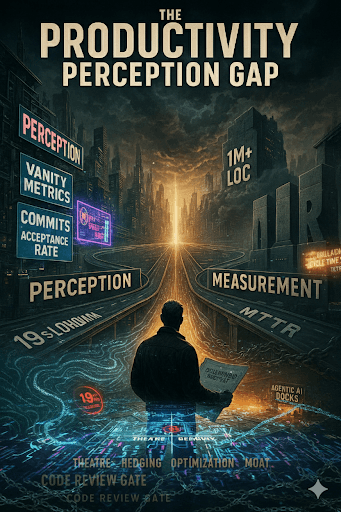
The productivity perception gap.
A analysis of AI’s impact on experienced developer productivity
Part I: Executive intelligence
The bottom line
Early-2025 Artificial Intelligence (AI) tools, contrary to widespread expectations, degrade the productivity of experienced developers working on complex, familiar software projects. A landmark randomized controlled trial (RCT) reveals a statistically significant 19% increase in task completion time when these tools are used.1 This empirical reality is dangerously masked by a universal and deeply held belief among developers and experts alike that these same tools provide a speedup of over 20%.1 This chasm between reality and perception constitutes a systemic “Productivity Perception Gap” a strategic discontinuity that introduces significant, unpriced risk of capital misallocation, flawed talent strategy, and eroded competitive advantage for organizations that fail to measure real-world impact. The confidence in this core finding is high, based on the methodological rigor of the underlying evidence.
Decision-Critical implications
The discovery of the Productivity Perception Gap has immediate and profound implications for key decision-makers across the technology and investment landscape.
-
For technology leaders (CTOs, CIOs, CSOs): Current AI adoption strategies, frequently driven by developer sentiment, anecdotal evidence, and vanity metrics (such as commit frequency or self-reported happiness), are likely destroying value within senior engineering teams. The prevailing “deploy everywhere” approach is not only failing to deliver promised returns but is actively slowing down the most critical and expensive engineering talent. The strategic imperative must shift immediately from broad tool deployment to targeted, context-specific application and the implementation of rigorous, outcome based measurement frameworks. Failing to do so risks institutionalizing inefficiency and accumulating a new, insidious form of technical debt born from AI-generated code that is poorly understood and difficult to maintain.4
-
For investment professionals (VC, PE): The dominant investment thesis for a significant segment of the AI developer tool market, which is predicated on universal and substantial productivity gains, is fundamentally flawed. The market is pricing tools based on their performance in low-complexity, greenfield scenarios or with junior talent, while ignoring the negative returns in high-value, complex enterprise environments. This creates a market inefficiency and a significant risk of an investment bubble. The next wave of value creation will not be in generic code generation, but in second-order tools that solve the new, AI-induced bottlenecks: AI-assisted code review, advanced context management, tacit knowledge ingestion for models, and sophisticated validation systems. Portfolios must be re-evaluated to distinguish between tools that merely fuel “productivity theatre” and those that deliver measurable, systemic improvements.
-
For policy makers: The labor market is already undergoing a significant bifurcation driven by AI. The automation of routine coding tasks is disproportionately impacting entry-level software roles, with recent studies showing a marked decline in employment for young professionals in AI-exposed fields since late 2022.6 Simultaneously, the METR study’s findings suggest the value of, and demand for, senior talent with deep, tacit knowledge and high-level judgment is increasing. This dynamic is creating a looming talent pipeline crisis: the very entry-level roles that serve as the training ground for future senior experts are being eliminated. Without strategic intervention in education, workforce development, and digital apprenticeship programs, the technology industry faces a systemic, long-term shortage of the high-judgment talent required to supervise and effectively leverage the next generation of AI.
Threat/Opportunity Matrix
The current strategic landscape, defined by the Productivity Perception Gap, can be visualized across two axes: reliance on perception versus reliance on measurement, and passive versus active strategic response. This creates four distinct quadrants for organizational positioning.
**Passive strategic response (Following the hype)**Active strategic response (Driving the agenda)Reliance on perceptionQuadrant I: Productivity theatre (High threat)Organizations in this quadrant invest heavily in AI tools based on developer sentiment and vendor marketing. They celebrate vanity metrics like increased commits and self-reported happiness, masking a net slowdown in value delivery and an increase in long-term technical debt. They are at high risk of capital destruction and competitive decline.8Quadrant II: Strategic hedging (Mitigated threat) Organizations here recognize the hype but lack the tools to measure reality. They make cautious, limited investments in AI, hedging their bets but failing to build a durable competitive advantage. They avoid the worst outcomes but capture none of the potential upside.Reliance on measurement****Quadrant III: Incremental optimization (Limited opportunity) These organizations measure productivity but use the data reactively. They identify the slowdown in senior teams and may restrict tool usage, preserving baseline productivity. However, they fail to proactively reshape workflows or talent strategies, missing the opportunity to leverage AI for a systemic advantage.**Quadrant IV: Measurement as a moat (High opportunity)**Leaders in this quadrant use rigorous, outcome-based measurement to see reality clearly. They deploy AI surgically where it creates value (juniors, greenfield projects) and protect senior talent for high-judgment tasks. They invest in the next generation of tools and training, turning superior insight into a defensible competitive advantage in talent, capital allocation, and delivery velocity.11
The primary threats are Productivity theatre, where performative work replaces productive work, and a Talent pipeline collapse, where the automation of junior roles creates a future deficit of senior expertise.6 The primary opportunities are leveraging measurement as a moat to make superior strategic decisions and capitalizing on the rising senior skill premium by becoming a magnet for high-judgment talent whose role is evolving from code creator to AI-augmented systems architect.14
Action requirements
Navigating this landscape requires a decisive and phased strategic response.
Immediate Actions (Next 90 Days):
-
Halt unmeasured deployments: Immediately pause all broad, mandated rollouts of AI coding assistants to senior development teams working on mature, mission-critical systems.
-
Initiate a metrics audit: Conduct a rigorous audit of all current engineering productivity metrics. Classify each metric as either a “Vanity Metric” (e.g., lines of code, commit frequency, AI suggestion acceptance rate) or a “Value Metric” (e.g., cycle time, deployment frequency, change failure rate, mean time to resolution).
-
Launch controlled pilots: Design and execute small-scale, controlled pilot programs to measure the real-world impact of AI tools on specific teams and project types within the organization. These pilots must be based on objective Value Metrics, not self-reported sentiment.
Medium-term actions (1-2 Years):
-
Develop a context-aware AI strategy: Replace any one-size-fits-all AI adoption policy with a differentiated strategy. This strategy must distinguish between developer experience levels (junior vs. senior), project type (greenfield vs. legacy), and task complexity.
-
Invest in measurement infrastructure: Allocate capital to build or acquire the necessary infrastructure to track end-to-end software delivery lifecycle metrics (e.g., DORA metrics). Make these metrics the foundation of engineering management and strategic decision-making.11
-
Redefine training and development: Shift training budgets away from basic tool usage and toward developing AI-specific meta-skills. These include advanced prompt engineering, critical output validation, systems-level thinking for AI-generated components, and the cognitive skills required to effectively supervise AI agents.
Part II: Evidence analysis & credibility assessment: deconstructing the METR study
The strategic analysis presented in this report is anchored by the findings of a pivotal July 2025 study from the Model Evaluation & Threat Research (METR) institute, titled “Measuring the Impact of Early-2025 AI on Experienced Open-Source Developer Productivity.” A thorough assessment of this study’s methodology, limitations, and credibility is essential for grounding strategic decisions in a robust evidence base.
Methodological strengths: A high-fidelity signal in a noisy landscape
The METR study’s primary strength, and the reason its findings carry significant strategic weight, is its exceptional methodological rigor, which directly addresses the critical flaws of prior research in this domain. The study employed a Randomized Controlled Trial (RCT), the gold standard for establishing causal inference, to isolate the specific impact of AI tool usage.1
Unlike previous studies that relied on artificial or synthetic tasks such as asking developers to implement a basic HTTP server in a controlled lab setting the METR study’s design was rooted in real-world complexity.3 The trial involved 16 highly experienced developers completing 246 actual tasks (bug fixes, feature implementations, refactors) drawn from the issue backlogs of large, mature open-source repositories they actively maintain.1 These “brownfield” projects, averaging over one million lines of code and 22,000 stars on GitHub, represent the kind of complex, interdependent systems that drive the most economic value in the software industry, a stark contrast to the clean slate “greenfield” tasks that dominate benchmarks.18
Furthermore, the study’s data collection methods provided an unprecedented level of observational detail. In addition to self-reported completion times, the researchers captured and manually labeled over 143 hours of screen recordings, allowing for a fine-grained analysis of how developers actually spent their time prompting, waiting for AI, reviewing suggestions, and debugging across the two experimental conditions.21 This multi-modal data collection provides a powerful check against self-reporting biases and offers a direct view into the workflow changes induced by AI. This combination of an RCT design, real-world tasks in complex environments, and detailed observational data makes the METR study a high-fidelity signal in a landscape previously dominated by the noise of unrealistic benchmarks and subjective anecdotes.
Validity limitations and boundary conditions: Defining the “slowdown zone”
The study’s authors are commendably transparent about the limitations of their findings, explicitly cautioning against overgeneralization.1 They do not claim that AI slows down all developers in all contexts. Instead, the study’s value lies in its precise definition of the boundary conditions under which the widely assumed productivity gains from AI not only disappear but actually invert into a net loss.
This “Slowdown Zone” is characterized by a specific confluence of factors:
-
High developer expertise: Participants had an average of five years of experience contributing to their specific project.2 They possessed deep, intimate knowledge of the codebase.
-
High codebase complexity: The repositories were mature, averaging 10 years in age with over 1.1 million lines of code.21 These are not simple applications but sprawling, legacy systems with significant technical debt and architectural nuance.
-
High quality standards: As prominent open-source projects, they are subject to rigorous review processes and have implicit requirements for testing, documentation, and coding style that far exceed those of many internal enterprise projects or prototypes.1
These boundary conditions are not a weakness of the study; they are its most important strategic finding. The results demonstrate that the impact of AI on developer productivity is not a universal constant but a variable highly sensitive to the context of the work. The slowdown is a specific, emergent phenomenon that appears at the intersection of high human expertise and high system complexity. This finding directly refutes the simplistic, monolithic narrative of “AI boosts productivity” and forces a more sophisticated, context-aware approach to technology adoption and investment.
Quantifying uncertainty: Learning curves and confidence intervals
The headline finding of a 19% slowdown is statistically robust, with a 95% confidence interval that clearly excludes zero and any positive speedup (approximately -40% to -2%).24 The researchers conducted numerous robustness checks, confirming that the slowdown was consistent across different outcome measures and statistical methodologies, and was not an artifact of experimental design flaws like participants dropping harder tasks in one condition.1
A primary critique, acknowledged by the authors and external commentators, revolves around the potential impact of a learning curve.21 A majority of participants (56%) had no prior experience with Cursor, the primary AI tool used in the study.21 This raises the possibility that the observed slowdown represents a temporary dip in performance as developers adapt to a new tool and workflow.
However, several factors suggest the learning curve is not the sole, or even primary, explanation. First, one of the study’s authors notes that many prior studies which found significant speedups used developers with similar or even less experience with the AI tools in question.21 Second, over 90% of the participants had significant prior experience with prompting LLMs, which was widely considered the core skill required.21
The most telling piece of evidence comes from within the study itself: the one developer who had more than 50 hours of prior experience with Cursor was also one of the few to see a positive speedup.21 This data point, while anecdotal, signals a crucial dynamic: the learning curve for effectively using AI on complex tasks may be far steeper and longer than commonly assumed. Achieving a positive return may require not just a few hours of acclimation, but potentially hundreds of hours of deliberate practice to build the necessary mental models and workflow adaptations.23 This creates a “Skill Ceiling Paradox”: the technology promises to save time, but unlocking that benefit for the most complex work requires a massive, un-costed, and often prohibitive upfront investment in time and training. The initial productivity dip during this extended learning phase could last for weeks or months, making the short-term ROI on AI tool deployment for senior teams decidedly negative.
Replication and future research: The path to validation
The METR study provides a critical, paradigm-shifting data point, but it is still a single study. For technology leaders and investors to build durable strategies, its findings must be validated and the boundaries of the “Slowdown Zone” must be more precisely mapped. A clear agenda for future research is required to move from this initial discovery to a comprehensive understanding.
Key research questions that demand immediate attention include:
-
Longitudinal analysis of the learning curve: A long-term study that tracks a cohort of experienced developers over a period of 6-12 months is needed to measure the full arc of the learning curve. This would answer the critical question: Do all experienced developers eventually cross the productivity threshold from negative to positive, and if so, after how many cumulative hours of use?
-
Task-type and codebase segmentation: The current finding aggregates all development tasks. Future research must disaggregate this effect. How does the productivity impact vary between bug fixing, refactoring, greenfield feature development, and documentation within the same complex codebase? How does it vary between a monolithic legacy system and a modern microservices architecture?
-
Toolchain and model impact: The METR study focused on a specific toolchain (Cursor with Claude 3.5/3.7 Sonnet). It is crucial to replicate the experiment with different IDEs, agentic frameworks, and foundation models to determine how much of the slowdown is attributable to the specific implementation versus the fundamental nature of human-AI interaction in these contexts.
-
Direct comparison of experience levels: While existing literature suggests AI benefits junior developers more than seniors 5, this has not been tested in a head-to-head RCT on identical, complex tasks. Such a study would provide definitive empirical evidence for the skill complementarity vs. substitution hypothesis and its impact on talent strategy.
Part III: Causal mechanism deep-dive: The anatomy of a slowdown
The 19% productivity degradation observed in the METR study is not a random artifact but the output of a complex system of interacting forces. Understanding these underlying causal mechanisms is critical for moving beyond simply acknowledging the slowdown to developing effective mitigation strategies. The negative productivity emerges from a combination of increased cognitive burdens, fundamental mismatches between AI capabilities and the nature of expert work, and the inherent complexity of mature software systems.
A systems dynamics model of productivity degradation
The slowdown can be conceptualized as a system of reinforcing feedback loops where initial time savings from AI-powered code generation are overwhelmed by new, and larger, time costs in other parts of the workflow.
The core negative productivity loop proceeds as follows:
-
A developer initiates a task and uses an AI tool to generate a block of code, saving initial typing and ideation time.
-
The developer must spend time crafting a sufficiently detailed prompt and then waiting for the model to respond.
-
The AI, lacking full context, produces code that is often “almost right” syntactically correct and plausible, but with subtle logical flaws, incorrect API usage, or violations of project-specific conventions.28
-
The developer must then engage in a time-consuming cycle of validation, debugging, and integration. This phase is often more difficult than writing the code from scratch because it involves deciphering the AI’s “thought process” and identifying errors that a human developer would not typically make.8
-
The cumulative time spent on this validation and correction cycle exceeds the time saved in the initial generation step, resulting in a net increase in total task time.
This core loop is amplified by several reinforcing loops:
-
The cognitive load loop: The constant task-switching between the distinct mental modes of creative problem-solving (specifying intent), critical evaluation (reviewing AI output), and forensic debugging (fixing AI errors) dramatically increases the developer’s cognitive load.30 This heightened mental strain leads to decision fatigue, a higher likelihood of human error in the validation process, and a general reduction in the state of “flow,” further extending the total task time.30
-
The code complexity loop: AI-generated code, particularly from models not fine-tuned on a specific repository, can be more verbose, less idiomatic, or introduce unnecessary dependencies compared to code written by a project expert.4 Each accepted AI suggestion, even if functional, can incrementally increase the local complexity and “foreignness” of the codebase. This accumulated complexity makes all subsequent development tasks whether performed by a human or another AI more difficult and time consuming, creating a vicious cycle of rising technical debt.33
-
The tacit knowledge mismatch loop: The AI generates a solution based on its public training data. The senior developer evaluates it against their deep, implicit understanding of the project’s history, architectural constraints, and unwritten rules. A mismatch occurs, forcing the developer to either engage in a lengthy prompt-refinement cycle to “teach” the AI the necessary context or manually rewrite the code. This friction represents the core conflict between the AI’s explicit knowledge and the human’s tacit knowledge, with each mismatch adding to the overall time cost.1
Factor contribution analysis: The four horsemen of the slowdown
While multiple factors are at play, the productivity degradation can be primarily attributed to four dominant forces.
1. The cognitive load tax (High Impact)
The most significant and insidious contributor to the slowdown is the shift in the nature of the developer’s work. The task of software development is transformed from one of primarily creation to one of constant supervision and validation. This new workflow imposes a heavy “cognitive tax” that is not captured by simple output metrics. Instead of entering a deep state of flow to write code, the developer must act as a high-stakes quality assurance engineer for an unreliable, non-deterministic junior partner.15 This involves a relentless cycle of context-switching: from specifying intent in a natural language prompt, to evaluating the plausibility of the generated code, to debugging subtle and often bizarre errors unique to LLMs (e.g., plausible looking but non-existent API calls), and finally to integrating the foreign code into the existing system.8 Emerging research using physiological measures like EEG and fMRI is beginning to quantify the intense mental effort associated with these new validation and repair tasks, confirming that the work is cognitively demanding even if it involves less typing.30 This tax explains the central paradox: developers
feel more productive because the physical effort of typing is reduced, but they are objectively slower because the total cognitive effort required to manage the AI and ensure quality has increased.
2. The tacit knowledge barrier (High Impact)
The second dominant factor is the AI’s fundamental inability to access and reason over tacit knowledge. A senior developer’s value in a mature codebase is not just their ability to write code, but their deep, internalized “mental model” of the system.35 This model is built over years and comprises an intricate web of unwritten rules, the history behind architectural decisions, awareness of fragile parts of the system, and an intuitive understanding of the project’s domain-specific logic.38 Current AI models, which operate on the explicit knowledge contained within their context window, are blind to this entire dimension of information. The METR study participants explicitly identified this “implicit repository context” as a key reason for the AI’s poor performance.1 The 19% slowdown is, in large part, a measurement of the friction generated at the interface between the AI’s explicit-but-naive suggestions and the human expert’s tacit but critical understanding. Each time the AI proposes a solution that is technically plausible but architecturally or contextually wrong, the developer must expend cognitive energy to identify the mismatch and manually correct it, effectively paying a time penalty for the AI’s ignorance.
3. The complexity penalty (Medium Impact)
AI performance is inversely correlated with the complexity of the environment. Research consistently shows that while LLMs excel at simple, self-contained, “greenfield” tasks, their accuracy and utility degrade significantly when applied to large, mature, “brownfield” codebases.18 This degradation is driven by several factors, including the limitations of finite context windows which prevent the model from “seeing” the entire system, and a lower signal-to-noise ratio where relevant information is buried within millions of lines of irrelevant code.19 The environment of the METR study large, long-lived open-source projects sits squarely in this high-complexity, low-performance zone for AI. The observed productivity loss is therefore a direct empirical measurement of the “complexity penalty” that current-generation AI pays when taken out of the sanitized environment of benchmarks and applied to the messy reality of mission-critical software.
4. The quality standard friction (Medium Impact)
Finally, the high quality standards inherent in prominent open-source projects contribute significantly to the slowdown. Unlike a quick prototype or an internal script, contributions to these repositories must adhere to stringent, often implicit, standards for testing, documentation, code style, and commit message formatting.1 AI-generated code is notoriously poor at meeting these ancillary requirements without extensive prompting and manual correction. While the AI might generate a functional algorithm quickly, the developer must then invest substantial time in writing unit tests, crafting clear documentation, refactoring the code to match project style guides, and ensuring it integrates cleanly with the existing CI/CD pipeline. This “last-mile” effort to bring AI-generated code up to a production-ready standard represents a significant and often underestimated time cost, contributing directly to the observed net slowdown.
Skill complementarity vs. substitution: The senior developer’s new job
The economic framework developed by Agrawal, Gans, and Goldfarb provides a powerful lens for interpreting these findings. They posit that AI is fundamentally a “prediction machine,” a technology that drastically lowers the cost of prediction.41 In software development, code generation can be seen as a prediction task: given the preceding code and a prompt, predict the most likely correct code to follow. The impact of this cheaper prediction depends critically on whether it substitutes for or complements human judgment.
-
For junior developers (Substitution): A large portion of the work performed by a junior developer consists of well-defined, routine “prediction” tasks: implementing a known algorithm, writing boilerplate code, or translating a detailed specification into a standard function. In this context, AI acts as a direct substitute for human labor. It can perform these prediction tasks faster and more cheaply. This explains why numerous studies find that AI provides the largest productivity boosts to less-experienced workers 27 and, concurrently, why economic data shows these junior roles are the most vulnerable to automation and displacement.6
-
For senior developers (Costly Complementarity): In stark contrast, the core function of a senior developer on a complex project is not prediction, but judgment. Their primary value lies in tasks that require weighing complex trade-offs, evaluating the long-term consequences of architectural decisions, ensuring the quality and maintainability of the system, and applying their tacit knowledge to solve ambiguous problems. Cheaper AI-driven code generation does not substitute for this judgment; it increases the demand for it. The senior developer is now flooded with a higher volume of low-cost, low-quality code predictions that must be evaluated. In this relationship, the AI complements the senior developer’s judgment. However, because the quality of the AI’s predictions is currently low in complex contexts, this complementarity is highly inefficient. The 19% slowdown is the measured cost of this new, supervision-focused “judgment” work that AI has created for senior developers. Their job has shifted from being a primary creator to being an editor-in-chief for a prolific but unreliable writer.
The great misperception: Deconstructing the productivity illusion
The most strategically critical finding of the METR study is not the slowdown itself, but the massive gap between this reality and the developers’ own perception. Participants believed they were working 20% faster when they were in fact 19% slower.1 This 39-point perception gap is not a simple measurement error; it is a systematic cognitive bias rooted in human psychology, and it is the primary fuel for organizational “Productivity theatre.”
The illusion can be explained by a combination of two powerful psychological principles:
-
Effort justification: This is a well-documented cognitive bias where humans tend to ascribe greater value to an outcome if they had to exert more effort to achieve it.30 The process of working with current AI tools on complex tasks is cognitively strenuous. It requires intense concentration to craft effective prompts, meticulously review generated code for subtle flaws, and debug unfamiliar error patterns. This high level of mental engagement may lead developers to subconsciously inflate the value and efficiency of the final result, convincing themselves that the difficult process must have been a productive one.
-
Cognitive load shifting and the feeling of “easiness”: AI tools automate the most tangible and physically effortful part of programming: typing. They shift the burden from the developer’s fingers to their prefrontal cortex from active creation to active validation. Developers in the METR study and other anecdotal reports consistently state that using AI feels easier even if it takes more time.26 This is likely because the workflow is broken into smaller chunks (prompt, wait, review) with built-in pauses while waiting for the LLM, which can feel less strenuous than the sustained concentration required for writing complex code from scratch.26 Developers are misinterpreting thefeeling of reduced effort (less typing, more pauses) as an actual reduction in total task time. They are conflating “easier” with “faster,” a cognitive error that completely masks the underlying productivity loss.
This misperception is a profound strategic risk. When the workforce responsible for using a new technology is fundamentally unable to assess its true impact on their own performance, organizations are flying blind. Decisions on technology investment, process changes, and talent management become unmoored from reality, based instead on a powerful and persistent illusion of progress.
Part IV: Strategic contextualization: Locating the paradox in the technology adoption lifecycle
The counterintuitive findings from the METR study do not exist in a vacuum. They are best understood when placed within the broader historical context of technology diffusion and compared with AI’s impact across different domains of knowledge work. This contextualization reveals that the current productivity slowdown in software development is not an anomaly but a predictable, albeit acute, phase in the adoption of a general-purpose technology, with unique characteristics stemming from the distinctive nature of software itself.
Historical parallels: The ghost of solow’s paradox
The current situation bears a striking resemblance to the “productivity paradox” of the 1970s and 1980s, famously summarized by Nobel laureate economist Robert Solow’s 1987 statement: “You can see the computer age everywhere but in the productivity statistics”.48 For over a decade, massive corporate investments in information technology (IT) failed to produce corresponding gains in national productivity measures.
The parallels to the current AI paradox are clear and instructive:
-
Visible technology, invisible gains: Just as computers were visibly proliferating on every desk in the 1980s, AI tools are now integrated into nearly every developer’s workflow. Yet, in the most complex use cases, the expected productivity dividend has not materialized in objective measurements.1
-
The lag of complementary innovation: The resolution to the original Solow Paradox was the understanding that productivity gains from a general-purpose technology like the computer are not automatic. They only arrive after a significant and time-consuming period of co-invention and investment in complementary factors. Organizations had to fundamentally reorganize their workflows, retrain their workforces, and reinvent business processes to take advantage of the new technology.50 For example, the true value of electricity in manufacturing was not realized by simply replacing steam engines with electric motors, but by redesigning the entire factory floor layout, which was no longer constrained by the logic of belts and driveshafts.50
Similarly, the current negative productivity in software development is a strong signal that the necessary complementary innovations have not yet occurred. Organizations are attempting to bolt a revolutionary technology (AI) onto an evolutionary workflow (the existing software development lifecycle), and the result is friction, inefficiency, and a net productivity loss. The slowdown is the measurable cost of this mismatch between the new tool and the old process. The key difference from the original paradox may be the speed of adoption; generative AI is being implemented far more rapidly than previous technologies, which could shorten the lag but also intensify the initial disruption.52
Cross-domain reality check: Why software Is different
The productivity paradox in software development becomes even more stark when contrasted with AI’s demonstrable successes in other high-skill knowledge work domains.
- Positive impact in law and medicine: A growing body of evidence shows significant, positive productivity impacts from AI in fields like law and medicine. In the legal sector, AI-powered tools for document review and contract analysis can process thousands of documents in hours, a task that would take human associates months. Lawyers report saving multiple hours per week, translating into substantial perceived value.53 In medicine, AI algorithms have achieved superhuman performance in diagnostic imaging, detecting conditions like lung nodules or breast cancer from scans with higher accuracy and speed than human radiologists.56
The divergence in outcomes between these fields and software engineering demands a deeper explanation. The critical distinction lies in the fundamental nature of the object of work.
A legal contract, a set of discovery documents, or a medical image are static, bounded artifacts. While complex, their state does not change during the process of analysis. The context required for the task is largely self-contained within the artifact itself. The AI’s task is to analyze and extract patterns from a fixed dataset.
In contrast, a mature software codebase is a dynamic, living system. It is an intricate, deeply interconnected entity with millions of dependencies, where a change in one part can have unforeseen consequences in another. The context is not bounded by the visible code; it is an unbounded web of architectural history, design trade-offs, technical debt, and years of accumulated, unwritten conventions.58
Therefore, the task of a senior software developer is less like reviewing a static document and more like performing surgery on a living organism. Every intervention must be considered in the context of its potential systemic effects. Current AI, with its limited context window and lack of a true, persistent “mental model” of the system, is a blunt and clumsy instrument for such a delicate and high-stakes operation. This fundamental difference between analyzing a static artifact and modifying a living system is the most compelling explanation for why AI is successfully accelerating productivity in law and medicine while actively degrading it for experienced developers in complex software projects.
Technology maturity assessment: Early adopter pain or fundamental limits?
The negative productivity findings of the METR study are characteristic of the “trough of disillusionment” phase in the technology adoption lifecycle. They represent the painful friction that occurs when a powerful but immature “point solution” (in this case, code generation) is misapplied to a complex, systemic problem (the end-to-end software development lifecycle). The current generation of AI tools demonstrates a fundamental mismatch between its capabilities and the true nature of expert-level software engineering work.
The evolution of AI’s impact on developer productivity is likely to proceed through three distinct phases:
-
Phase 1: Point solution friction (current state; negative productivity): This phase is defined by standalone code generation tools like those used in the METR study. They operate with limited context and are poorly integrated into the broader workflow. Their application in complex environments creates more cognitive overhead and validation work than they save, resulting in a net productivity loss for experienced users.
-
Phase 2: Workflow integration (near-term; neutral to slightly positive productivity): The next generation of tools will move beyond simple code generation to focus on deeper workflow integration. This will involve technologies like Retrieval Augmented Generation (RAG) that can index and query entire code repositories, providing more context-aware suggestions. We will also see the rise of AI-assisted tools for the new bottlenecks, such as intelligent code review assistants that can flag architectural inconsistencies in AI-generated pull requests. In this phase, the productivity impact for senior developers will likely become neutral or slightly positive, but substantial gains will remain elusive.
-
Phase 3: Agentic system orchestration (mid-term; significant positive productivity): A true breakthrough in productivity will only occur with the advent of genuinely “agentic” AI systems. These systems will be capable of understanding high-level developer intent (e.g., “Implement feature XYZ as described in this ticket”), independently breaking the problem down into sub-tasks, writing the code, creating the tests, and submitting a pull request with a reasoned explanation of its changes. Only when the AI can operate on the entire development lifecycle, not just on isolated snippets of code, will the exponential productivity gains promised by futurists begin to materialize. This phase, however, requires significant advances in long-range planning, reasoning, and autonomous error correction that are not yet on the immediate horizon.
Part V: Economic & strategic implications analysis
The revelation of a productivity slowdown for experienced developers is not merely an academic curiosity; it is a seismic event with profound economic and strategic implications. The vast gap between perceived and actual productivity creates market inefficiencies, introduces significant investment risks, reshapes the software development labor market, and offers a powerful source of competitive advantage for organizations that can see reality more clearly than their rivals.
Investment risk: The $4.4 trillion question mark
The global economy is in the midst of an unprecedented wave of capital allocation driven by the promise of AI-led productivity. Projections from major consultancies estimate that AI could add trillions of dollars in annual value to the global economy, with a significant portion derived from the automation and augmentation of knowledge work.60 The venture capital market has responded accordingly, with investment in AI developer tools in the first half of 2025 already surpassing the total for all of 2024, driven by mega-rounds for AI-centric companies.61
The METR study’s findings introduce a critical and un-priced risk factor into these optimistic models. The core assumption underpinning much of this investment is that AI tools provide a universal, or near-universal, productivity lift across all of software development. The discovery that these tools can have a significant negative productivity impact on the most senior, experienced, and highly compensated developers calls this entire thesis into question.
This creates a substantial risk of an investment bubble in the AI developer tool space, analogous in structure to the dot-com bubble of the late 1990s. Capital is flowing based on hype, flawed metrics, and a fundamental misunderstanding of the technology’s real-world impact in high-value enterprise settings. The market appears to be pricing tools based on their impressive but misleading performance on simple tasks or with junior developers, while ignoring their value-destructive effects in complex, mature environments. The Productivity Perception Gap is fueling a market inefficiency where vast sums of capital are being misallocated to tools that may be actively harming the productivity of the organizations that adopt them. The eventual market correction could be severe for companies and investors who have failed to look beyond the hype and measure tangible, outcome-based ROI.
Labor economics: The great bifurcation
The differential impact of AI on junior and senior developers is not just a matter of productivity; it is actively reshaping the structure of the technology labor market. Recent economic research provides clear empirical evidence of this “Great Bifurcation.” A landmark Stanford study revealed a 13% relative decline in employment for early-career workers (ages 22-25) in AI-exposed occupations, including software engineering, since the widespread adoption of generative AI tools began in late 2022. During the same period, employment for more experienced workers in the exact same roles remained stable or even grew.6
This data is the real-world manifestation of the substitution and complementarity effects discussed previously. AI is directly substituting for the routine, well-defined tasks that have historically formed the basis of entry-level software jobs. This was the crucial first rung on the career ladder, where new graduates learned the craft by writing boilerplate code, fixing simple bugs, and implementing small, well-scoped features under supervision.
This dynamic poses a critical, long-term systemic risk to the entire technology ecosystem:
-
Short-term incentive: In the immediate term, companies have a strong economic incentive to reduce hiring at the junior level and substitute that labor with AI tools, thereby cutting costs.
-
Long-term consequence: This strategy systematically starves the talent pipeline. By automating the training ground, organizations are preventing the next generation of developers from acquiring the foundational experience necessary to become the senior experts of tomorrow. In 5 to 10 years, this will lead to a severe, structural shortage of qualified senior engineers, the very individuals with the high-level judgment and tacit knowledge required to supervise more advanced AI systems and solve complex architectural problems.13 The short-term efficiency gain of replacing junior developers creates a long-term strategic vulnerability for the entire industry.
Competitive dynamics: The advantage of seeing reality
In a market environment distorted by the Productivity Perception Gap, the single greatest source of competitive advantage is the ability to accurately measure reality. The competitive landscape will be defined by the divide between organizations that operate on perception and those that operate on measurement.
-
The laggards (perception-driven): These organizations will continue to make strategic decisions based on flawed inputs. They will purchase AI tools based on developer sentiment surveys, measure success with vanity metrics like the number of commits, and celebrate the “happiness” of their developers. Unseen to them, their true delivery velocity will slow, their most senior talent will become bogged down in unproductive validation work, and their codebases will accumulate a hidden layer of AI-generated technical debt, making future innovation slower and more expensive.16 They will be performing “Productivity Theatre,” putting on a great show of being busy while falling behind their competitors.
-
The leaders (measurement-driven): These organizations will recognize that in the age of AI, a sophisticated measurement infrastructure is not a “nice-to-have” but a core strategic asset.11 By implementing robust, outcome-based frameworks like DORA metrics (Deployment Frequency, Lead Time for Changes, Mean Time to Recovery, Change Failure Rate), they will be able to objectively identify the specific contexts where AI tools create value and where they destroy it. This superior vision will enable them to make a series of winning strategic moves:
-
Surgical deployment: They will aggressively deploy AI tools to junior teams and on greenfield projects, where the ROI is demonstrably positive.
-
Strategic protection: They will shield their senior developers working on legacy systems from mandated AI tool usage, protecting their focus for the high-judgment architectural and problem-solving tasks that drive the most value.
-
Targeted investment: They will bypass the hype cycle around generic code generators and instead invest their capital and attention in the next generation of tools that solve the real, newly created bottlenecks in the AI-augmented workflow, such as AI-powered testing and code review.
Over time, this ability to allocate capital, talent, and attention based on an accurate map of reality will create a durable and compounding competitive advantage.
Table 1: Comparative analysis of AI developer productivity studies
Study / ReportMethodologyParticipant Profile (Experience)Task Environment (Greenfield/Brownfield)Codebase ComplexityKey Measured OutcomeKey LimitationsMETR (July 2025) 1Randomized Controlled Trial (RCT)16 Experienced (avg. 5 yrs on project)Brownfield (real tasks on own projects)High (avg. 1M+ LOC)-19% in task completion time (slowdown)Small sample size; potential learning curve effects.Peng et al. (2023) 3Randomized Controlled Trial (RCT)95 Professional Developers (varied)Greenfield (implementing an HTTP server)Low (from scratch)+56% in task completion time (speedup)Synthetic, non-representative task; not generalizable to complex systems.Faros AI (2025) 4Observational Data AnalysisEnterprise developers (varied)Brownfield (real enterprise work)Varied**+21%** tasks completed, but +91% PR review timeCorrelation, not causation; shows bottleneck shift, not net system speedup.McKinsey (2023) 44Observational StudyEnterprise developers (varied)Not specifiedNot specifiedUp to 2x faster on some tasks; juniors saw smaller/negative gainsLacks RCT rigor; tasks not specified; may focus on easily automated work.Google (2024) 69Randomized Controlled Trial (RCT)96 Google Software EngineersBrownfield (complex enterprise task)High**+21%** in task completion time (speedup)Single enterprise context; AI features integrated, not standalone tools.IT Revolution (2024) 27Longitudinal Observational StudyEnterprise developersBrownfield (real enterprise work)Varied**+26%** more tasks completed; juniors gained most (21-40%)Observational; does not measure total task time or downstream costs like review.
Part VI: Foresight & strategic response framework
The emergence of the Productivity Perception Gap necessitates a fundamental reassessment of how organizations, investors, and policymakers approach the integration of AI into software development. A passive, “wait-and-see” approach is insufficient; a proactive, evidence-based strategic framework is required to navigate the uncertainties of the coming years, mitigate the identified risks, and capitalize on the opportunities created by this market discontinuity.
Scenario planning: Three futures for AI in software development (2025-2030)
To prepare for a range of potential outcomes, stakeholders should consider three plausible scenarios for the evolution of AI’s impact on software development over the next five years.
-
Scenario 1 (Stagnation, “The productivity trap”): In this future, the progress of AI models on tasks requiring complex, long-range reasoning and true system understanding plateaus. The “tacit knowledge barrier” proves to be a fundamental and intractable problem for current AI architectures. The productivity slowdown for senior developers working on complex systems persists or even worsens as AI-generated code further complicates legacy systems. The automation of junior-level tasks continues, leading to a severe and chronic talent crisis as the industry fails to produce enough experienced engineers. In this scenario, the primary use of AI in software development remains confined to niche, low-value tasks, and the massive investments in developer tools result in a widespread write-down of capital.
-
Scenario 2 (Incremental progress, “The long climb”): This scenario represents a future of steady but challenging progress. AI capabilities improve incrementally. Context windows expand to encompass entire codebases, and repository-aware RAG systems become standard. The productivity impact for senior developers slowly moves from negative to neutral, and eventually to a modest positive (e.g., 5-15% speedup), but this requires significant, sustained investment in workflow re-engineering, measurement infrastructure, and continuous training. The junior-to-senior talent gap becomes a major operational drag and a key point of competitive differentiation, with companies that invest in novel apprenticeship and training programs gaining a significant advantage. The market for AI developer tools consolidates around platforms that offer integrated, lifecycle-aware solutions rather than simple code generators.
-
Scenario 3 (Breakthrough, “The agentic leap”): A fundamental breakthrough in AI, perhaps through new architectures focused on autonomous planning or causal reasoning, enables the creation of true “agentic” software engineering assistants. These agents can build and maintain a persistent “mental model” of an entire codebase, allowing them to take a high-level requirement (e.g., a user story in a project management tool) and autonomously execute the entire development cycle: planning the implementation, writing the code, creating comprehensive tests, and submitting a high-quality pull request for human review. This scenario finally unlocks the exponential (e.g., 2x to 10x) productivity gains that have been promised. However, it also dramatically accelerates the displacement of a much broader range of software engineering roles, forcing a radical rethinking of the nature of technical work and creating significant societal and economic disruption.
Threshold Analysis: What needs to be true for AI to be a net positive?
For the industry to move from the current state of negative productivity for experts toward a future of positive returns (i.e., Scenarios 2 or 3), several key technological and organizational thresholds must be crossed. Monitoring progress against these thresholds can serve as an early warning system for strategic inflection points.
Technological thresholds:
-
Full-context ingestion: AI systems must move beyond the limitations of fixed context windows. The threshold is the ability to ingest, index, and perform complex queries across an entire multi-million line codebase and its full version history with near-perfect recall and accuracy.
-
Tacit knowledge elicitation: The system must be able to infer unwritten architectural principles, coding conventions, and domain logic from the existing code, documentation, and even related artifacts like code review comments and project discussion forums. A key metric would be the AI’s ability to predict whether a human expert would approve a given code change with >95% accuracy.
-
Low-error generation: To reduce the cognitive validation load on senior developers to a point where it is less than the time saved by generation, the error rate for AI-generated code on complex, context-dependent tasks must fall below a critical threshold, likely in the range of 1-5%.
Organizational thresholds:
-
Measurement maturity: The organization must shift its primary engineering metrics from output-based vanity metrics (lines of code, commits) to outcome-based value metrics (DORA metrics, cycle time). Widespread adoption of such metrics is a prerequisite for making rational decisions about AI tool deployment.
-
Workflow re-engineering: Organizations must move beyond simply providing AI tools and actively design a new, AI-native software development lifecycle (SDLC). This involves redefining roles (e.g., creating “AI-Interaction Specialists” or formalizing the “Principal Editor” role for senior engineers) and redesigning processes like code review and testing for a world of human-AI collaboration.
Strategic positioning: A differentiated adoption playbook
Given the high degree of context-dependency, a one-size-fits-all adoption strategy is guaranteed to fail. Technology leaders should adopt a differentiated, evidence-based playbook.
Table 2: Causal factor contribution analysis for productivity slowdown
Causal FactorDescriptionSupporting EvidenceEstimated Impact ContributionNature of ChallengeCognitive Load TaxThe mental overhead of constant context-switching between prompting, validating, and debugging unreliable AI output, shifting work from creation to supervision.8HighCognitive / WorkflowTacit Knowledge BarrierAI’s inability to access the unwritten rules, architectural history, and domain context that are critical for correct implementation in mature systems.1HighTechnological / DataComplexity PenaltyThe degradation of AI performance in large, mature “brownfield” codebases due to factors like limited context windows and low signal-to-noise ratio.18MediumTechnologicalQuality Standard FrictionThe significant time required to bring plausible but incomplete AI-generated code up to the high standards of testing, documentation, and style required for production.1MediumWorkflow / Process
Adoption Strategy by Context:
-
For junior developers & greenfield projects, aggressive adoption: In these contexts, AI acts as a powerful substitute for routine tasks and an accelerator for learning. Organizations should deploy best-in-class AI tools to this cohort to speed up onboarding, accelerate initial development, and handle boilerplate code generation. The productivity gains are real and substantial in these low-complexity, low-tacit-knowledge environments.
-
For senior developers & legacy systems, surgical & measured adoption: This is the “Slowdown Zone.” Mandating universal tool usage here is counterproductive. Instead, adoption should be voluntary and focused on specific, high-value use cases. The most promising applications are not in writing new code, but in understanding existing complex code (e.g., using AI for code summarization, dependency mapping, or explaining unfamiliar sections). All deployments in this context must be accompanied by rigorous measurement of impact on cycle time and code quality before any scaling decisions are made.
-
For all teams, invest in measurement and meta-skills: The highest and most durable ROI from AI investment in the near term will not come from purchasing more tool licenses. It will come from building the internal organizational capacity to (1) measure what actually works, and (2) train the workforce in the new “meta-skills” required for effective human-AI collaboration. This includes critical evaluation of AI outputs, advanced prompt engineering techniques, and the systems-thinking required to integrate AI components safely and effectively.70
Policy implications and recommendations: Averting the talent crisis
The market, driven by short-term efficiency incentives, is unlikely to solve the long-term talent pipeline crisis it is creating by automating entry-level roles. This creates a clear need for forward-looking policy interventions to ensure the long-term health of the technology ecosystem.
Table 3: Stakeholder-specific strategic response framework
Stakeholder GroupKey Challenge/OpportunityRecommended Strategic Actions**Technology Leaders (CTO, CIO, CSO)**Challenge: Risk of “Productivity Theatre” and value destruction in senior teams. Opportunity: Gain competitive advantage through superior measurement and talent strategy.Short-Term (0-12 months): 1. Audit and replace vanity metrics with outcome-based metrics (DORA). 2. Halt unmeasured, mandated AI tool rollouts for senior teams. 3. Launch controlled pilots to measure real impact. Long-Term (1-3 years): 1. Build a permanent, robust measurement infrastructure. 2. Develop a differentiated AI adoption strategy based on context (experience, project type). 3. Invest in training for AI-specific meta-skills (validation, supervision).**Investment Professionals (VC, PE)**Challenge: Risk of a market bubble in developer tools based on flawed productivity assumptions. Opportunity: Identify undervalued assets that solve real, second-order problems.Short-Term (0-12 months): 1. Add “Productivity Reality” as a key due diligence criterion. 2. Re-evaluate portfolio companies whose value proposition relies solely on universal code generation speedups. 3. Shift investment focus to tools solving AI-induced bottlenecks (review, testing, context management). Long-Term (1-3 years): 1. Develop an investment thesis around “Agentic Software Development” platforms. 2. Fund startups creating novel solutions for tacit knowledge capture and transfer. 3. Prioritize companies with strong evidence of measurable, positive ROI in enterprise settings.Policy Makers & Educators****Challenge: Looming talent pipeline crisis due to automation of entry-level roles. Opportunity: Proactively shape the future workforce to be AI-ready and globally competitive.Short-Term (0-12 months): 1. Convene industry-government task forces to study the talent pipeline issue. 2. Launch public awareness campaigns on the changing nature of software development skills. 3. Fund pilot programs for new “digital apprenticeship” models. Long-Term (1-3 years): 1. Collaborate with industry to develop standardized frameworks for measuring knowledge worker productivity. 2. Reform computer science curricula to focus on systems thinking, AI supervision, and critical judgment skills over rote coding. 3. Provide tax incentives or grants for companies that invest in structured, long-term training programs for junior talent.
Geciteerd werk
-
Measuring the Impact of Early-2025 AI on Experienced Open-Source Developer Productivity, METR, geopend op augustus 31, 2025, https://metr.org/blog/2025-07-10-early-2025-ai-experienced-os-dev-study/
-
[2507.09089] Measuring the Impact of Early-2025 AI on Experienced Open-Source Developer Productivity, arXiv, geopend op augustus 31, 2025, https://arxiv.org/abs/2507.09089
-
Measuring the Impact of Early-2025 AI on Experienced Open-Source Developer Productivity, geopend op augustus 31, 2025, https://www.researchgate.net/publication/393686050_Measuring_the_Impact_of_Early-2025_AI_on_Experienced_Open-Source_Developer_Productivity
-
The AI Productivity Paradox Research Report | Faros AI, geopend op augustus 31, 2025, https://www.faros.ai/blog/ai-software-engineering
-
The Reality of AI Developer Productivity in 2025: What the Data Actually Shows, geopend op augustus 31, 2025, https://www.hospedales.com/articles/ai-developer-productivity-reality-2025
-
AI is destroying entry-level jobs for young Americans and how it’s only getting worse: Stanford Study reveals, geopend op augustus 31, 2025, https://timesofindia.indiatimes.com/technology/tech-news/ai-is-destroying-entry-level-jobs-for-young-americans-and-how-its-only-getting-worse-stanford-study-reveals/articleshow/123558176.cms
-
Looking for your first job? You’re AI’s prime target, geopend op augustus 31, 2025, https://economictimes.indiatimes.com/jobs/fresher/looking-for-your-first-job-youre-ais-prime-target/articleshow/123547194.cms
-
Study: Experienced devs think they are 24% faster with AI, but they’re actually ~20% slower, Reddit, geopend op augustus 31, 2025, https://www.reddit.com/r/ExperiencedDevs/comments/1lwk503/study_experienced_devs_think_they_are_24_faster/
-
dev.to, geopend op augustus 31, 2025, https://dev.to/bgust/stop-measuring-keystrokes-how-vanity-metrics-are-fueling-a-productivity-theater-crisis-4m9h#:~:text=%22Productivity%20Theater%22%20is%20the%20phenomenon,it’s%20not%20a%20minor%20issue.
-
Productivity Theatre: Meaning, Impact & How to Avoid It, Pocket HRMS, geopend op augustus 31, 2025, https://www.pockethrms.com/hr-terms/productivity-theatre/
-
The 21 Developer Productivity Metrics You Should Measure | LinearB Blog, geopend op augustus 31, 2025, https://linearb.io/blog/developer-productivity-metrics
-
How to Measure Developer Productivity To Better Efficiency, EARLY’s time-tracking, geopend op augustus 31, 2025, https://early.app/blog/measure-developer-productivity/
-
What’s going to happen to junior engineers?, Sean Goedecke, geopend op augustus 31, 2025, https://www.seangoedecke.com/juniors-and-ai/
-
the affect of AI in programming careers : r/cscareerquestions, Reddit, geopend op augustus 31, 2025, https://www.reddit.com/r/cscareerquestions/comments/1m696cc/the_affect_of_ai_in_programming_careers/
-
AI can’t replace experience: Why senior engineers might be more valuable than ever, geopend op augustus 31, 2025, https://engineering.deptagency.com/ai-cant-replace-experience-why-senior-engineers-might-be-more-valuable-than-ever
-
How to measure developer productivity | McKinsey, geopend op augustus 31, 2025, https://www.mckinsey.com/industries/technology-media-and-telecommunications/our-insights/yes-you-can-measure-software-developer-productivity
-
Measuring the Impact of Early-2025 AI on Experienced Open …, geopend op augustus 31, 2025, https://sd.blackball.lv/data/files/20027/2507.09089v2.pdf
-
Does AI Actually Boost Developer Productivity? (100k Devs Study), Yegor Denisov-Blanch, Stanford : r/programming, Reddit, geopend op augustus 31, 2025, https://www.reddit.com/r/programming/comments/1mkp3sn/does_ai_actually_boost_developer_productivity/
-
Does AI Actually Boost Developer Productivity? (100k Devs Study), Yegor Denisov-Blanch, Stanford, YouTube, geopend op augustus 31, 2025, https://www.youtube.com/watch?v=tbDDYKRFjhk
-
Surprise Research Finding: Developers Using AI Take 19% Longer on Tasks, eWeek, geopend op augustus 31, 2025, https://www.eweek.com/news/news-ai-tools-slow-developer-productivity-study/
-
Measuring the Impact of Early-2025 AI on Experienced Open …, geopend op augustus 31, 2025, https://simonwillison.net/2025/Jul/12/ai-open-source-productivity/
-
AI Coding Tools Underperform in Field Study with Experienced Developers, InfoQ, geopend op augustus 31, 2025, https://www.infoq.com/news/2025/07/ai-productivity/
-
Measuring the Impact of Early-2025 AI on Experienced Open-Source Developer Productivity, geopend op augustus 31, 2025, https://www.lesswrong.com/posts/9eizzh3gtcRvWipq8/measuring-the-impact-of-early-2025-ai-on-experienced-open
-
My Participation in the METR AI Productivity Study | Domenic Denicola, geopend op augustus 31, 2025, https://domenic.me/metr-ai-productivity/
-
Measuring the impact of AI on experienced open-source developer productivity | Hacker News, geopend op augustus 31, 2025, https://news.ycombinator.com/item?id=44522772
-
METR’s AI productivity study is really good, sean goedecke, geopend op augustus 31, 2025, https://www.seangoedecke.com/impact-of-ai-study/
-
New Research Reveals AI Coding Assistants Boost Developer Productivity by 26%: What IT Leaders Need to Know, IT Revolution, geopend op augustus 31, 2025, https://itrevolution.com/articles/new-research-reveals-ai-coding-assistants-boost-developer-productivity-by-26-what-it-leaders-need-to-know/
-
AI slows down some experienced software developers, study finds, The Economic Times, geopend op augustus 31, 2025, https://m.economictimes.com/tech/artificial-intelligence/ai-slows-down-some-experienced-software-developers-study-finds/articleshow/122369895.cms
-
The Uncanny Valley Of Code: Why AI-Generated Code Is So Hard To Debug | HackerNoon, geopend op augustus 31, 2025, https://hackernoon.com/the-uncanny-valley-of-code-why-ai-generated-code-is-so-hard-to-debug
-
Towards Decoding Developer Cognition in the Age of AI Assistants, arXiv, geopend op augustus 31, 2025, https://arxiv.org/html/2501.02684v1
-
How Generative-AI-Assistance Impacts Cognitive Load During Knowledge Work: A Study Proposal, ResearchGate, geopend op augustus 31, 2025, https://www.researchgate.net/publication/389508848_How_Generative-AI-Assistance_Impacts_Cognitive_Load_During_Knowledge_Work_A_Study_Proposal
-
Atlassian research: AI adoption is rising, but friction persists, geopend op augustus 31, 2025, https://www.atlassian.com/blog/developer/developer-experience-report-2025
-
Why does AI generated code get worse as complexity increases?, Reddit, geopend op augustus 31, 2025, https://www.reddit.com/r/ChatGPTCoding/comments/1ljpiby/why_does_ai_generated_code_get_worse_as/
-
The Hidden Risks of Overrelying on AI in Production Code, CodeStringers, geopend op augustus 31, 2025, https://www.codestringers.com/insights/risk-of-ai-code/
-
What are the main limitations of current AI models when it comes to coding, and how could these be overcome?, Quora, geopend op augustus 31, 2025, https://www.quora.com/What-are-the-main-limitations-of-current-AI-models-when-it-comes-to-coding-and-how-could-these-be-overcome
-
The AI productivity paradox in software engineering: Balancing …, geopend op augustus 31, 2025, https://sdtimes.com/agile/the-ai-productivity-paradox-in-software-engineering-balancing-efficiency-and-human-skill-retention/
-
Towards Decoding Developer Cognition in the Age of AI …, arXiv, geopend op augustus 31, 2025, https://arxiv.org/pdf/2501.02684
-
Tacit Knowledge and AI: When Machines Know More Than We Can Tell | by Elliott Grant, geopend op augustus 31, 2025, https://medium.com/@elliottbgrant/tacit-knowledge-and-ai-when-machines-know-more-than-we-can-tell-825ddc6ad174
-
Unlocking the Potential of Tacit Knowledge, geopend op augustus 31, 2025, https://www.tradoc.army.mil//uploads/2024/03/Unlocking-the-Potential-of-Tacit-Knowledge.pdf
-
Artificial intelligence and knowledge management: questioning the tacit dimension, ScienceOpen, geopend op augustus 31, 2025, https://www.scienceopen.com/hosted-document?doi=10.1080/08109028.2017.1364547
-
Prediction, Judgment, and Complexity: A Theory of Decision Making and Artificial Intelligence, geopend op augustus 31, 2025, https://www.nber.org/system/files/chapters/c14010/revisions/c14010.rev2.pdf
-
What to Expect From Artificial Intelligence, MIT Sloan Management Review, geopend op augustus 31, 2025, https://sloanreview.mit.edu/article/what-to-expect-from-artificial-intelligence/
-
geopend op januari 1, 1970, httpshttps://www.nber.org/system/files/chapters/c14010/revisions/c14010.rev2.pdf
-
Unleash developer productivity with generative AI, McKinsey, geopend op augustus 31, 2025, https://www.mckinsey.com/capabilities/mckinsey-digital/our-insights/unleashing-developer-productivity-with-generative-ai
-
Unlocking productivity with generative AI: Evidence from experimental studies, OECD, geopend op augustus 31, 2025, https://www.oecd.org/en/blogs/2025/07/unlocking-productivity-with-generative-ai-evidence-from-experimental-studies.html
-
The Junior Developer Extinction: We’re All Building the Next Programming Dark Age, geopend op augustus 31, 2025, https://generativeai.pub/the-junior-developer-extinction-were-all-building-the-next-programming-dark-age-f66711c09f25
-
Measuring the Impact of AI on Experienced Open-Source Developer Productivity, Reddit, geopend op augustus 31, 2025, https://www.reddit.com/r/programming/comments/1lwk6nj/measuring_the_impact_of_ai_on_experienced/
-
The Productivity Paradox: Implications for Libraries, ALAIR, geopend op augustus 31, 2025, https://alair.ala.org/items/2118015a-b115-4b43-81c7-8b50d757bd59
-
Productivity paradox, Wikipedia, geopend op augustus 31, 2025, https://en.wikipedia.org/wiki/Productivity_paradox
-
You can see the computer age everywhere but in the productivity statistics (Robert Solow), geopend op augustus 31, 2025, https://www.duperrin.com/english/2025/02/07/paradox-solow-productivity-technology-artificial-intelligence/
-
Productivity Paradox | American Enterprise Institute, AEI, geopend op augustus 31, 2025, https://www.aei.org/articles/productivity-paradox/
-
Technology alone is never enough for true productivity, McKinsey, geopend op augustus 31, 2025, https://www.mckinsey.com/capabilities/mckinsey-digital/our-insights/technology-alone-is-never-enough-for-true-productivity
-
How AI is Transforming the Legal Profession in 2025, Deepak Gupta, geopend op augustus 31, 2025, https://guptadeepak.com/how-ai-is-transforming-the-legal-profession-2/
-
Artificial Intelligence and law: Guide for legal professionals, geopend op augustus 31, 2025, https://legal.thomsonreuters.com/blog/artificial-intelligence-and-law-guide/
-
Lawyers Report Saving up to 32.5 Working Days per Year with Generative AI, Everlaw, geopend op augustus 31, 2025, https://www.everlaw.com/blog/ai-and-law/lawyers-report-saving-up-to-32-5-working-days-per-year-with-generative-ai/
-
AI Diagnostics: Revolutionizing Medical Diagnosis in 2025 | Trends, Scispot, geopend op augustus 31, 2025, https://www.scispot.com/blog/ai-diagnostics-revolutionizing-medical-diagnosis-in-2025
-
AI IN THE HEALTH CARE SECTOR, Brookings Institution, geopend op augustus 31, 2025, https://www.brookings.edu//uploads/2025/04/20250401_CRM_BailyKane_AICaseStudies_HealthCare_FINAL.pdf
-
AI’s coding evolution hinges on collaboration and trust, Hacker News, geopend op augustus 31, 2025, https://news.ycombinator.com/item?id=45065343
-
Guide to Using AI Agents with Existing Codebases : r/vibecoding, Reddit, geopend op augustus 31, 2025, https://www.reddit.com/r/vibecoding/comments/1komwqr/guide_to_using_ai_agents_with_existing_codebases/
-
AI in the workplace: A report for 2025, McKinsey, geopend op augustus 31, 2025, https://www.mckinsey.com/capabilities/mckinsey-digital/our-insights/superagency-in-the-workplace-empowering-people-to-unlock-ais-full-potential-at-work
-
Global Venture Capital Outlook: The Latest Trends, Bain & Company, geopend op augustus 31, 2025, https://www.bain.com/insights/global-venture-capital-outlook-latest-trends-snap-chart/
-
Major AI deal lifts Q1 2025 VC investment | EY, US, geopend op augustus 31, 2025, https://www.ey.com/en_us/insights/growth/venture-capital-investment-trends
-
The Latest VC Investment Deals in AI Startups, 2025 | News, Crescendo.ai, geopend op augustus 31, 2025, https://www.crescendo.ai/news/latest-vc-investment-deals-in-ai-startups
-
Outcomes over outputs: Why productivity is no longer the metric that matters most, Deloitte, geopend op augustus 31, 2025, https://www.deloitte.com/us/en/insights/topics/talent/measuring-productivity.html
-
The problem with productivity metrics, Work Life by Atlassian, geopend op augustus 31, 2025, https://www.atlassian.com/blog/productivity/the-problem-with-productivity-metrics
-
Why McKinsey’s Software Engineering Productivity Metrics Don’t Align w, Ship it!, geopend op augustus 31, 2025, https://shipit.hashnode.dev/debunking-mckinseys-software-engineering-productivity-metrics-a-technical-perspective
-
Software Development Metrics for Evaluating Developer Productivity, Wipro, geopend op augustus 31, 2025, https://www.wipro.com/network-edge-providers/articles/measuring-developer-success-beyond-metrics/
-
How AI-powered software development may affect labor markets, Brookings Institution, geopend op augustus 31, 2025, https://www.brookings.edu/articles/how-ai-powered-software-development-may-affect-labor-markets/
-
How much does AI impact development speed? An enterprise-based randomized controlled trial, arXiv, geopend op augustus 31, 2025, https://arxiv.org/html/2410.12944v3
-
Create your strategy for AI adoption, Cloud Adoption Framework | Microsoft Learn, geopend op augustus 31, 2025, https://learn.microsoft.com/en-us/azure/cloud-adoption-framework/scenarios/ai/strategy
-
Best Practices for Using AI in Software Development 2025, Leanware, geopend op augustus 31, 2025, https://www.leanware.co/insights/best-practices-ai-software-development
-
Strategies for Successful AI Adoption and Implementation, Microsoft, geopend op augustus 31, 2025, https://www.microsoft.com/en-us/microsoft-365/business-insights-ideas/resources/ai-implementation
The productivity perception gap.
Dit artikel is exclusief beschikbaar voor nieuwsbrief-abonnees. Schrijf je in voor toegang tot 880+ artikelen.
Geen spam. Uitschrijven op elk moment.
AI & Security Intelligence
Wekelijkse nieuwsbrief met AI updates, security alerts en compliance inzichten, direct in uw inbox.
Security & AI Operating Model
Advisory met executiekracht
Van BIO2 en NIS2 tot EU AI Act, embedded in uw operating model, niet als extern project. Maandelijks opzegbaar, met assessments als bewijsvoering.