Transforming enterprise architecture into a decision infrastructure
1.0 Vision and Strategic Imperative: From Ivory Tower to Decision Engine
In an environment of high volatility, delayed decisions are not mere operational nuisances; they are killers of strategic clarity that corrode momentum from the inside out. The primary inhibitor to organizational agility is not the speed of technology but the latency of strategic decision-making, which imposes a silent “latency tax” on every initiative. This strategic plan reframes Enterprise Architecture (EA) from a passive, documentation-focused function into an active, essential decision infrastructure designed to accelerate the pace and improve the quality of high-impact choices.
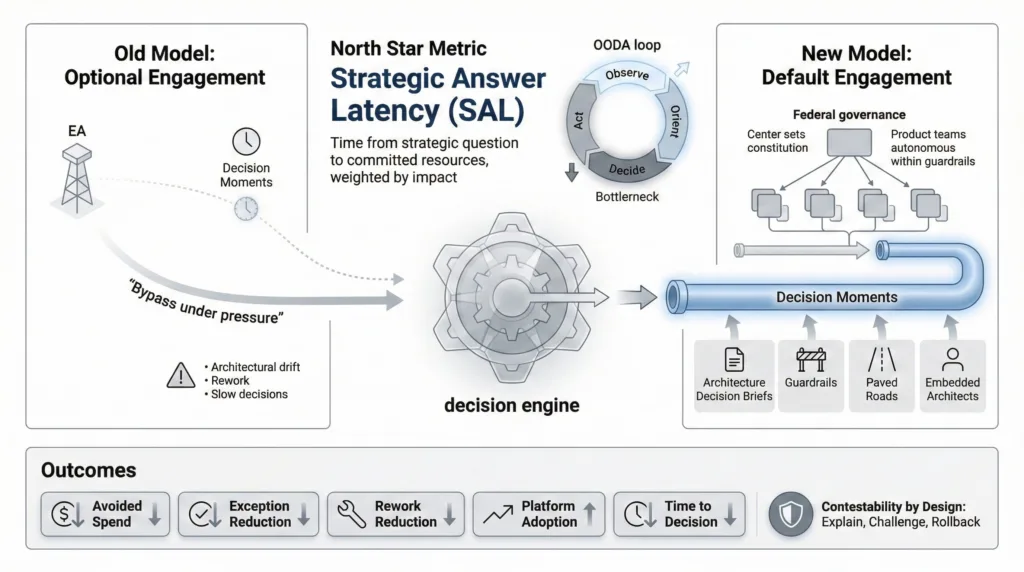
The “Ivory Tower” phenomenon is not an attitude problem but a structural operating model failure. It arises when architectural engagement is optional, informal, and decoupled from formal decision rights. This fragile model is easily bypassed under pressure, leading to isolated decisions, architectural drift, and costly rework. We are redesigning this model from the ground up.
Our new vision is to establish Enterprise Architecture as the enterprise’s “decision infrastructure.” In this future state, EA is an embedded, indispensable capability that provides the guardrails, patterns, and insights necessary to accelerate and improve the quality of strategic choices. It is a function measured not by the artifacts it produces, but by its direct contribution to organizational coherence, agility, and competitive advantage.
The goal of this strategic plan is to systematically reduce Strategic Answer Latency (SAL) by redesigning the EA operating model to ensure architectural insight is a default, integrated component of all high-impact decisions.
2.0 Situational Analysis: Diagnosing Decision Latency and Architectural Debt
Before prescribing solutions, we must rigorously diagnose the sources of latency and debt that currently constrain our strategic options. This multi-layered analysis will identify the root causes of our decision friction, informing a targeted and effective strategy.
2.1 The Anatomy of Latency and Debt
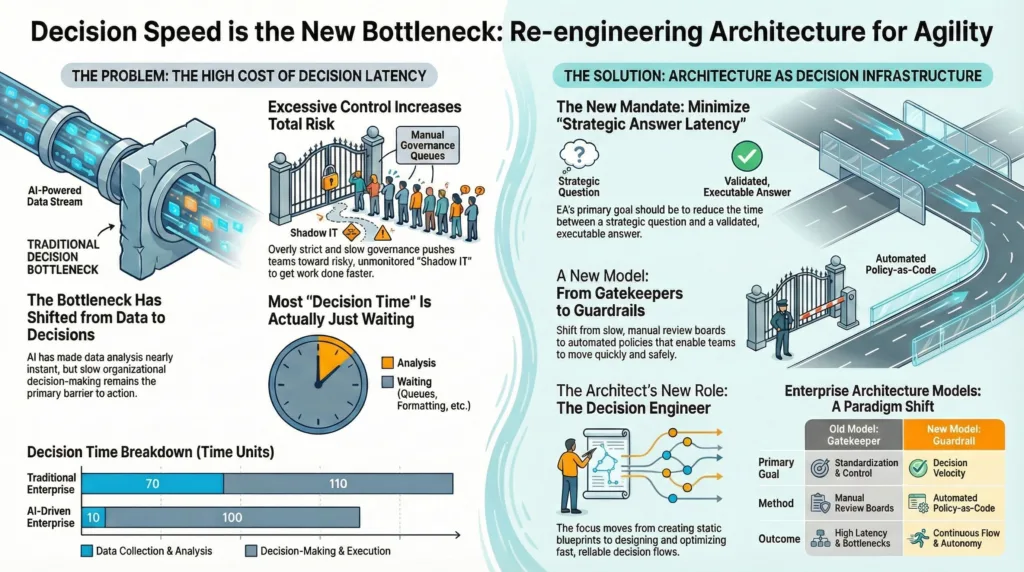
The “Strategic Answer Latency (SAL) Stack” reveals a structural mismatch in our organization’s capabilities. While modern tools have compressed the time required for data collection and analysis, the human and structural layers of decision-making have become the dominant bottlenecks.
| Latency Layer | Traditional Enterprise (Relative Time) | AI-Driven Enterprise (Relative Time) |
|---|---|---|
| Data Collection | 30 | 5 |
| Analysis & Insight | 40 | 5 |
| Decision Making | 60 | 55 |
| Execution | 50 | 45 |
Latency LayerTraditional Enterprise (Relative Time)AI-Driven Enterprise (Relative Time)Data Collection305Analysis & Insight405Decision Making6055Execution50****45
This analysis, when viewed through the lens of the OODA loop (Observe, Orient, Decide, Act), is stark. AI has dramatically compressed the “Observe” and “Orient” phases, making the organization faster at “thinking.” However, the “Decide” and “Act” phases, governed by human structures, remain stubbornly slow. This reveals that Decision Latency and Execution Latency are now the primary constraints on agility. Our organization generates insights faster than our governance architecture can process them, a dysfunction amplified by three interconnected forms of organizational debt.
-
Technical Debt This is the implied cost of rework caused by choosing an easy (limited) solution now instead of using a better approach that would take longer. While it slows execution and increases maintenance costs, its impact on strategic latency is often indirect.
-
Architectural Debt This is a far more pernicious form of debt. It stems from structural decisions, such as adopting a monolithic architecture or creating deep dependencies on a proprietary vendor API, that constrain future options. It is the invisible force that answers a strategic query with “we can’t,” because past choices have foreclosed future possibilities.
-
Organizational Debt This debt accumulates in the org chart and governance processes, manifesting as outdated decision rights, misaligned incentives, and redundant committees. It is the residue of past strategies embedded in the power structure, creating friction that directly increases decision latency.
These debts fuel a vicious Debt Amplification Cycle: Organizational Debt (e.g., unclear ownership) leads to technical shortcuts (Technical Debt), which in turn creates structural rigidity (Architectural Debt), further increasing SAL and encouraging more shortcuts. Breaking this cycle is the central task of the new EA operating model.
2.2 Architecture Health Assessment: A Two-Layered Diagnostic
We employ a two-layered diagnostic to assess our architecture’s health: a deep technical assessment via the Control Plane and a strategic inquiry to connect those findings to business impact.
The 8-Question Technical Control Plane
The 8-Question Architecture Control Plane is a diagnostic instrument for assessing the “Decision Readiness” of our technical environment. It probes the hard constraints that determine whether our architecture is an accelerator or a brake on strategic answers.
Dimension 1: Visibility & Observability
Q1: Does the organization possess an automated, near-real-time map of data lineage from ingestion to decision?
-
Rationale: Regulations like the EU AI Act and GDPR mandate a “Right to Explanation” for automated decisions. Without automated lineage, tracing why a system made a particular recommendation becomes a manual, weeks-long forensic project, causing SAL to explode and creating unacceptable regulatory risk.
-
Control Metric: Lineage Coverage Ratio, Percentage of critical data assets with fully automated, traversable lineage graphs.
-
“Silent Killer” Detected: Regulatory paralysis and a collapse of trust in AI systems.
Q2: Is “Architectural Debt” explicitly measured and reported to the Board alongside financial debt?
-
Rationale: Architectural debt is a real liability that constrains future strategy. If it is not measured and made visible to leadership, it cannot be managed. Reporting it to the board forces a “price” on complexity, creating incentives for simplification.
-
Control Metric: Architectural Debt Index (ADI), A composite score of coupling, obsolescence, and deviation from standards.
-
“Silent Killer” Detected: The “Legacy Trap,” where the majority of the budget is consumed by maintenance, leaving no capacity for strategic response.
Dimension 2: Coupling & Modularity
Q3: Can a “Two-Pizza Team” deploy a change to a core business capability without synchronous coordination with more than one other team?
-
Rationale: High coupling between teams forces synchronous coordination (meetings, committees), which is the primary source of delivery latency. If a team cannot deploy independently, its speed is capped by its slowest dependency.
-
Control Metric: Dependency Ratio, The average number of external teams required to coordinate a release.
-
“Silent Killer” Detected: Gridlock, where innovation and delivery speed are limited by the slowest component in the system.
Q4: What is the “Switching Cost” coefficient for the organization’s primary cloud and platform vendors?
-
Rationale: Vendor lock-in is a form of externally held architectural debt that creates a “strategic tax.” High switching costs remove the organization’s ability to make rational choices in response to market or regulatory changes, severely limiting strategic options and increasing SAL.
-
Control Metric: Migration Effort Estimate (MEE), Estimated engineering months to migrate top critical workloads to a competitor.
-
“Silent Killer” Detected: Strategic captivity and loss of bargaining power with key suppliers.
Dimension 3: Governance & Agency
Q5: Is there a codified mechanism for “Decision Rollback” or “Contestability” for automated systems?
-
Rationale: The EU AI Act mandates human oversight and the ability to reverse high-risk AI outputs. A “black box” system without a rollback mechanism is a latency trap; when it inevitably fails, the organization freezes because it lacks a safe way to intervene.
-
Control Metric: Mean Time to Override (MTTO), The average time required for a human operator to successfully reverse an automated decision.
-
“Silent Killer” Detected: Algorithmic brittleness and operational paralysis during AI failure modes.
Q6: Do “Shadow IT” initiatives have a sanctioned “on-ramp” to become enterprise-supported products?
-
Rationale: Shadow IT is a market response to the high SAL of central IT. Suppressing it destroys innovation. A sanctioned “sunlighting” process treats these initiatives as valuable R&D, converting risk into a source of velocity by providing a clear path to becoming a supported product.
-
Control Metric: Shadow-to-Platform Conversion Rate, The number of Shadow IT projects successfully transitioned to the formal platform per quarter.
-
“Silent Killer” Detected: The “Innovation Gap,” where the business builds its own future while IT polices the past.
Dimension 4: Strategic Alignment
Q7: Is the architecture funding model based on “Project Milestones” or “Product Value Streams”?
-
Rationale: Project-based funding creates “stop-and-go” latency, where knowledge is lost every time a team disbands. Continuous funding for long-lived product teams maintains deep context, allowing them to answer strategic questions instantly.
-
Control Metric: Product-Mode Allocation, The percentage of the IT budget allocated to long-lived product teams versus transient projects.
-
“Silent Killer” Detected: “Amnesia,” where the organization forgets how its own systems work each time a project ends.
Q8: Are “Strategic Answers” delayed by a lack of “Information Processing Capacity” (e.g., manual reporting)?
-
Rationale: If executive leadership relies on manual spreadsheets and slide decks, decision-making is floored by the speed of human data entry. High-performing decision infrastructure automates the upward flow of information, ensuring leaders react to today’s reality, not last month’s report.
-
Control Metric: Time to Insight (TTI), The duration from a data event to its reflection in the executive dashboard.
-
“Silent Killer” Detected: “Steering by the Wake”, making critical decisions based on historical data rather than current signals.
A diagnostic assessment using this framework, visualized in a spider chart like “Het 8-Punten Architectuur Controlepaneel,” provides a clear gap analysis between our current and desired states. A hypothetical assessment highlights critical weaknesses in areas like Leveranciersafhankelijkheid (Vendor Lock-in) and Integratie Shadow IT, pinpointing where our architectural debt is highest.
The Executive-Level Strategic Inquiry
While the Control Plane provides a deep technical diagnostic, the following eight questions serve as the bridge between that assessment and business impact. This inquiry is designed for the C-suite to force a conversation about how the technical landscape directly enables or constrains strategic ambition.
-
Which systems are actively constraining our strategic options today?
-
What capabilities are duplicated, and what business decisions caused that duplication?
-
Where is architectural debt materially increasing operational or regulatory risk?
-
Which investments will be hardest and most expensive to unwind?
-
Which platforms are we effectively locked into for the next three years?
-
Where is complexity growing faster than business value?
-
Which dependencies could stall execution if priorities change?
-
What would we stop funding if capital tightened tomorrow?
2.3 Transformation Readiness Assessment: The 20-Question Failure Predictor
While the 8-Question instruments measure the health of the machine (the technical architecture), this 20-question predictor measures the health of the organism (the social and behavioral system). Transformation efforts often fail due to human factors, and this tool is designed to identify those risks upfront by probing the underlying theories of organizational behavior.
Cluster A: The Agency & Incentives Trap
Agency Theory warns that when the incentives of individuals (“agents”) diverge from the goals of the organization (“principal”), agents will act in their own self-interest, creating friction and latency. These questions detect such misalignments.
-
Does every transformation initiative have a named business owner with P&L or outcome accountability?
-
If two critical leaders left tomorrow, would the transformation continue without reset?
Cluster B: Cognitive Bias & Decision Structure
Behavioral Economics teaches us that human decision-making is subject to systematic biases. A poorly designed governance structure can amplify these biases, leading to phenomena like “sunk cost fallacy,” where failing projects are kept alive, consuming resources and increasing SAL for new initiatives. These questions probe the structural safeguards against such biases.
-
Can you point to three initiatives that were stopped this year because they did not deliver value?
-
Are funding decisions made only after value is validated, not at idea or design stage?
-
Can you explain, in one sentence, what will be measurably different in 12 months if this transformation succeeds?
-
Do product teams have decision rights without waiting for steering committees?
-
Is there a single prioritisation mechanism across business, data, and technology work?
-
Are escalation paths clear enough that teams resolve blockers in days, not quarters?
-
Has any governance forum been formally shut down in the last 18 months?
Cluster C: The Shadow & The Edge (Innovation Dynamics)
Innovation often happens at the “edge” of the organization, sometimes in direct violation of central policy (“Shadow IT”). How an organization responds to these signals, by punishing them or learning from them, is a powerful predictor of its adaptive capacity. These questions assess the health of this dynamic.
-
Do you know which five data assets actually drive revenue, risk reduction, or cost efficiency?
-
Is data ownership assigned to business roles, not IT titles?
-
Can teams access production-grade data without raising tickets or manual approvals?
-
Has architecture ever stopped a solution because it increased long-term operational or risk exposure?
Cluster D: Operational Rigor & Debt
Systems Theory highlights how interconnected components and feedback loops determine overall system health. In an organization, this translates to the rigorous management of data, AI, and technical debt. These questions test whether the organization has the operational discipline required to maintain a healthy technical ecosystem.
-
Are data quality issues detected before they impact customers or reports?
-
Is there at least one AI or advanced analytics use case in production with a tracked business outcome?
-
Are business outcome metrics weighted more heavily than model performance metrics in reviews?
-
Can you explain how an AI decision is challenged, overridden, or rolled back in operations?
-
Are you actively retiring analytics models and dashboards that no longer influence decisions?
-
Do teams understand architecture principles without reading a deck?
-
Is technical debt tracked with the same rigor as financial risk, not as a backlog item?
This multi-layered diagnosis is unequivocal: our decision latency is not a technology problem but a structural one, rooted in ambiguous decision rights, unmanaged architectural debt, and a governance model that inadvertently rewards cautious inaction. The following strategy directly targets these root causes.
https://speakerdeck.com/djimit123/velocity-truth-architecture
3.0 Core Strategy: Optimizing for Strategic Answer Latency (SAL)
Based on the preceding analysis, our core strategy is to re-orient the entire Enterprise Architecture function around a single, measurable outcome: the reduction of Strategic Answer Latency. This moves EA from a cost center focused on producing artifacts to a value-creating capability focused on enabling swift, high-quality strategic action.
3.1 Establishing SAL as the North Star Metric
We formally define Strategic Answer Latency (SAL) as the duration between the articulation of a strategic question and the irrevocable commitment of resources to a course of action. SAL is a measure of organizational coherence in motion.
Crucially, SAL incorporates the validity of the answer. A rapid but flawed decision that leads to rework does not reduce SAL; it merely defers the latency to a later, more costly stage. A low SAL indicates an organization with high information processing capacity, capable of rapidly reducing uncertainty and achieving consensus.
The conceptual formula for SAL is:
Where:
3.2 Shifting from Optional to Default Engagement
Our current operating model is characterized by two modes of EA engagement:
-
Official Engagement (OE): Institutionalized participation in formal decision processes.
-
Unofficial Engagement (UE): Ad hoc, invitation-dependent involvement that is fragile under pressure and leads to the “ivory tower” effect.
The core strategic lever to shift from a high-UE to a high-OE model is Decision Moment Coupling (DMC). We define DMC as the degree to which EA is systematically and formally connected to key decision points in the organization, such as portfolio funding, vendor selection, or major design approvals.
Our central strategic hypothesis is that increasing DMC will drive a shift from UE to OE. This, in turn, will directly reduce SAL by ensuring architectural insights inform high-impact decisions from their inception, preventing costly rework and strategic misalignment.
4.0 The New Operating Model: Activating Architecture as a Decision Service
Executing our strategy requires a fundamental redesign of the EA operating model. We are redesigning the operating model to function as a decision service that enables speed and quality, moving away from a traditional gatekeeping function. This section details the new governance structure, the specific interventions we will undertake, and the principles for ensuring accountability.
4.1 The Federal Governance Model: Guardrails, Not Gates
Pure centralization creates bottlenecks, while pure decentralization leads to fragmentation and chaos. We will therefore adopt a Federal Model of governance, which balances central coherence with local autonomy.
-
The “Federal Government” (Center): The central EA function is responsible for defining the non-negotiable “constitution” for the enterprise. This includes core identity services, security standards, network backbone, and common data definitions. The Center’s role is to define the boundaries of safe autonomy.
-
The “States” (Product Teams/BUs): Product teams and business units have full autonomy to choose their tools and design their applications, provided they adhere to the Federal constitution. Their responsibility is to execute and deliver value within that constitutional framework.
This model enables a critical shift from a high-latency, “Permission-Based” system to a low-latency, “Compliance-Based” one. Instead of asking for permission, teams operate freely within automated Guardrails that enforce the constitution. The role of EA changes from approving every decision to designing the guardrails that make most decisions safe by default.
4.2 Core Transformation Interventions
The following eight interventions are the primary mechanisms for implementing the new operating model.
Anchor EA in Decision Points
-
Mechanism: Formally identify 5-8 critical decision moments (e.g., portfolio funding, vendor selection) and mandate a one-page “architecture decision brief” as a required input. This brief concisely outlines options, risks, and alignment with standards.
-
Expected Effect: This directly increases DMC, making architectural input a default part of the process. It reduces SAL by ensuring decision-makers have clear, timely information, minimizing rework and debate cycles.
Make Decision Rights Explicit
-
Mechanism: Document and publish a clear decision rights matrix (e.g., RACI) that specifies which decisions teams can make autonomously within guardrails and which require central oversight.
-
Expected Effect: This eliminates ambiguity-driven escalations and “governance ghosting.” It reduces Time to Decision (TTD) for teams by empowering them to act decisively on local matters.
Embed Consultation in Discovery
-
Mechanism: Integrate EA consultation as a mandatory, lightweight step during the initial discovery phase of any new initiative, before major commitments are made.
-
Expected Effect: This ensures architectural considerations are “shifted left,” preventing teams from pursuing paths that are technically unviable or strategically misaligned. It reduces rework and lowers SAL by avoiding late-stage surprises.
Translate Guardrails into Paved Roads
-
Mechanism: Move beyond documenting standards to providing ready-to-use templates, reference implementations, and automated components (e.g., a compliant CI/CD pipeline) that make adherence the path of least resistance.
-
Expected Effect: This directly reduces TTD for delivery teams by eliminating the time spent reinventing the wheel or navigating compliance. It accelerates delivery by providing safe, pre-approved patterns.
Couple Architecture Runway to Portfolio
-
Mechanism: Secure a dedicated funding stream within the portfolio for an “architecture runway”, the proactive development of enabling infrastructure, platforms, and standards that unblock future product development.
-
Expected Effect: This reduces future SAL by building necessary capabilities before they become urgent bottlenecks. It ensures the enterprise can respond to new strategic questions faster because the foundational components are already in place.
Adopt an Embedded Architect Model
-
Mechanism: Assign architects to work directly within portfolio or product leadership teams, acting as advisors and facilitators rather than external reviewers. Their role is to improve decision quality and reduce the need for formal escalations.
-
Expected Effect: This dramatically reduces the friction of engagement. Real-time consultation replaces formal meetings, shrinking TTD for design questions and improving trust between architects and delivery teams.
Use Board-Relevant KPIs
-
Mechanism: Shift EA’s success metrics from activity counts (e.g., diagrams produced) to outcome-oriented KPIs such as avoided spend, exception reduction, platform adoption, and rework reduction.
-
Expected Effect: This aligns EA’s incentives with executive priorities, focusing effort on activities that deliver tangible value. Making SAL and TTD formal KPIs ensures they are actively managed and improved.
Security and Compliance as Accelerator
-
Mechanism: Treat regulatory requirements (e.g., BIO, NIS2, GDPR) as non-negotiable design constraints. Integrate these requirements directly into paved roads and automated guardrails.
-
Expected Effect: This transforms compliance from a late-stage brake into an early-stage accelerator. Projects avoid last-minute roadblocks, and SAL is reduced for strategic decisions with compliance implications because the path to adherence is pre-defined.
4.3 Ensuring Accountability in the Age of AI
As automation compresses decision cycles, a new form of latency emerges: Accountability Latency. This is the delay that occurs when a human cannot explain, challenge, or reverse a decision made by an automated system.
The legal and ethical imperatives for human oversight, codified in regulations like the EU AI Act and GDPR, are not just compliance checklists; they are functional requirements for a low-latency architecture. To address this, we will enforce the principle of “Contestability by Design” for all automated decision systems.
-
Technical Contestability: The system must log its decision logic and data lineage in a human-readable format, ensuring full transparency.
-
Process Contestability: There must be a defined, low-friction workflow for a human to challenge, override, or reverse an automated decision without breaking the system.
This ensures the “human in the loop” is a safety valve, not a bottleneck, preventing algorithmic errors from causing operational paralysis.
5.0 Measuring Impact and Ensuring Value
The success of this plan will be measured by a new set of KPIs directly relevant to executive leadership. We will move beyond traditional activity-based metrics to focus on tangible outcomes that demonstrate EA’s contribution to the bottom line.
5.1 Board-Relevant Key Performance Indicators (KPIs)
Our measurement framework will focus on value, not volume. The new KPIs for the EA function will include:
-
Avoided Spend: Quantifiable savings from eliminating duplicative systems, consolidating licenses, or reusing existing platforms. This measures EA’s direct impact on efficiency.
-
Exception Reduction: A decrease in the number of requests for deviation from standards. This indicates that our architectural guardrails and “paved roads” are effective and fit for purpose.
-
Rework Reduction: A measurable decline in rework caused by poor architectural decisions. This is a direct indicator of improved decision quality and foresight.
-
Platform Adoption: The usage rate of centrally provided platforms and patterns. High adoption is a market signal that EA is providing solutions that teams find valuable.
-
Time to Decision (TTD): The measured reduction in time for key operational and design decisions. This demonstrates improved agility at the team level.
The primary, “North Star” KPI for the Enterprise Architecture function will be Strategic Answer Latency (SAL). Success will ultimately be defined by our ability to systematically reduce the time between a strategic question and a committed, well-founded course of action.
5.2 The 30-Minute Executive Verdict Protocol
To ensure the EA function remains focused on delivering and articulating measurable value, we will implement the 30-Minute EA “Verdict” Protocol. This is not a passive review; it is an active, demanding protocol designed as a recurring “moment of truth.” Its purpose is to force the conversation away from technical jargon and into the language of the C-suite: money, risk, and speed. The protocol assesses four key dimensions:
-
Decisions Influenced: What are the top strategic decisions that EA meaningfully influenced in the last period, and what was the outcome?
-
Risk Mitigated: What significant risks were avoided or mitigated due to architectural intervention?
-
Cost or Time Savings: Where did EA save the organization money or time, and can it be quantified?
-
Strategy Enablement: How has EA made it easier or faster to execute our corporate strategy?
This high-stakes accountability mechanism ensures the EA function either proves its value in terms that matter to the business or is held accountable for its absence.
6.0 Risk Management and Mitigation
Any significant transformation carries inherent risks. This section proactively identifies the most critical failure modes for this plan and outlines mitigation strategies to ensure its success.
| Blind-Spot Failure Mode | Impact on SAL/TTD | Mitigation Strategy |
|---|---|---|
| Over-Centralization Resurgence | Increases TTD and SAL as the central architecture function becomes a bottleneck again. | Institute periodic reviews of central decisions; delegate low-risk decisions to teams. Measure and cap the lead time for central reviews. |
| Unofficial Shadow Governance (“Ghosting”) | Undermines the model, causing unpredictable SAL spikes and rework when unvetted decisions fail. | Foster a culture of transparency. Mandate that all major decisions are logged in a public system. Leadership must not reward “rogue success.” |
| Leadership Churn and Evangelist Dependency | Stalls momentum and can lead to a full reset if the new leader does not support the model. SAL spikes during review periods. | Institutionalize the model in corporate governance charters and audit requirements. Build a broad coalition of support beyond a single champion. |
| Transformation Saturation and Fatigue | Spreads resources too thin, increasing TTD for all initiatives and degrading decision quality. | Use a portfolio-level EA view to sequence initiatives and apply Work-in-Progress (WIP) limits to the portfolio. |
| Shadow AI (Rogue Automation) | Creates unmanaged compliance, security, and quality risks that can cause catastrophic “stop-ship” events, creating infinite SAL. | Provide a sanctioned “fast path” for AI experimentation in a monitored sandbox. Make official AI governance processes more agile. |
| Governance Theater (Form Over Substance) | Processes are followed ceremonially, but no real value is added. SAL fails to improve despite apparent compliance. | Focus on outcomes, not just process adherence. Use the 30-Minute Verdict to force a conversation on tangible results. |
| The Cataloging Trap | EA focuses on creating documentation (e.g., application catalogs) that is not coupled to any decision forum, wasting effort. | Couple every architectural artifact to a specific decision moment. Measure the usage and impact of documentation on actual decisions. |
| Technical Debt Overhang | Accumulated technical debt gradually slows delivery, increasing TTD and eventually constraining strategic pivots, increasing SAL. | Implement a rigorous debt management process, tracking debt like financial risk and allocating dedicated capacity to pay it down. |
| Data Access vs. Usability (Trust Gap) | Teams have access to data but cannot use it due to poor quality or documentation, delaying analysis and increasing SAL. | Pair open data access with robust metadata catalogs, data lineage, and data stewardship to build trust and usability. |
| Platform Lock-In Creep | Gradual adoption of proprietary features leads to irreversible lock-in, eliminating future strategic options and increasing SAL. | Maintain a lock-in register that tracks unwind costs. Conduct an annual review of vendor dependencies and plan for exit strategies. |
| Expertise Concentration | Critical knowledge resides in a few key individuals, creating bottlenecks and single points of failure. SAL spikes when they are unavailable. | Institutionalize knowledge through documented decision records, patterns, and cross-training. Plan for succession in critical knowledge areas. |
| Decision Rationale Loss | The “why” behind past architectural decisions is lost, making it difficult to safely evolve systems. | Mandate the use of Architecture Decision Records (ADRs) that capture not just the decision but the context and rationale behind it. |
Blind-Spot Failure ModeImpact on SAL/TTDMitigation StrategyOver-Centralization ResurgenceIncreases TTD and SAL as the central architecture function becomes a bottleneck again.Institute periodic reviews of central decisions; delegate low-risk decisions to teams. Measure and cap the lead time for central reviews.**Unofficial Shadow Governance (“Ghosting”)**Undermines the model, causing unpredictable SAL spikes and rework when unvetted decisions fail.Foster a culture of transparency. Mandate that all major decisions are logged in a public system. Leadership must not reward “rogue success.”Leadership Churn and Evangelist DependencyStalls momentum and can lead to a full reset if the new leader does not support the model. SAL spikes during review periods.Institutionalize the model in corporate governance charters and audit requirements. Build a broad coalition of support beyond a single champion.Transformation Saturation and FatigueSpreads resources too thin, increasing TTD for all initiatives and degrading decision quality.Use a portfolio-level EA view to sequence initiatives and apply Work-in-Progress (WIP) limits to the portfolio.**Shadow AI (Rogue Automation)**Creates unmanaged compliance, security, and quality risks that can cause catastrophic “stop-ship” events, creating infinite SAL.Provide a sanctioned “fast path” for AI experimentation in a monitored sandbox. Make official AI governance processes more agile.**Governance Theater (Form Over Substance)**Processes are followed ceremonially, but no real value is added. SAL fails to improve despite apparent compliance.Focus on outcomes, not just process adherence. Use the 30-Minute Verdict to force a conversation on tangible results.The Cataloging TrapEA focuses on creating documentation (e.g., application catalogs) that is not coupled to any decision forum, wasting effort.Couple every architectural artifact to a specific decision moment. Measure the usage and impact of documentation on actual decisions.Technical Debt OverhangAccumulated technical debt gradually slows delivery, increasing TTD and eventually constraining strategic pivots, increasing SAL.Implement a rigorous debt management process, tracking debt like financial risk and allocating dedicated capacity to pay it down.**Data Access vs. Usability (Trust Gap)**Teams have access to data but cannot use it due to poor quality or documentation, delaying analysis and increasing SAL.Pair open data access with robust metadata catalogs, data lineage, and data stewardship to build trust and usability.Platform Lock-In CreepGradual adoption of proprietary features leads to irreversible lock-in, eliminating future strategic options and increasing SAL.Maintain a lock-in register that tracks unwind costs. Conduct an annual review of vendor dependencies and plan for exit strategies.Expertise ConcentrationCritical knowledge resides in a few key individuals, creating bottlenecks and single points of failure. SAL spikes when they are unavailable.Institutionalize knowledge through documented decision records, patterns, and cross-training. Plan for succession in critical knowledge areas.Decision Rationale LossThe “why” behind past architectural decisions is lost, making it difficult to safely evolve systems.Mandate the use of Architecture Decision Records (ADRs) that capture not just the decision but the context and rationale behind it.
Presentatie: Velocity Truth Architecture
Velocity Truth Architecture
Transforming enterprise architecture into a decision infrastructure
Dit artikel is exclusief beschikbaar voor nieuwsbrief-abonnees. Schrijf je in voor toegang tot 880+ artikelen.
Geen spam. Uitschrijven op elk moment.
AI & Security Intelligence
Wekelijkse nieuwsbrief met AI updates, security alerts en compliance inzichten, direct in uw inbox.
Security & AI Operating Model
Advisory met executiekracht
Van BIO2 en NIS2 tot EU AI Act, embedded in uw operating model, niet als extern project. Maandelijks opzegbaar, met assessments als bewijsvoering.