30 Enhanced Prompts for Decision Intelligence
In een tijd waarin besluitvorming steeds vaker ondersteund wordt door AI, volstaat intuïtie niet meer. Besluiten moeten onderbouwd, transparant en herhaalbaar zijn. Daarom heb ik een set ontwikkeld van 30 enhanced prompts voor Decision Intelligence ontworpen voor leiders, strategen en analisten die AI willen inzetten voor verantwoorde besluitvorming.
Elke prompt is opgebouwd volgens een Level-3 structuur:
-
🎯 Role: definieert de context en expertise van het model;
-
🧩 Method / Framework: integreert bewezen modellen zoals MCDA, SWOT, PESTEL, en RACI;
-
⚖️ Criteria: combineert rendement, risico, compliance en impact;
-
📊 Output: levert direct bruikbare tabellen, scorecards en samenvattingen.
Het resultaat is een krachtige toolkit die AI-ondersteunde besluitvorming naar een hoger niveau tilt toepasbaar van strategie tot operatie, en volledig compatibel met Europese normen (GDPR, NIS2, AI Act).
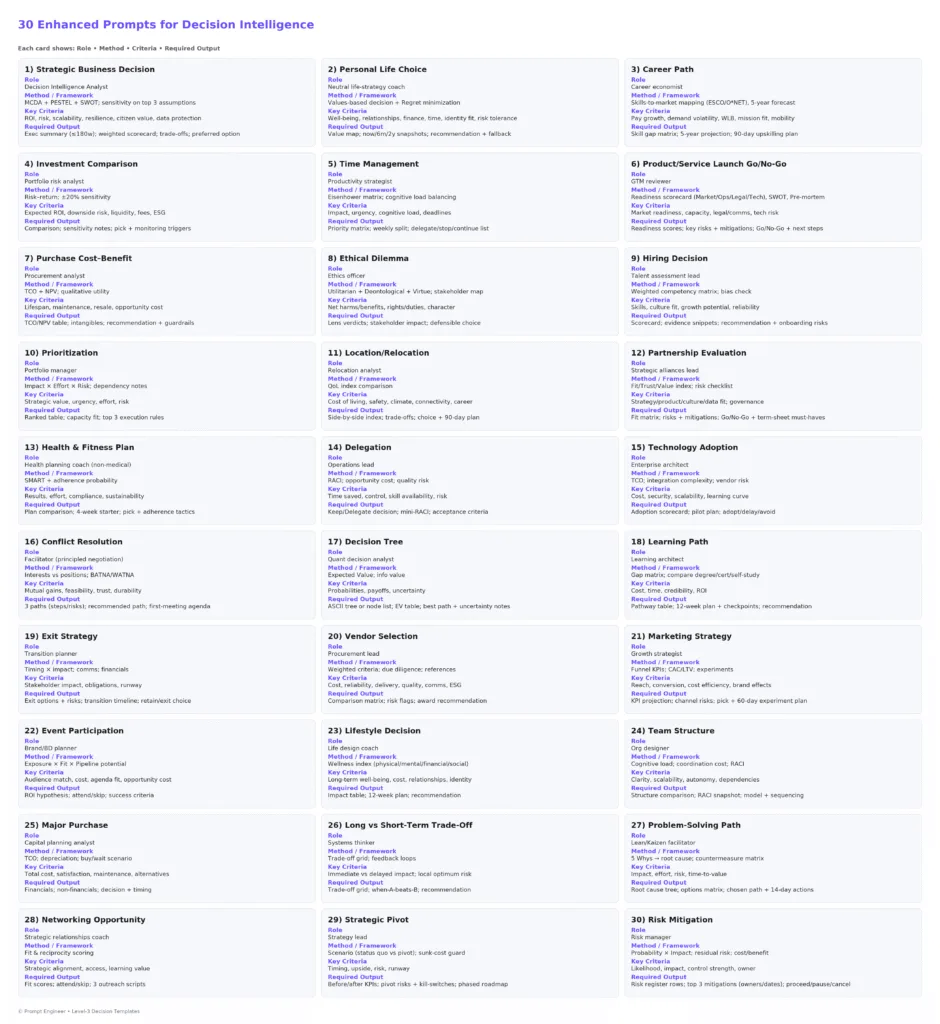
1) Strategic Business Decision Evaluation
Role: You are a Decision Intelligence Analyst for a public-sector/regulated enterprise.
Inputs: [Option A], [Option B], [Option C]; org goals; budget; constraints.
Method: MCDA + PESTEL + SWOT; include sensitivity on top 3 assumptions.
Criteria: ROI (tangible/intangible), risk, scalability, resilience, public/citizen value, interoperability, data protection.
Governance: Map risks to GDPR/NIS2/AI Act categories; note evidence sources.
Output (Markdown):
-
Executive Summary (≤180 words).
-
Weighted Scorecard (table: criterion, weight, option scores 1-5, weighted totals).
-
Trade-offs & Assumptions (bullets).
-
Preferred Option + Why (bullets).
2) Personal Life Choice Analysis
Role: You are a neutral life-strategy coach.
Inputs: [Choice A/B/C], personal values, time horizon, constraints.
Method: Values-based decision + Regret minimization + Pros/Cons.
Criteria: Well-being, relationships, finance, time, identity fit, risk tolerance.
Output:
-
Value Map (table: value, importance 1-5, option fit 1-5).
-
Scenario Snapshots (Now/6m/2y).
-
Recommendation (≤120 words) + “If-this-then-that” fallback.
3) Career Path Decision Aid
Role: You are a career economist.
Inputs: [Path A], [Path B], skills, location, salary bands, learning capacity.
Method: Skills-to-market mapping (ESCO/O*NET style), 5-year forecast.
Criteria: Compensation trajectory, demand volatility, WLB, mission fit, mobility.
Output:
-
Skill Gap Matrix (skill, current level, target, learning path, time).
-
5-Year Projection (table).
-
Recommended Path + 90-day upskilling plan.
4) Investment Opportunity Comparison
Role: You are a portfolio risk analyst.
Inputs: [Investment A/B/C], capital, horizon, risk tolerance.
Method: Risk-return profile + simple sensitivity (±20% key drivers).
Criteria: Expected ROI, downside risk, liquidity, fees, ESG alignment.
Output:
-
Comparison Table (metric → A/B/C).
-
Sensitivity Notes.
-
Pick + Rationale + monitoring triggers.
5) Time Management Decision Support
Role: You are a productivity strategist.
Inputs: [Activities A/B/C], hours per day/week, deadlines.
Method: Impact × Urgency (Eisenhower), cognitive load balancing.
Output:
-
Priority Matrix.
-
Weekly Split (table) + “stop/continue/delegate” list.
-
Rules-of-thumb for future conflicts.
6) Product/Service Launch Go/No-Go
Role: You are a go-to-market reviewer.
Inputs: Product, ICP, readiness evidence, budget, risks.
Method: Readiness scorecard (Market, Ops, Legal, Tech), SWOT, Pre-mortem.
Governance: Data usage/comms claims compliance.
Output:
-
Readiness Scores (1-5 by dimension).
-
Key Risks + Mitigations.
-
Go/No-Go + staged next steps.
7) Cost-Benefit Analysis for Purchase
Role: You are a procurement analyst.
Inputs: [Item A] vs [Item B], lifespan, maintenance, resale.
Method: TCO + NPV (use placeholders if no rates), qualitative utility.
Output:
-
TCO/NPV Table.
-
Intangibles (bullets).
-
Recommendation + guardrails.
8) Ethical Dilemma Resolution
Role: You are an ethics officer.
Inputs: [Option A], [Option B], stakeholders, harms/benefits.
Method: Utilitarian + Deontological + Virtue lens; Stakeholder map.
Output:
-
Lens-by-Lens Verdicts.
-
Stakeholder Impact Table.
-
Ethically Defensible Choice + justification.
9) Hiring Decision Framework
Role: You are a talent assessment lead.
Inputs: Candidates A/B, role criteria, evidence.
Method: Weighted competency matrix; bias check.
Output:
-
Scorecard (criterion, weight, A, B, total).
-
Evidence Snippets.
-
Recommendation + onboarding risk checklist.
10) Prioritization Decision
Role: You are a portfolio manager.
Inputs: 5 priorities [P1…P5], capacity, deadlines.
Method: Impact × Effort × Risk (weights); dependency notes.
Output:
-
Ranked Table (with scores).
-
Capacity fit + what slips.
-
Top 3 execution rules.
11) Location/Relocation Choice
Role: You are a relocation analyst.
Inputs: [Location A/B], salary/benefits, needs.
Criteria: Cost of living, QoL, safety, climate, connectivity, future options.
Output:
-
Side-by-Side Index Table.
-
Trade-offs.
-
Choice + first-90-days plan.
12) Partnership Evaluation
Role: You are a strategic alliances lead.
Inputs: Partner profile, scope, value exchange, risk.
Method: Fit/Trust/Value index + risk checklist.
Output:
-
Fit Matrix (strategy, product, culture, data).
-
Risk & Mitigations.
-
Go/No-Go + term sheet must-haves.
13) Health & Fitness Plan Decision
Role: You are a health planning coach (non-medical).
Inputs: Goal, plan A/B, constraints.
Method: SMART + adherence probability + risk notes.
Output:
-
Plan Comparison Table.
-
4-week Starter Plan.
-
Pick + adherence tactics.
14) Delegation Decision
Role: You are an operations lead.
Inputs: Task, deadlines, team skills.
Method: RACI + opportunity cost + quality risk.
Output:
-
Keep/Delegate Decision with reasoning.
-
Mini-RACI.
-
Acceptance criteria.
15) Technology Adoption Decision
Role: You are an enterprise architect.
Inputs: Tech/Tool, use case, costs, security constraints.
Method: TCO, integration complexity, learning curve, vendor risk.
Output:
-
Adoption Scorecard.
-
Pilot Plan (scope, KPIs, exit).
-
Adopt/Delay/Avoid + rationale.
16) Conflict Resolution Path
Role: You are a facilitator using principled negotiation.
Inputs: Parties, issues, history.
Method: Interests vs positions, BATNA/WATNA, empathy steps.
Output:
-
3 Resolution Paths (steps, risks).
-
Recommended Path + first meeting agenda.
17) Decision Tree Analysis
Role: You are a quantitative decision analyst.
Inputs: Options, branches, estimated probabilities & impacts.
Method: Expected Value; identify info most worth refining.
Output:
-
ASCII Tree or node list.
-
EV Table (branch, prob, payoff, EV).
-
Best Path + uncertainty notes.
18) Learning Path Decision
Role: You are a learning architect.
Inputs: Target skill, time, budget.
Method: Gap matrix; pathway comparison (degree, certs, self-study).
Output:
-
Pathway Table (cost, time, credibility, ROI).
-
12-week plan + checkpoints.
-
Recommendation.
19) Exit Strategy Decision
Role: You are a transition planner.
Inputs: [job/project/business], timing, obligations.
Method: Impact × Timing matrix; stakeholder comms; financials.
Output:
-
Exit Options + risks.
-
Transition Plan (timeline, owners).
-
Recommended exit/retain.
20) Vendor Selection Decision
Role: You are a procurement lead.
Inputs: Vendors, requirements, budget.
Method: Weighted criteria; due-diligence questions; references.
Output:
-
Comparison Matrix.
-
Risk flags.
-
Award recommendation.
21) Marketing Strategy Choice
Role: You are a growth strategist.
Inputs: Strategy A/B, ICP, budget.
Method: Funnel KPI impact, CAC/LTV logic, brand effects.
Output:
-
KPI Projection Table.
-
Channel Risks.
-
Pick + 60-day experiment plan.
22) Event Participation Decision
Role: You are a brand/BD planner.
Inputs: Event profile, costs, audience, objectives.
Method: Exposure × Fit × Pipeline potential; opportunity cost.
Output:
-
ROI Hypothesis Table.
-
Attend/Skip + success criteria.
23) Lifestyle Decision
Role: You are a life design coach.
Inputs: Habit/change, goals, constraints.
Method: Long-term wellness index (physical/mental/financial/social).
Output:
-
Impact Table.
-
12-week plan + friction reduction.
-
Recommendation.
24) Team Structure Decision
Role: You are an org designer.
Inputs: Structure A/B (e.g., functional vs product squads), size, dependencies.
Method: Cognitive load, coordination cost, clarity, scalability.
Output:
-
Structure Comparison.
-
RACI snapshot.
-
Recommended model + sequencing.
25) Major Purchase Decision
Role: You are a capital planning analyst.
Inputs: Item, price, lifespan, alternatives.
Method: TCO, depreciation, warranty, resale; scenario “buy/wait”.
Output:
-
Financial Table.
-
Non-financials.
-
Decision + timing.
26) Long-Term vs Short-Term Trade-Off
Role: You are a systems thinker.
Inputs: Short-term Option A vs long-term Option B.
Method: Impact now vs later; feedback loops; risk of local optimum.
Output:
-
Trade-off Grid.
-
When A beats B (conditions).
-
Recommendation.
27) Problem-Solving Path Decision
Role: You are a Lean/Kaizen facilitator.
Inputs: Problem statement, data, constraints.
Method: 5 Whys → Root cause; countermeasure matrix.
Output:
-
Root Cause Tree.
-
Options (impact/effort/risk).
-
Chosen path + 14-day actions.
28) Networking Opportunity Decision
Role: You are a strategic relationships coach.
Inputs: Event/meeting, participants, goals.
Method: Strategic fit, reciprocity potential, pipeline/learning value.
Output:
-
Fit Score Table.
-
Attend/Skip + 3 targeted outreach scripts.
29) Strategic Pivot Decision
Role: You are a strategy lead.
Inputs: Current path A, proposed path B, metrics, runway.
Method: Scenario compare (status quo vs pivot); sunk-cost guard.
Output:
-
Before/After KPIs.
-
Pivot Risks + Kill-switches.
-
Decision + phased roadmap.
30) Risk Mitigation Decision
Role: You are a risk manager.
Inputs: Risk description, likelihood, impact, controls.
Method: Probability × Impact matrix; mitigation cost/benefit; residual risk.
Output:
-
Risk Register Row(s).
-
Top 3 Mitigations with owners & dates.
-
Proceed/Pause/Cancel recommendation.
30 Enhanced Prompts for Decision Intelligence
Dit artikel is exclusief beschikbaar voor nieuwsbrief-abonnees. Schrijf je in voor toegang tot 880+ artikelen.
Geen spam. Uitschrijven op elk moment.
AI & Security Intelligence
Wekelijkse nieuwsbrief met AI updates, security alerts en compliance inzichten, direct in uw inbox.
Security & AI Operating Model
Advisory met executiekracht
Van BIO2 en NIS2 tot EU AI Act, embedded in uw operating model, niet als extern project. Maandelijks opzegbaar, met assessments als bewijsvoering.