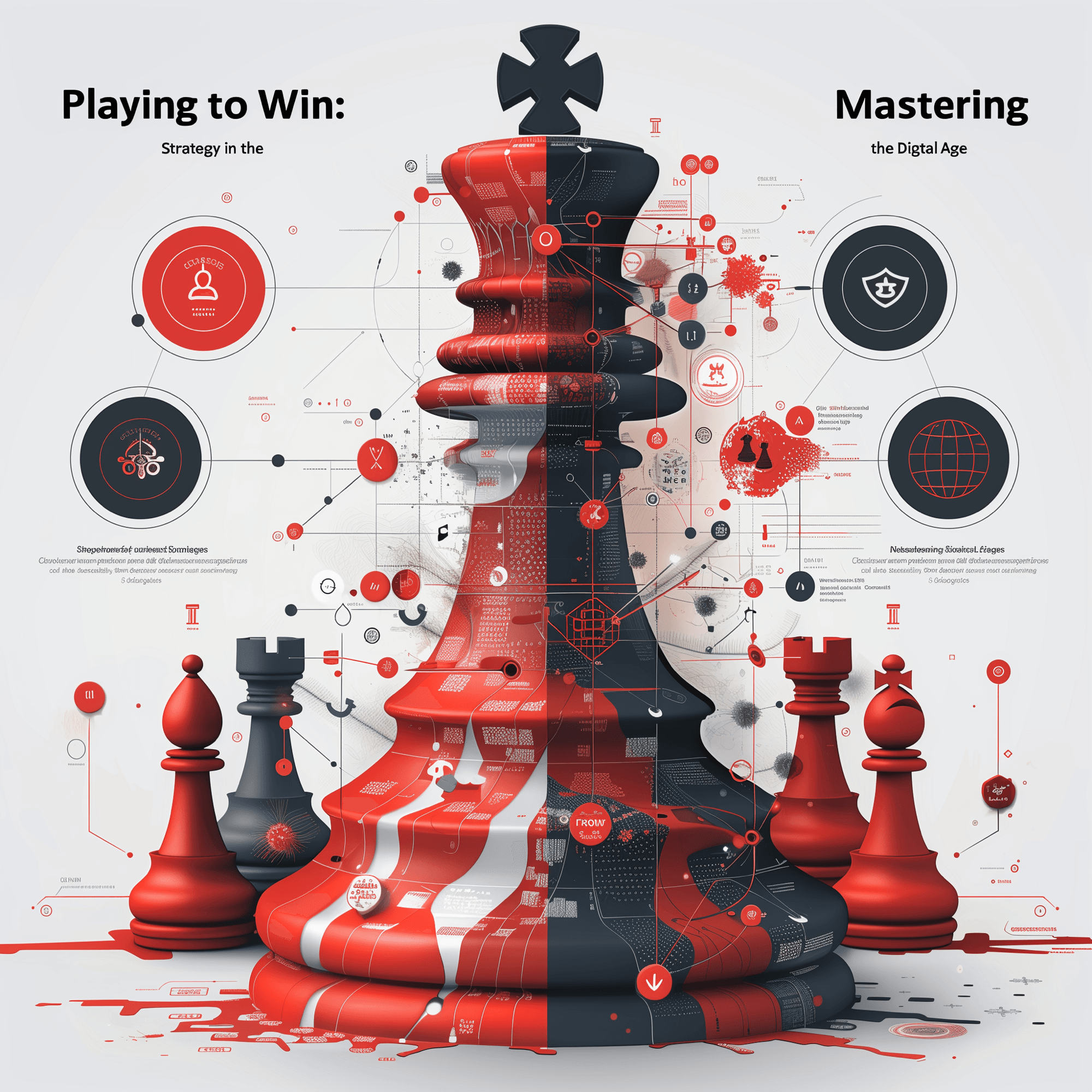
Playing to Win: Mastering Strategy in the Digital Age
In today’s rapidly evolving business landscape, developing and executing an effective strategy is more crucial, and challenging, than ever. As software pioneer Marc Andreessen famously declared, “Software is eating the world,” underscoring the need for digitally-savvy strategic thinking. This article will explore the key elements of successful strategy, common pitfalls to avoid, and practical frameworks to guide your strategic planning process.
What is Strategy?
Strategy is about:
-
Making specific choices to win in the marketplace
-
Deliberately choosing a different set of activities to deliver unique value
-
An integrated set of choices that uniquely positions the firm in its industry to create sustainable advantage and superior value relative to competition
-
Increasing our odds of success, not guaranteeing it
-
Combining rigor and creativity
The Strategic Choice Cascade
At its core, strategy is a coordinated and integrated set of five choices:
- What is Our Winning Aspiration?
- Define the purpose of your enterprise and your guiding aspirations.
- Where Will We Play?
- Determine your competitive arena: which geographies, product categories, consumer segments, channels, and vertical stages of production you’ll focus on.
- How Will We Win?
- Identify your unique value proposition and competitive advantage.
- What Capabilities Must Be in Place?
- Outline the reinforcing activities and specific configurations needed to win in your chosen arena.
- What Management Systems Are Required?
- Establish the systems, structures, and measures needed to support your choices.
This cascade ensures that your strategy is coherent and all elements are aligned towards your ultimate goals.
The Strategic Logic Flow
To inform your strategic choices, direct your thinking to these key analyses:
- Industry Analysis
-
Examine the structure of your industry and the attractiveness of its segments.
-
Ask: How structurally attractive are the segments?
- Customer Value Analysis
-
Understand what your channel and end customers truly value.
-
Ask: What constitutes value for the customers?
- Analysis of Relative Position
-
Assess how your capabilities compare to competitors, and how they could improve.
-
Ask: How do our capabilities stack up against competitors?
- Competitor Analysis
-
Predict how your competition will react to your chosen course of action.
-
Ask: How will competitors react to our actions?
This logical flow ensures that your strategy is grounded in a thorough understanding of your competitive landscape.
Reverse Engineering: Testing Your Strategy
To rigorously evaluate your strategic options and build consensus, use the reverse engineering approach. This method focuses on analyzing the critical factors by asking:
“What would have to be true for every member of the group to feel intellectually and emotionally committed to the strategic option under consideration?”
The process involves:
-
Framing the choice
-
Generating strategic possibilities
-
Specifying conditions
-
Identifying barriers to choice
-
Designing valid tests
-
Conducting tests
-
Making the choice
This approach helps you thoroughly evaluate your strategic options and build consensus around your chosen direction.
The 7 Red Flags of Strategy: Pitfalls to Avoid
While developing your strategy, be aware of these common pitfalls:
-
The “It’s Not Really a Strategy” Red FlagSymptoms: Long list of incoherent goals and initiatives; actions don’t lead to clear outcomes; lack of focus and prioritization. Example: In the early 2000s, General Motors had a vast portfolio of brands with overlapping markets and unclear differentiation. This lack of focus led to inefficiencies and market confusion until their 2009 restructuring. How to avoid it: Focus on key challenges and opportunities; clearly articulate expected outcomes; limit your strategic focus to actionable items.
-
The “Business School Strategy” Red FlagSymptoms: Analysis paralysis; excessive use of PowerPoint decks and frameworks; lack of creativity and innovation in strategic thinking. Example: Netflix’s shift from DVD rentals to streaming wasn’t born from excessive analysis, but from a creative vision of the future of entertainment consumption. How to avoid it: Balance analysis with creativity and intuition; embrace Blue Ocean Strategy concepts to create uncontested market space.
-
The “Everybody’s Darling” Red FlagSymptoms: Diluted strategy trying to please everyone; lack of tough decisions; overemphasis on consensus at the expense of clarity. Example: Microsoft’s Windows Vista operating system, released in 2007, tried to cater to too many different user groups and hardware configurations, resulting in an OS that satisfied very few. How to avoid it: Foster an open atmosphere for differing opinions; be willing to make and communicate difficult choices; implement a Balanced Scorecard approach to ensure alignment.
-
The “Ivory Tower” Red FlagSymptoms: Strategies disconnected from day-to-day realities; overuse of buzzwords and lofty goals; lack of practical applicability. Example: Google Glass, launched in 2013, was developed primarily by tech enthusiasts without sufficient consideration for real-world social norms and privacy concerns, leading to significant backlash. How to avoid it: Involve a diverse cross-section of your organization in strategy development; regularly test your assumptions against real-world conditions.
-
The “Microwave Strategy” Red FlagSymptoms: Copying others’ strategies without consideration for unique context; prioritizing “best practices” over company-specific needs; lack of competitive differentiation. Example: Kodak’s failure to adapt to digital photography, despite inventing the first digital camera, showcases the danger of clinging to old strategies in a rapidly changing digital landscape. How to avoid it: Design a strategy uniquely tailored to your organization’s strengths and market position; adapt ideas to fit your unique circumstances.
-
The “Circus is in Town” Red FlagSymptoms: Launching strategy with fanfare but no follow-through; lack of consistent execution; neglecting solid implementation plans. Example: Yahoo!’s 2013 acquisition of Tumblr for $1.1 billion, followed by poor execution, led to a significant write-down of Tumblr’s value and Yahoo!’s eventual sale. How to avoid it: Establish regular review processes; create support structures and accountability mechanisms; consider adopting agile methodologies for strategy implementation.
-
The “Wag the Dog” Red FlagSymptoms: Organizational politics overshadowing strategic priorities; multiple interpretations of strategy with no alignment; lack of commitment to strategic objectives. Example: Wells Fargo’s account fraud scandal, revealed in 2016, stemmed from misaligned incentives that led employees to open millions of fraudulent accounts, severely damaging the bank’s reputation. How to avoid it: Ensure leadership speaks with one voice on strategic priorities; align incentives and performance metrics with strategic objectives.
Conclusion
Effective strategy isn’t just about avoiding pitfalls; it’s about making deliberate, integrated choices that position your organization for success. By utilizing tools like the Strategic Choice Cascade, Strategic Logic Flow, and Reverse Engineering, while being mindful of common red flags, you can develop robust strategies that stand the test of time and drive your organization forward in the digital age.
Remember, as Peter Drucker wisely noted, “Culture eats strategy for breakfast.” Ensure your organizational culture aligns with and supports your strategic objectives. Stay focused on your winning aspiration, remain adaptable in your approach, and continually engage your entire organization in the process. By doing so, you’ll maximize your chances of playing to win in today’s complex and rapidly evolving business landscape.
Strategy Health Check:Ask yourself these questions to assess your strategy:
-
Can every employee articulate our strategy in a sentence?
-
Does our strategy clearly differentiate us from competitors?
-
Are we consistently executing on our strategic priorities?
-
Does our strategy account for major digital trends in our industry?
-
Do we have mechanisms in place to adapt our strategy as conditions change?
By integrating classical strategic frameworks with modern digital considerations and emphasizing the importance of execution and adaptability, organizations can navigate the complex landscape of strategy formulation and execution more effectively. The key is to remain vigilant for red flags while fostering a culture of continuous learning, stakeholder engagement, and agile response to change.
Playing to Win: Mastering Strategy in the Digital Age
Dit artikel is exclusief beschikbaar voor nieuwsbrief-abonnees. Schrijf je in voor toegang tot 880+ artikelen.
Geen spam. Uitschrijven op elk moment.
AI & Security Intelligence
Wekelijkse nieuwsbrief met AI updates, security alerts en compliance inzichten, direct in uw inbox.
Security & AI Operating Model
Advisory met executiekracht
Van BIO2 en NIS2 tot EU AI Act, embedded in uw operating model, niet als extern project. Maandelijks opzegbaar, met assessments als bewijsvoering.