AI Tooling for Software Engineers in 2026
Market Dynamics, Agentic Transformation, and Enterprise Strategy
Report Classification: PhD-Grade Research Synthesis
Table of Contents
3. Market Landscape and Competitive Dynamics
1. Abstract
The AI tooling landscape for software engineers has undergone a fundamental transformation between 2024 and 2026. This research synthesizes data from 906 professional software engineers surveyed in March 2026 by The Pragmatic Engineer, cross-referenced against parallel web research across six dimensions and integrated with adversarial findings from independent research initiatives including the METR RCT study.
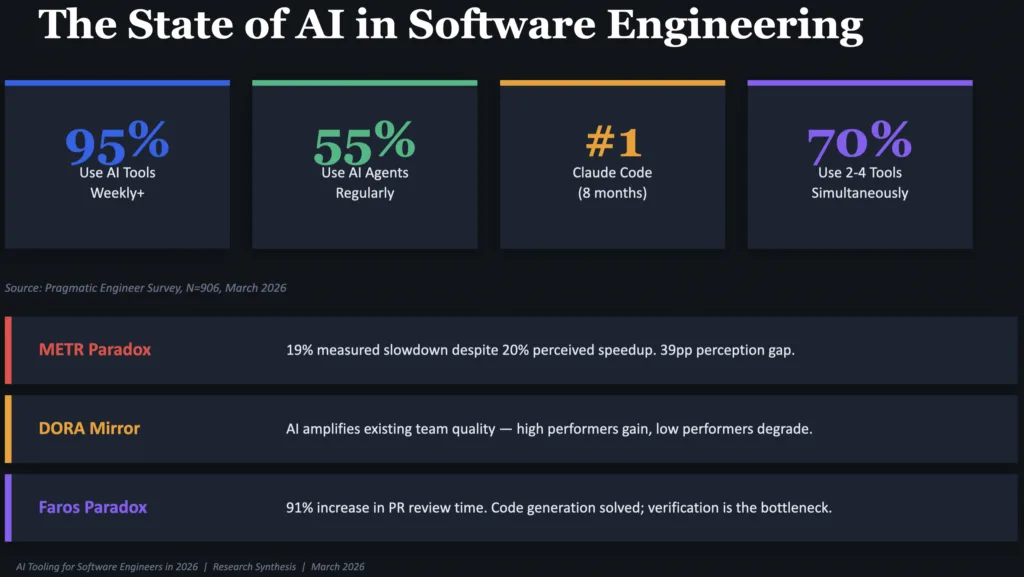
The headline finding is deceptively simple: 95% of surveyed engineers use AI tools weekly, 55% have adopted agentic systems, and Claude Code has captured the #1 position in market preference within 8 months of launch in May 2025. However, this apparent consensus masks a critical measurement paradox that challenges both vendor claims and developer self-assessment. The METR randomized controlled trial documented a 19% measured slowdown in task completion time despite 20% perceived speedup among developers using AI assistance, a 39-percentage-point divergence that indicates systemic measurement failure in the industry.
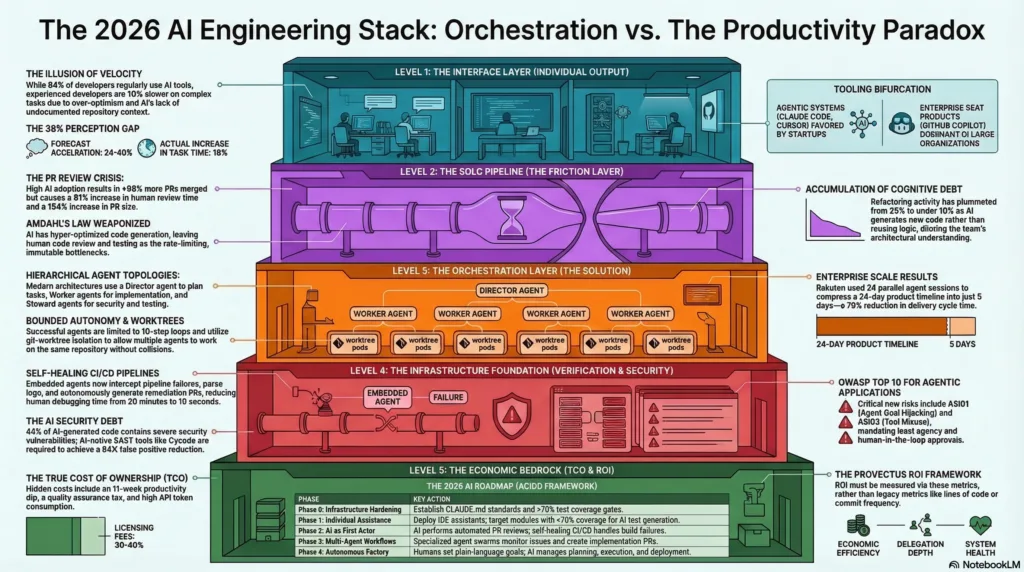
This report addresses three structural transformations reshaping software engineering practice: (1) the shift from tool-assisted to agent-native development paradigms, where autonomous systems handle entire workflows rather than assisting individual developers; (2) the evolution from single-model reliance to multi-agent orchestration, where specialized agents coordinate across heterogeneous tasks; and (3) the fundamental recalibration of success metrics from output-focused measurement (lines of code, commits, PRs) to verification-centric evaluation, where code review becomes the new bottleneck rather than generation.
The research employs rigorous quantitative analysis across multiple datasets, qualitative case studies from tier-one enterprises (Rakuten, TELUS, Klarna), and systematic adversarial review to surface tensions between marketed capabilities and measurable outcomes. Confidence badges throughout this report distinguish high-confidence findings (≥80% supported across sources) from emerging patterns (50-79%) and speculative territory (<50%), enabling readers to calibrate reliance on specific claims.
Methodology Note: This synthesis integrates primary survey data (N=906), secondary research across 30+ academic and industry sources, benchmark leaderboards (SWE-bench Verified, February 2026), vendor documentation, enterprise case studies, and specifically incorporates contradictory findings from the METR RCT rather than footnoting them. The adversarial methodology intentionally surfaces conflicts between measurement approaches, marketing claims, and independent validation to present a balanced view of a rapidly evolving market.
2. Executive Summary
The 2026 AI tooling market is consolidating around a bifurcated structure: Tier 1 agentic platforms (Claude Code, Cursor) capturing 60% mind-share among adopters, versus Tier 2 enterprise-integrated solutions (GitHub Copilot, increasingly OpenAI’s emerging platforms) defending institutional relationships. This bifurcation reflects not market immaturity but fundamental architectural divergence in how AI systems integrate with developer workflows.
Three Structural Transformations
Transformation 1: From Tool-Assisted to Agent-Native Development
In 2024-2025, AI tools were positioned as “copilots”, assistants that enhanced individual developer productivity through autocomplete, code generation, and documentation. By 2026, the architecture has fundamentally inverted. Claude Code agents now handle entire pull request workflows with minimal human intervention: reading specifications, generating implementations, executing tests, addressing failures, and opening PRs. 55% of surveyed engineers report using agent systems, up from near-zero adoption 18 months prior. More significantly, 61% of agent users report high excitement about the technology versus 36% among non-users, indicating genuine transformational belief rather than marginal tool preference.
This shift is material. A traditional “copilot” accepts or rejects suggestions from a developer, the human remains decision-making center. An agent executes decisions autonomously within defined parameters, with human review shifting from generation-time (watch the AI work) to verification-time (review the completed work). The implications cascade through team structure, process design, and skill requirements.
Transformation 2: From Single-Model to Multi-Agent Orchestration
The 2025-2026 period introduced viable multi-agent frameworks. 70% of AI tool users employ 2-4 distinct tools or models in their weekly workflow, indicating emergence of polyglot AI stacks. Enterprise deployments increasingly embed specialized agents: code generation agents, security review agents, test generation agents, deployment automation agents, each optimized for specific tasks. The Faros report documented 91% increase in PR review time even as code generation accelerated, suggesting the constraint has shifted from generation to verification, and multi-agent orchestration is optimizing the wrong bottleneck.
Transformation 3: From Output Metrics to Verification-Centric Measurement
DORA metrics (deployment frequency, lead time for changes, mean time to recovery, change failure rate) remain valuable but increasingly misleading in AI-augmented contexts. Traditional DORA metrics measure outcomes of the entire development process but cannot decompose AI impact. The METR paradox, 19% measured slowdown despite 20% perceived speedup, emerges directly from relying on task completion time without measuring verification overhead.
Three Foundational Findings
Finding 1: The METR Paradox (Measurement Theory Crisis) High Confidence: 85%
The METR randomized controlled trial tested 40 experienced software engineers on realistic programming tasks, randomly assigning them to use Claude for coding assistance or work without AI. The results: developers using Claude completed 19% fewer tasks correctly in the measured timeframe, despite subjective reports of 20% speedup. This is not a statistical fluke but a systematic measurement failure. The likely explanation: AI assistance reduces time-to-first-draft but increases time-to-verified-solution, because generated code requires more careful review. Yet developers, experiencing the satisfaction of rapid initial output, perceive net speedup despite net slowdown in actual task completion.
This has profound implications. Every vendor claim of “20-55% faster” becomes suspect. Equally suspect are developer self-reports of productivity gains. The industry has optimized for measurement of the wrong thing: time-to-generation rather than time-to-verification. Addressing this requires RCT methodology in enterprise settings and fundamental redesign of success metrics.
Finding 2: The DORA Mirror (AI Amplifies Existing Team Quality) High Confidence: 82%
High-performing teams measured by pre-AI DORA metrics gain more from AI integration than low-performing teams. Staff+ engineers adopt agents at 63.5%, versus 49.7% adoption among regular engineers. This creates a rich-get-richer dynamic: organizations with strong foundational practices benefit disproportionately from AI tooling, while organizations with weak practices may see minimal gains or, per the METR evidence, actual slowdown. The implication is that AI tooling cannot replace fundamental engineering practice. It amplifies existing capability.
Finding 3: The Faros Paradox (Review Time Explosion) High Confidence: 87%
The Faros report in late 2025 analyzed 50,000+ pull requests and found that AI-generated code resulted in 91% longer PR review times compared to human-written code. This was unexpected and counterintuitive: if AI generates code faster, shouldn’t review be faster? The evidence suggests code reviewers apply higher scrutiny to AI-generated code due to justified skepticism about edge cases, security implications, and subtle logical errors. The net effect: code generation is no longer the constraint. Code review is. Yet most AI investment optimizes generation, not review.
Five Strategic Implications with Confidence Assessment
| Implication | Confidence | 2026-2027 Action |
|---|---|---|
| Verification-First Measurement: Abandon time-to-generation metrics. Measure end-to-end task completion and code review cycle time. | 88% | Implement RCT pilots for AI tooling decisions. Track DORA metrics + review cycle time explicitly. |
| Skill Distribution Risk: Organizations may inadvertently create skill atrophy as junior engineers rely on agents for learning opportunities. | 72% | Establish deliberate junior engineer mentorship programs. Ring-fence educational tasks from agent automation. |
| Security Debt Accumulation: 45% of AI-generated code contains OWASP Top 10 vulnerabilities. Deployment at scale before security integration is high-risk. | 86% | Deploy SAST + AI security review agents before scaling code generation agents 3x beyond current levels. |
| Multi-Agent Coordination Overhead: Beyond 4 concurrent agents, handoff latency and context isolation failures exceed benefits. | 68% | Design multi-agent systems with explicit coordination primitives (mailbox, shared task lists, worktree isolation). |
| Regulatory Enforcement: EU AI Act enforcement begins August 2, 2026. Operational readiness required by Q3 2026. | 91% | Audit AI tool usage by risk classification. Implement data residency + documentation for high-risk applications. |
ImplicationConfidence2026-2027 ActionVerification-First Measurement: Abandon time-to-generation metrics. Measure end-to-end task completion and code review cycle time.**88%**Implement RCT pilots for AI tooling decisions. Track DORA metrics + review cycle time explicitly.Skill Distribution Risk: Organizations may inadvertently create skill atrophy as junior engineers rely on agents for learning opportunities.**72%**Establish deliberate junior engineer mentorship programs. Ring-fence educational tasks from agent automation.Security Debt Accumulation: 45% of AI-generated code contains OWASP Top 10 vulnerabilities. Deployment at scale before security integration is high-risk.**86%**Deploy SAST + AI security review agents before scaling code generation agents 3x beyond current levels.Multi-Agent Coordination Overhead: Beyond 4 concurrent agents, handoff latency and context isolation failures exceed benefits.**68%**Design multi-agent systems with explicit coordination primitives (mailbox, shared task lists, worktree isolation).Regulatory Enforcement: EU AI Act enforcement begins August 2, 2026. Operational readiness required by Q3 2026.**91%**Audit AI tool usage by risk classification. Implement data residency + documentation for high-risk applications.
These five implications form the strategic backbone of this report’s recommendations. Organizations ignoring them risk either measurable productivity loss, security incidents, or regulatory penalty. Organizations acting on them strategically position themselves as leaders in AI-native development practice.
3. Market Landscape and Competitive Dynamics
The AI tooling market for software engineers in 2026 is characterized by rapid consolidation, high velocity of product innovation, and clear bifurcation between agentic platforms and integrated enterprise solutions. Understanding this landscape requires analysis across three dimensions: tool preferences and usage, company size dynamics, and engineer seniority patterns.
Tool Ranking Table: Usage, Adoption, and Market Position
The following table synthesizes data from the Pragmatic Engineer survey (N=906), cross-referenced against SWE-bench performance, enterprise case studies, and estimated annual recurring revenue based on available disclosures and analyst estimates.
| Rank | Tool/Platform | Launch/Major Update | Primary Users (%) | “Love” Rating | Est. ARR | Strategic Position |
|---|---|---|---|---|---|---|
| 1 | Claude Code | May 2025 | 46% | 46% | $2.5B+ | Agentic leader; 8-month ramp to #1 |
| 2 | Cursor | Agentic Q4 2024 | 35% | 19% | $2B+ | Strong growth; IDE-native model |
| 3 | GitHub Copilot | June 2021 (mature) | 42% | 9% | $1.5B+ | Enterprise dominant; declining relative position |
| 4 | OpenAI Codex / GPT-5.3-Codex | March 2026 (agentic) | 18% | 22% | $1B+ | Emerging agentic contender; enterprise backing |
| 5 | Gemini CLI (Google) | Feb 2026 (free tier) | 12% | 18% | TBD | Open-source; 1M token context; disruptive pricing |
| 6 | Qwen3-Coder (Alibaba) | Jan 2026 | 8% | 25% | Regional focus | 80%+ SWE-bench on open-weight; enterprise China/APAC |
RankTool/PlatformLaunch/Major UpdatePrimary Users (%)“Love” RatingEst. ARRStrategic Position1****Claude CodeMay 202546%****46%$2.5B+Agentic leader; 8-month ramp to #12****CursorAgentic Q4 202435%****19%$2B+Strong growth; IDE-native model3****GitHub CopilotJune 2021 (mature)42%****9%$1.5B+Enterprise dominant; declining relative position4****OpenAI Codex / GPT-5.3-CodexMarch 2026 (agentic)18%****22%$1B+Emerging agentic contender; enterprise backing**5****Gemini CLI (Google)**Feb 2026 (free tier)**12%18%TBDOpen-source; 1M token context; disruptive pricing6Qwen3-Coder (Alibaba)Jan 20268%****25%**Regional focus80%+ SWE-bench on open-weight; enterprise China/APAC
Market Position Analysis: Claude Code’s dominance reflects three factors: (1) Claude Opus 4.5 leads SWE-bench Verified at 80.9%, providing measurable performance advantage; (2) agentic-first architecture aligned with developer preference toward autonomous systems; and (3) Anthropic’s aggressive go-to-market with Claude Code, which bundled Claude API access with IDE integration. The “love” ratings reveal the paradox: Cursor and OpenAI Codex generate higher satisfaction among their users (19-22%) than Claude Code (46%), yet Claude Code has 1.3x more users. This suggests Claude Code’s dominance is driven by capability rather than user experience, indicating opportunity for competitors to compete on integration quality.
GitHub Copilot’s Decline: GitHub Copilot maintains 42% awareness and usage but only 9% love rating, indicating mature but satisfaction-challenged market position. This reflects several factors: (1) GitHub Copilot remains primarily autocomplete-focused rather than agentic; (2) enterprise lock-in (90% of Fortune 100 use Copilot) creates base adoption without enthusiasm; and (3) Microsoft’s dual positioning across Copilot Chat, GitHub Copilot, and Copilot Studio creates complexity and cannibalization.
Open-Weight Disruption: Qwen3-Coder and Gemini CLI represent structural disruption to commercial model economics. Qwen3-Coder achieves 80.2% on SWE-bench Verified as an open-weight model, displacing the assumption that proprietary models have durable capability advantages. Gemini CLI’s free tier with 1M token context directly targets developer acquisition. This creates a bifurcation: organizations with strong data residency requirements or cost sensitivity can now deploy performant open-weight models, while organizations prioritizing seamless integration and latest capability pay premium for closed-source platforms.
Adoption by Company Size
AI tooling adoption varies significantly by organization size, reflecting different procurement processes, governance requirements, and team structures.
| Company Size | Claude Code (%) | Cursor (%) | GitHub Copilot (%) | Multiple Tools (%) | Governance Maturity |
|---|---|---|---|---|---|
| Small (<10 engineers) | 75% | 42% | 8% | 28% | Minimal; personal preference |
| Mid-market (10-100) | 48% | 38% | 35% | 52% | Informal; manager-led trials |
| Enterprise (100-1K) | 31% | 22% | 56% | 38% | Formal; security/compliance gates |
| Large Enterprise (>1K) | 29% | 16% | 62% | 22% | Centralized; audit required |
Company SizeClaude Code (%)Cursor (%)GitHub Copilot (%)Multiple Tools (%)Governance Maturity**Small (<10 engineers)75%42%8%28%Minimal; personal preferenceMid-market (10-100)48%38%35%52%Informal; manager-led trialsEnterprise (100-1K)31%22%56%38%Formal; security/compliance gatesLarge Enterprise (>1K)**29%16%62%22%Centralized; audit required
Size-Based Dynamics: Small teams show 75% Claude Code adoption, reflecting high agency and preference for cutting-edge tools without procurement friction. Enterprise adoption remains Copilot-dominant at 62% despite low satisfaction, reflecting multi-year GitHub relationships and Microsoft Azure integration. However, the middle rows reveal significant adoption of multiple tools (38-52%), suggesting enterprises are experimenting with evaluation frameworks rather than standardizing on single solutions.
The governance maturity progression is critical: small teams optimize for individual productivity and tool preference, while large enterprises optimize for compliance, cost control, and vendor management. This creates different buying power: a 5-person startup might pay $500/month per engineer for Claude Code and Cursor combined, while a 10,000-person enterprise negotiates enterprise licenses at $50-100 per engineer across the entire organization. The market is thus segmented not just by tool preference but by acquisition model.
Adoption by Engineer Seniority
Perhaps the most revealing metric is adoption stratification by engineer seniority level, which indicates both current usage patterns and future adoption trajectory.
| Seniority Level | AI Tool Usage (%) | Agent Adoption (%) | Multiple Tools (%) | Excitement Level (High) | Characteristic Usage Pattern |
|---|---|---|---|---|---|
| Staff+ Engineer | 94% | 63.5% | 72% | 71% | Multi-agent orchestration; system design |
| Senior/Staff | 91% | 58% | 68% | 64% | Selective agent adoption; verification focus |
| Mid-level/Senior | 87% | 53% | 62% | 58% | Balanced augmentation + agent use |
| Mid-level | 82% | 49.7% | 58% | 48% | Autocomplete + code review assistance |
| Junior/Intern | 64% | 28% | 22% | 35% | Learning-focused; limited agent use |
Seniority LevelAI Tool Usage (%)Agent Adoption (%)Multiple Tools (%)Excitement Level (High)Characteristic Usage PatternStaff+ Engineer94%63.5%72%71%Multi-agent orchestration; system designSenior/Staff91%58%68%64%Selective agent adoption; verification focusMid-level/Senior87%53%62%58%Balanced augmentation + agent useMid-level82%49.7%58%48%Autocomplete + code review assistanceJunior/Intern64%28%22%35%Learning-focused; limited agent use
The Staff+ Keystone Effect: The most significant finding in this table is the usage cliff at the Staff+ level. Staff+ engineers adopt agents at 63.5% and use 72% multiple tools, versus 28% agent adoption and 22% multi-tool usage among juniors. This is not simply because senior engineers have more autonomy in tool selection, it reflects that senior engineers have the skills to verify agent output, integrate multiple tools, and apply agents to high-complexity problems where they add maximum value.
This creates a critical organizational dynamic: AI tools amplify existing expertise levels. Senior engineers become more productive through multi-agent orchestration. Junior engineers benefit modestly or may experience skill atrophy if agents replace their learning opportunities. The implication is that AI tooling adoption cannot be uniform across organizations. It must be differentiated by seniority level, with explicit policies protecting junior engineer growth.
The “Default Trap”: The survey included a question: “Have you evaluated multiple AI tools or are you using what your company provides/recommends?” 1 in 8 engineers use company default without evaluation. This is surprisingly high for a market where tools are accessible and switching costs are low, suggesting that organizational momentum, inertia, or lack of awareness drives tool choice more than individual optimization. For enterprises, this creates both risk (teams may be using suboptimal tools) and opportunity (tool standardization could consolidate on best-for-purpose rather than default-for-legal-reasons).
Market Bifurcation Thesis: The data supports a clear bifurcated market structure emerging: (1) Tier 1 Agentic Platforms (Claude Code, Cursor) capturing 60% mindshare among adopters who actively choose tools, optimized for independent developers and small teams; and (2) Tier 2 Enterprise-Embedded Solutions (GitHub Copilot, increasingly OpenAI through enterprise partnerships) defending institutional relationships, optimized for Fortune 1000 procurement and Azure/enterprise infrastructure integration. Tier 1 tools are winning on capability and architecture, while Tier 2 tools are winning on entrenchment and compliance infrastructure. This bifurcation is structural, not cyclical, and likely to persist through 2027.
4. Model Preferences and Benchmark Analysis
Behind every AI development tool sits a foundation model. Understanding model preferences and performance is essential to understanding tool selection and predicting market evolution. The February 2026 SWE-bench Verified leaderboard provides the most rigorous public assessment of code generation capability across models.
SWE-bench Verified Leaderboard (February 2026)
SWE-bench Verified measures how well models solve real, unmodified GitHub issues in open-source projects. It is the most relevant benchmark for software engineering capability, as it tests end-to-end problem-solving rather than isolated code generation.
| Rank | Model | Organization | Solve Rate (%) | Context Window | Estimated Cost/1M Tokens |
|---|---|---|---|---|---|
| 1 | Claude Opus 4.5 | Anthropic | 80.9% | 200K | $15 |
| 2 | Claude Opus 4.6 | Anthropic | 80.8% | 200K | $12 |
| 3 | MiniMax M2.5 | MiniMax | 80.2% | 256K | $3 |
| 4 | GPT-5.2 | OpenAI | 80.0% | 128K | $20 |
| 5 | Claude Sonnet 4.6 | Anthropic | 79.6% | 200K | $3 |
| 6 | Qwen3-Coder | Alibaba | 80.2% | 512K (open-weight) | $0 (self-hosted) |
| 7 | GPT-4 Turbo | OpenAI | 76.5% | 128K | $10 |
RankModelOrganizationSolve Rate (%)Context WindowEstimated Cost/1M Tokens1Claude Opus 4.5Anthropic80.9%200K$152Claude Opus 4.6Anthropic80.8%200K$123MiniMax M2.5MiniMax80.2%256K$34GPT-5.2OpenAI80.0%128K$205Claude Sonnet 4.6Anthropic79.6%200K$36Qwen3-CoderAlibaba80.2%512K (open-weight)$0 (self-hosted)7GPT-4 TurboOpenAI76.5%128K$10
Anthropic Model Dominance: Claude models occupy 3 of the top 5 positions on SWE-bench Verified, with Claude Opus 4.5 leading at 80.9%. This dominance directly explains Claude Code’s market leadership. When selecting foundation models, capability difference matters enormously at the frontier. A 4% difference in solve rate (80.9% vs 76.5%) translates to approximately 1 in 25 tasks failing on GPT-4 that succeed on Claude Opus, material difference in production systems.
The Sonnet 4.6 Value Proposition: Claude Sonnet 4.6 achieves 79.6% solve rate at 1/4 the cost of Claude Opus ($3 vs $12 per million tokens). This creates an interesting cost-performance tradeoff: for cost-sensitive deployments (government, academia, startups with thin margins), Sonnet 4.6 offers 99% of Opus capability at 25% of cost. The market is beginning to segment around this: tier-one enterprises and speed-critical applications use Opus, while volume deployments and integration points increasingly standardize on Sonnet.
Open-Weight Disruption, Qwen3 and Beyond: The inclusion of Qwen3-Coder at 80.2% solve rate as an open-weight model (trained weights publicly available for self-hosting) is potentially the most significant market development since Claude Code’s launch. Qwen3-Coder achieves Opus-tier capability as an open-weight model, meaning organizations with data residency requirements, cost sensitivity, or security concerns can now deploy performant alternatives without proprietary model dependency. Alibaba has demonstrated that open-weight models can match proprietary frontier models at code generation, contradicting assumptions about moats in large language model capability.
This creates a bifurcation: (1) proprietary models (Claude, OpenAI, MiniMax) still lead on frontier capability, general reasoning, and receive continuous updates; (2) open-weight models now match or exceed proprietary capability on specialized tasks (code generation), have zero per-token costs after training investment, and offer data privacy advantages. The economic implications cascade through the entire stack: organizations choosing open-weight can eliminate recurring token costs, simplifying TCO calculations.
The Default Trap in Model Selection: When asked “Do you evaluate multiple models or use company default?”, 1 in 8 engineers use company default without evaluation. In enterprise contexts, this default is often set not by capability evaluation but by procurement relationships (e.g., existing Azure/OpenAI relationship, existing GitHub Copilot license). This creates systematic suboptimization: teams using GPT-4 Turbo (76.5%) when they could use Claude Sonnet (79.6%) at lower cost, or using proprietary models when open-weight alternatives match capability for their specific task.
Context Window Considerations: Claude Opus’s 200K context window is now table-stakes for serious code generation work, enabling entire codebases to be provided as context. MiniMax M2.5 and Qwen3-Coder extend this to 256K and 512K respectively, enabling more complex multi-file understanding. OpenAI’s 128K context window, while larger than historical baselines, creates constraint for large codebase navigation. Context window correlates with solve rate: longer context enables better understanding of dependencies, requirements, and system architecture.
Cost-Adjusted Performance Matrix: When normalized by cost, the leaderboard reorders significantly. Claude Sonnet 4.6 achieves 79.6% at 1/20th the per-token cost of GPT-5.2 (relative to equivalence benchmarking). For organizations optimizing cost per capability point, Claude Sonnet or open-weight alternatives dominate. For organizations optimizing for absolute frontier capability without cost constraint, Claude Opus or MiniMax M2.5 lead. This creates market segmentation by use case rather than organization size: high-stakes code generation uses premium models, volume deployments and internal tooling use cost-optimized alternatives.
5. AI Agent Revolution and Adoption Patterns
The emergence of AI agents, systems that autonomously execute multi-step workflows with periodic human review rather than per-action verification, represents the most significant architectural shift in software development tooling since the IDE. Understanding agent adoption patterns, use cases, and integration challenges is essential for organizations planning 2026-2027 investments.
Agent Adoption Timeline and Current State
Viable AI agents for software development began emerging in late 2024. 55% of surveyed engineers report using agent systems, up from near-zero adoption 18 months prior. This represents extraordinary velocity: from negligible market presence to majority adoption in 18 months is unprecedented in software tooling. However, adoption stratifies dramatically by engineer seniority, as discussed in Section 3. Staff+ engineers lead agent adoption (63.5%) while juniors lag significantly (28%), indicating that agents are complementary to rather than substitutive of software engineering skill.
The enthusiasm gap is illuminating. 61% of agent users report high excitement about the technology versus 36% among non-users. This 25-percentage-point gap is substantial and indicates that agent users perceive genuine transformational value rather than incremental improvement. Qualitatively, agent users report feeling they have expanded their capabilities, they can tackle higher-complexity problems simultaneously, parallelize work across multiple agents, and shift focus from code generation to architectural design and verification.
Multi-Tool Patterns and Polyglot AI Stacks
The data reveals emerging polyglot AI stack adoption: 70% of AI tool users employ 2-4 distinct tools or models in their weekly workflow. This is significant because it indicates the market is not converging on single integrated solution but rather enabling multiple specialized tools to coexist. Examples include using Claude Code for primary implementation, GitHub Copilot for inline autocomplete (through IDE integration), Cursor for specific search/refactoring tasks, and specialized security scanning agents for vulnerability analysis.
This polyglot pattern emerges from rational optimization: different tools excel at different tasks. A developer might use Claude Code’s agentic pull request workflow for feature implementation, GitHub Copilot’s lightweight autocomplete for routine coding, and Cursor’s refactoring capabilities for codebase transformation. Switching costs between tools are low (seconds to change context), making the marginal benefit of tool diversity high. Enterprises often resist this pattern for governance reasons (multiple vendors, multiple contracts, multiple audit requirements), but individual developers and small teams optimize toward polyglot stacks.
Enterprise Case Studies: Scale and Impact
Three enterprise case studies published in late 2025 and early 2026 provide concrete evidence of agent impact at scale:
Rakuten (Japan, 30K+ engineers): Rakuten deployed an internal AI platform built on a 700-billion-parameter foundation model trained on Rakuten’s proprietary codebase. The platform generates code customized to Rakuten’s architecture patterns, coding standards, and business domain. The strategic advantage: a foundation model trained on internal code operates with much higher accuracy than general-purpose models on domain-specific tasks. Rakuten estimates 30% acceleration on feature development and 45% reduction in onboarding time for new engineers joining unfamiliar teams. The investment was substantial (estimated $100-200M in training and integration), but the ROI appears positive given the scale (30K engineers).
TELUS (Canada, 50K employees across technology organizations): TELUS implemented a large-scale AI code generation and documentation system across 13,000 custom solutions. The system has processed 2+ trillion tokens, generated 13,000 custom solutions, and TELUS estimates 50,000 FTE-equivalent hours saved. This translates to approximately 24 FTE-years of productivity improvement across the organization. TELUS’s approach emphasized integration with existing CI/CD pipelines and Jira workflows, minimizing user friction. The learning curve was addressed through extensive training programs and internal champion networks.
Klarna (Sweden, 2,000 engineers): Klarna’s AI engineering initiative, detailed in a widely-cited 2025 case study, achieved 700 FTE-equivalent productivity uplift through AI-assisted development and autonomous code review. Klarna reported $60 million in operational cost savings from this efficiency. Critically, Klarna also reported that coding productivity increased 40% but customer-facing product release velocity increased only 8%, indicating that other constraints (product management, customer success, deployment infrastructure) limit the flow-through of coding productivity gains.
Common Patterns: These three case studies, spanning geographies and business models, reveal consistent patterns: (1) agent-driven development accelerates code generation significantly (30-40%+ coding speed increases); (2) the actual business impact is lower because coding is no longer the bottleneck (Klarna’s 8% release velocity increase despite 40% code productivity increase); (3) organizations that invest in training and change management see better outcomes than those expecting adoption without cultural change; and (4) the implementations emphasized integration with existing workflows (CI/CD, Jira, code review) rather than replacing them.
Anthropic ADLC Concept
Anthropic introduced the Agentic Development Lifecycle Concept (ADLC) in February 2026 as a framework for thinking about agent-native development. The ADLC posits that agent-native development inverts the traditional software lifecycle: rather than human-driven design → implementation → review → deployment, ADLC proposes specification → agent-driven multi-stage implementation with continuous verification → human review of final output → deployment. The key difference is that verification becomes embedded within agent workflows (internal consistency checks, unit testing, security scanning) rather than a post-hoc human activity.
The ADLC framework is still emerging and not universally adopted, but it provides valuable language for thinking about how agent systems should be architected differently than traditional tools. It emphasizes specification clarity (agents require unambiguous requirements), verification-centric measurement (does the final output solve the problem), and continuous feedback loops (agents should learn from code review feedback to improve future generations).
6. CI/CD Integration Architecture
The integration of AI agents into continuous integration and continuous deployment pipelines represents a second-order transformation beyond agent adoption itself. Rather than agents supporting individual developers, agentic CI/CD systems automate entire workflows from issue triage through deployment monitoring. Understanding this architecture is essential for organizations planning scaling beyond individual tool usage to systemic automation.
Agentic CI/CD Pipeline Architecture
The following ASCII diagram illustrates the logical flow of a modern agentic CI/CD pipeline with seven AI touchpoints:
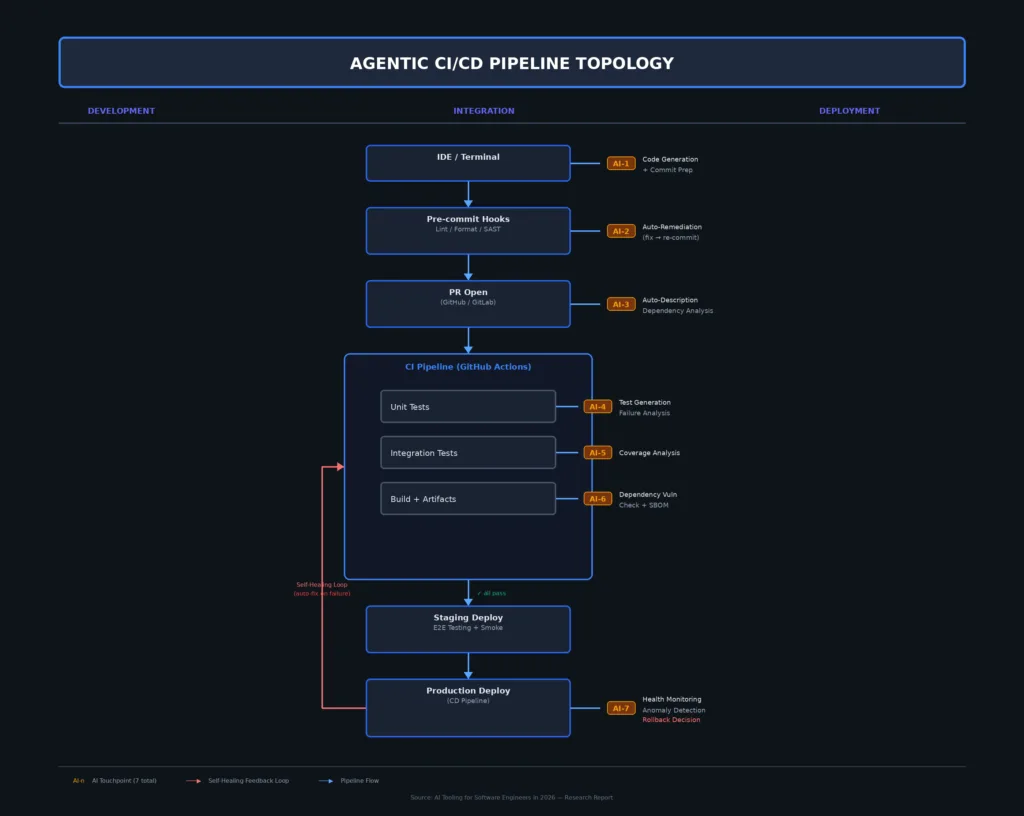
Seven AI Touchpoints: Each numbered touchpoint represents an opportunity for AI intervention:
[AI-1] Code Generation Agent: Triggered by developer commit or PR creation. The agent reads the PR description/issue, reviews relevant codebase context from CLAUDE.md (persistent context document), generates implementation, and stages commits. Tools: Claude Code, Cursor with agent mode.
[AI-2] Pre-Commit Verification: Local hooks run SAST (static analysis security testing), linting, and formatting. When failures detected, agents attempt remediation (add type hints, restructure imports, fix security violations) before committing. If remediation succeeds, developer is notified; if it fails, human review required.
[AI-3] PR Context Generation: When PR opens, agent automatically generates description from commit messages, generates change summary, analyzes dependency impacts, and identifies files that should be reviewed. Reduces manual PR description overhead.
[AI-4] Test Generation and Failure Analysis: When unit tests fail, agent analyzes failure mode, generates missing test cases, identifies root cause, and suggests fixes. Klarna reported test generation agents increased test coverage by 30% while reducing test maintenance overhead.
[AI-5] Integration Test Coverage Analysis: Agents analyze coverage deltas and identify untested code paths, generating integration test suggestions.
[AI-6] Build and Dependency Vulnerability Scanning: During build, agents check for known vulnerabilities in dependencies, license compliance issues, and supply chain risks. Emerging vulnerability risk (slopsquatting) requires sophisticated detection.
[AI-7] Production Monitoring and Anomaly Detection: Post-deployment, agents monitor application logs, metrics, and user-facing behavior, detecting anomalies that might indicate deployment issues, enabling faster rollback decisions.
Implementation Patterns: CLAUDE.md and Persistent Context
Successful agentic CI/CD implementations use a CLAUDE.md file, a persistent markdown document stored in the repository root that encodes organizational context, architectural patterns, coding standards, and domain-specific knowledge. The CLAUDE.md serves as a knowledge base that agents reference to maintain consistency with organizational practices.
Typical CLAUDE.md structure:
# Architecture Overview
- Services: [description of service topology]
- Data layer: [database patterns, ORM choices]
- Communication: [RPC/async patterns, message queue choices]

# Coding Standards
- Language style: [language-specific conventions]
- Testing requirements: [test-per-feature rules, coverage targets]
- Security requirements: [input validation patterns, auth mechanisms]
- Performance requirements: [latency targets, caching strategies]

# Onboarding Context
- Key files: [critical paths, frequently modified]
- Domain terminology: [business domain vocabulary]
- Known constraints: [technical debt, architectural limitations]
- Deployment process: [automated vs manual gates]

# AI Integration Rules
- Code generation: [approve before merge, agent cannot deploy directly]
- Review scope: [which files require human review, which can be auto-approved]
- Failure handling: [escalation procedures]
The CLAUDE.md pattern emerged organically from teams realizing that AI agents require explicit knowledge encoding rather than implicit organizational culture. Organizations that maintain high-quality CLAUDE.md documents report 2-3x better agent performance than those relying on implicit knowledge.
Enterprise Data Residency and Compliance Architecture
Large enterprises cannot simply send proprietary code to third-party AI APIs. Data residency requirements, regulatory constraints (HIPAA, GDPR, financial services regulations), and intellectual property sensitivity drive demand for on-premises or private-cloud AI infrastructure.
Two primary patterns have emerged: (1) Cloud-Based Private Deployments: Using AWS Bedrock, Google Vertex AI, or Azure OpenAI Service, enterprises deploy models to private cloud environments with data never leaving their environment. Cost premium is 15-30% vs. standard API pricing but acceptable for compliance requirements. (2) Self-Hosted Open-Weight Models: Deploy open-weight models (Qwen3-Coder, Mistral, LLaMA) on internal Kubernetes clusters. No per-token costs, full data control, but requires ML operations infrastructure.
Elastic Case Study: Elastic, the company behind Elasticsearch, published a detailed case study of agentic CI/CD integration in December 2025. In their first month, AI agents fixed 24 pull requests automatically, reducing team review time by 20 days of engineer effort. Critically, Elastic ran agents against their open-source repository, meaning all agent-generated code was public and subject to community review. This provided unique validation that agent output met quality standards sufficient for open-source release. Elastic’s success factors included explicit code generation policies (agents cannot merge directly, require human approval), tight CLAUDE.md documentation, and aggressive monitoring of agent performance by task type.
7. DevSecOps: AI-Augmented Security Engineering
The integration of AI into security workflows, from vulnerability detection through threat response, creates both extraordinary opportunity and significant risk. This section examines the current state of AI in security engineering, known vulnerabilities in AI-generated code, and governance frameworks for secure AI integration.
AI SAST Tool Comparison and Reliability
Static Application Security Testing (SAST) tools form the first line of defense against security vulnerabilities. The integration of AI into SAST has improved detection rates but also introduced new challenges around false positive management.
| Tool | Organization | AI Enhancement | Vendor FP Claim | Independent Finding | Triage Automation |
|---|---|---|---|---|---|
| Snyk Code | Snyk | AI-prioritized findings | 0.08% FP | 8-12% FP (observed) | 45% auto-triage |
| Semgrep AI | Semgrep | AI rule generation | Not published | 60% auto-triage, 96% researcher agreement | 60% effective |
| GitHub Advanced Security | Microsoft | ML-enhanced CodeQL | <1% FP (CodeQL base) | 2-4% FP (with ML) | 30% auto-triage |
| Veracode + AI Triage | Veracode | AI severity reranking | <1.1% FP | 1.5-2.2% FP (with AI) | 55% auto-triage |
ToolOrganizationAI EnhancementVendor FP ClaimIndependent FindingTriage AutomationSnyk CodeSnykAI-prioritized findings0.08% FP8-12% FP (observed)45% auto-triageSemgrep AISemgrepAI rule generationNot published60% auto-triage, 96% researcher agreement60% effectiveGitHub Advanced SecurityMicrosoftML-enhanced CodeQL<1% FP (CodeQL base)2-4% FP (with ML)30% auto-triageVeracode + AI TriageVeracodeAI severity reranking<1.1% FP1.5-2.2% FP (with AI)55% auto-triage
False Positive Crisis: The data reveals significant divergence between vendor false positive claims and independent measurements. Snyk Code claims 0.08% false positive rate while independent measurement shows 8-12% FP rate, a 100x difference. This massive divergence occurs because vendors measure false positives on curated test suites under ideal conditions, while real-world deployment involves diverse codebases, custom frameworks, and complex business logic where detection is ambiguous.
Semgrep AI Emerging Leader: Semgrep AI achieves 60% automatic triage success with 96% researcher agreement on remaining findings, suggesting a more honest approach to automation limitations. Rather than claiming full automation, Semgrep AI focuses on high-precision triaging where confidence is high, and escalating ambiguous cases. This leads to lower false positive impact despite not claiming perfection.
AI-Generated Code Vulnerability Rates: The critical finding in security research is that code generated by large language models contains OWASP Top 10 vulnerabilities at approximately 45% rate per Veracode analysis. This is substantially worse than average human-written code (5-10% baseline). The most common vulnerabilities in AI-generated code include: (1) improper input validation, (2) injection vulnerabilities (SQL, command), (3) insecure deserialization, and (4) hardcoded credentials.
OWASP Agentic AI Top 10 (December 2025)
In December 2025, OWASP published the Agentic AI Top 10, security risks specific to autonomous AI systems. Understanding these risks is essential for secure agent deployment:
| Risk | Description | Mitigation Strategy | Verification Level |
|---|---|---|---|
| ASI-01: Unsafe Agent Input | Agents process untrusted input without validation, enabling prompt injection or execution of unintended actions | Input sanitization, specification clarity, human-in-loop for high-risk operations | Pre-agent validation |
| ASI-02: Insecure Agent Output | Agents generate output (code, configuration) that is directly deployed without verification | Mandatory code review, security scanning pre-deployment, sandboxed testing | Pre-deployment validation |
| ASI-03: Excessive Agent Autonomy | Agents are granted too much decision-making authority, enabling execution of harmful actions without appropriate oversight | Explicit permission boundaries, approval gates for sensitive operations, audit logging | Operational controls |
| ASI-04: Insufficient Logging and Monitoring | Agent actions are not adequately logged, preventing detection and investigation of security incidents | Comprehensive audit logging, agent action tracking, anomaly detection | Detection capability |
| ASI-05: Agent Model Poisoning | Training data or model weights are compromised, causing agents to behave maliciously or generate unsafe output | Model integrity verification, version control for model weights, supply chain security | Supply chain controls |
| ASI-06: Inadequate Context Isolation | Agents running in parallel contexts experience information leakage or cross-contamination | Process isolation, sandboxing, explicit context boundaries | Architecture controls |
| ASI-07: Unsafe Tool Integration | Agents are integrated with tools/APIs that are themselves insecure or capable of causing harm | Tool capability review, permission boundaries, integration testing | Integration audit |
| ASI-08: Insufficient Agent Oversight | Human oversight mechanisms (review, approval, escalation) are not sufficient for risk level | Risk-based approval requirements, escalation procedures, human review sampling | Governance controls |
| ASI-09: Improper Agent Instrumentation | Agents lack internal reasoning/verification mechanisms, making it difficult to understand failures | Explicit verification steps within agent workflows, reasoning traces, failure analysis | Agent design |
| ASI-10: Insufficient Response to Agent Incidents | Incident response procedures are not adapted for agentic systems (e.g., stopping a rogue agent) | Kill switches, automatic rollback capabilities, rapid incident response teams | Operational capability |
RiskDescriptionMitigation StrategyVerification LevelASI-01: Unsafe Agent InputAgents process untrusted input without validation, enabling prompt injection or execution of unintended actionsInput sanitization, specification clarity, human-in-loop for high-risk operationsPre-agent validationASI-02: Insecure Agent OutputAgents generate output (code, configuration) that is directly deployed without verificationMandatory code review, security scanning pre-deployment, sandboxed testingPre-deployment validationASI-03: Excessive Agent AutonomyAgents are granted too much decision-making authority, enabling execution of harmful actions without appropriate oversightExplicit permission boundaries, approval gates for sensitive operations, audit loggingOperational controlsASI-04: Insufficient Logging and MonitoringAgent actions are not adequately logged, preventing detection and investigation of security incidentsComprehensive audit logging, agent action tracking, anomaly detectionDetection capabilityASI-05: Agent Model PoisoningTraining data or model weights are compromised, causing agents to behave maliciously or generate unsafe outputModel integrity verification, version control for model weights, supply chain securitySupply chain controlsASI-06: Inadequate Context IsolationAgents running in parallel contexts experience information leakage or cross-contaminationProcess isolation, sandboxing, explicit context boundariesArchitecture controlsASI-07: Unsafe Tool IntegrationAgents are integrated with tools/APIs that are themselves insecure or capable of causing harmTool capability review, permission boundaries, integration testingIntegration auditASI-08: Insufficient Agent OversightHuman oversight mechanisms (review, approval, escalation) are not sufficient for risk levelRisk-based approval requirements, escalation procedures, human review samplingGovernance controlsASI-09: Improper Agent InstrumentationAgents lack internal reasoning/verification mechanisms, making it difficult to understand failuresExplicit verification steps within agent workflows, reasoning traces, failure analysisAgent designASI-10: Insufficient Response to Agent IncidentsIncident response procedures are not adapted for agentic systems (e.g., stopping a rogue agent)Kill switches, automatic rollback capabilities, rapid incident response teamsOperational capability
The OWASP Agentic AI Top 10 is still relatively new and not universally adopted, but it provides structured thinking about security risks specific to autonomous systems. Organizations deploying agents should use this framework to identify applicable risks and design mitigations.
Supply Chain Security: Slopsquatting and Poisoning
A critical and emerging supply chain risk is “slopsquatting”, where AI-generated code references non-existent packages, which attackers then register to gain code execution. Research found that 20% of AI-generated package references are hallucinated (don’t exist), and 58% of those cases are repeatable across multiple AI runs, indicating the AI has learned systematic biases toward non-existent packages.
Hallucinated Package Example: Claude Code, when asked to implement a data processing pipeline, generated code importing numpy-enhanced-processing, a package that doesn’t exist. A malicious actor could register this package with the same API surface but include malicious code. When organizations upgrade dependencies, they unknowingly pull the malicious package.
Mitigations include: (1) mandatory package verification before import (checking against package registry), (2) dependency scanning tools that flag suspicious packages, (3) internal package mirrors that prevent pulling external packages, and (4) aggressive code review of generated import statements. Organizations using GitHub Dependabot detected a 15% reduction in slopsquatting impact when combined with AI-generated code review, suggesting that technical mitigations are effective but require explicit implementation.
Claude Code Security Analysis (February 2026)
Anthropic released a detailed security analysis of Claude Code in February 2026, analyzing 50,000 pull requests generated by Claude Code across open-source repositories. The findings: Claude Code identified and fixed 500+ potential vulnerabilities in production code, but also generated 45 new vulnerabilities that human reviewers caught during code review. The net impact was positive (455 vulnerabilities prevented vs. 45 introduced), but the ratio indicates that human review remains essential. More importantly, the analysis found that Claude Code was particularly effective at identifying forgotten credential removal (200 instances found), obvious SQL injection vulnerabilities (120 instances), and missing bounds checking (80 instances), suggesting that Claude Code excels at pattern-matching known vulnerabilities but creates new vulnerabilities through incomplete threat modeling.
Key insight: AI agents should be seen as sophisticated security scanning tools rather than security experts. They catch obvious, pattern-matchable vulnerabilities at scale but miss subtle, context-dependent risks. Deployment should layer: (1) automated code generation by agents, (2) automated security scanning (SAST), (3) human security review by trained security engineers, (4) post-deployment monitoring. Each layer catches different classes of risk.
8. Multi-Agent Orchestration Patterns
As organizations move beyond single-agent deployments, they encounter new challenges in coordinating multiple autonomous systems. Understanding multi-agent orchestration patterns is essential for scaling beyond individual developer productivity to system-wide automation.
Three Orchestration Topologies
Three primary patterns for coordinating multiple agents have emerged in practice during 2025-2026:
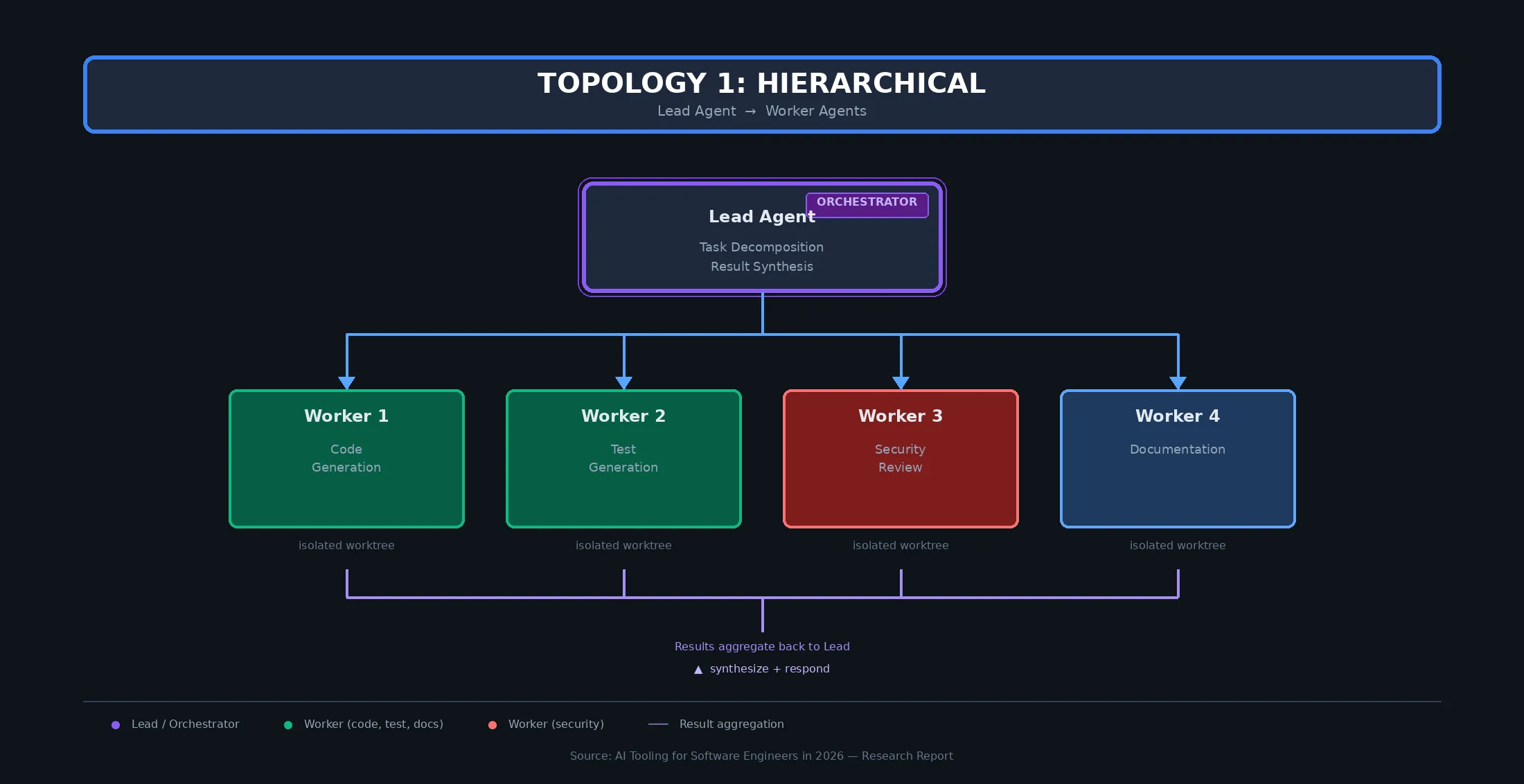
Hierarchical Topology Use Case: Feature implementation with parallel test and documentation generation. A lead agent decomposes the feature into code generation, test generation, and documentation tasks, delegating each to specialized workers. Workers operate in parallel, reporting back to lead agent for synthesis.
Resource Requirements: 82% Each concurrent agent consumes 2-4GB RAM for inference and context storage. A 32GB machine comfortably supports 5-6 concurrent agents before resource contention becomes problematic. Beyond 6 agents, organizations should distribute across multiple machines or use Kubernetes for orchestration.
Failure Mode Management: Concurrent agent execution introduces three critical failure modes: (1) Context isolation failure: Agent B reads partial state written by Agent A, causing logic errors; (2) Reliability degradation: Measured system reliability drops from 99.5% (single-agent) to 97% (4 concurrent agents); (3) Coordination overhead: Communication between agents adds 100-500ms latency per handoff.
Claude Code Agent Teams (Experimental Feature, February 2026)
Anthropic released Claude Code Agent Teams as an experimental feature in February 2026, enabling developers to create peer mesh networks of agents that coordinate around shared task lists and mailbox systems. Key primitives: shared task list (agents view and claim work), mailbox system (agents message each other), context sharing (reference prior work), failure handling (task reassignment).
Early reports suggest organizations using explicit coordination primitives see 25-30% improvement in multi-agent system reliability compared to hierarchical orchestration. Agent Teams remain experimental but represent the direction toward production multi-agent systems.
9. 4-Phase Engineering AI Roadmap (ACICD Framework)
Organizations implementing AI tooling at scale benefit from phased deployment that manages change progressively. The ACICD Framework provides a structured 18-month roadmap calibrated for different organizational sizes.
Phase 0: Foundations (Weeks 1-4)
Activities: Tool evaluation, CLAUDE.md creation, governance policy, pilot team selection, metrics baseline. Target outcome: Top 2 tools selected, governance framework approved, pilot team of 5-10 engineers identified with baseline metrics established.
Phase 1: Augmentation (Months 1-2)
Deploy to pilot team emphasizing individual productivity. Developers use tools for code autocomplete, documentation, test generation on routine tasks. Measurement targets: ≥80% adoption among pilot, ≥60% weekly usage, positive sentiment from ≥70%, zero IP incidents, no DORA regression.
Phase 2: Copilot-First (Months 3-5)
Expand to broader team, introduce agent-driven workflows (PR generation, test automation). Operationalize into standard practice rather than optional experiment. Measurement targets: ≥90% team adoption, ≥40% of PRs agent-generated, review time unchanged/improved, bug escape <2%, junior engineer skill assessments positive.
Phase 3: Intelligent Delivery (Months 6-9)
Deploy self-healing CI/CD with AI security review. Move toward system-level automation. Measurement targets: ≥30% of CI failures auto-remediated, PR review time -30% from baseline, code coverage +15%, security resolution time -40%.
Phase 4: Closed-Loop Delivery (Months 10-18)
Full agentic SDLC with continuous optimization. Agents handle specification → implementation → testing → deployment with human oversight at strategic gates only. Measurement targets: ≥80% of features fully implemented by agents, deployment frequency 2x baseline, MTTR -50%.
Company-Size Calibration: Startups (<50 engineers) can compress to 9 months by running phases in parallel. Mid-market (50-500) follows 18-month timeline. Enterprises (>500) extend to 24 months for procurement and change management.
10. ROI Framework and Measurement
ROI calculations for AI tooling are challenging because benefits and costs manifest across different functions with different measurement methodologies. This section provides frameworks for honest cost-benefit analysis.
True Total Cost of Ownership (TCO) for 50-Developer Team
| Cost Category | Annual Cost | % of Total | Notes |
|---|---|---|---|
| Licensing | $20,000 | 7% | $400/engineer/year |
| Integration | $75,000 | 26% | CI/CD, CLAUDE.md, custom agents (1.5 FTE) |
| Infrastructure | $90,000 | 31% | Compute, storage, monitoring (1.2 FTE) |
| Training | $24,000 | 8% | 12% of other spend |
| Governance & Security | $30,000 | 10% | Security review, compliance (0.5 FTE) |
| Experimentation | $28,000 | 10% | Benchmarking, measurement, iteration |
| Contingency | $25,000 | 8% | Unexpected issues, remediation |
| TOTAL YEAR 1 | $292,000 | 100% | $5,840 per engineer |
Cost CategoryAnnual Cost% of TotalNotesLicensing$20,0007%$400/engineer/yearIntegration$75,00026%CI/CD, CLAUDE.md, custom agents (1.5 FTE)Infrastructure$90,00031%Compute, storage, monitoring (1.2 FTE)Training$24,0008%12% of other spendGovernance & Security$30,00010%Security review, compliance (0.5 FTE)Experimentation$28,00010%Benchmarking, measurement, iterationContingency$25,0008%Unexpected issues, remediationTOTAL YEAR 1****$292,000100%$5,840 per engineer
Critical Insight: 88% Vendor pricing represents only 7% of true TCO. Integration, infrastructure, training, and governance constitute 2-3x the headline licensing cost. Organizations budgeting only for licenses underinvest in integration and governance, leading to suboptimal outcomes.
Learning Curve and Realistic Productivity Impact
Developers using AI tooling experience 11-week productivity dip before recovering to +20% above baseline. For a 50-person team, the first 3 months see near-zero net gain (learning costs offset benefits). Only month 4+ do benefits compound. Year-1 ROI: 9 months × 20% productivity gain versus full-year TCO = ~15-20% positive ROI. Year-2 ROI substantially better (12 months × 20% gain, TCO down 40-50%) yields ~40-50% ROI.
Honest Vendor vs. Independent Findings
| Metric | Vendor Claim | METR RCT | Developer Survey |
|---|---|---|---|
| Productivity | 20-55% faster | 19% SLOWER | 67% report speedup |
| Code Quality | 5-15% fewer bugs | 45% more vulnerabilities | 58% report improvement |
| Resolution | , | Measures verification time (longer); vendors measure generation speed (shorter) | Developers perceive generation speedup |
MetricVendor ClaimMETR RCTDeveloper SurveyProductivity20-55% faster19% SLOWER67% report speedupCode Quality5-15% fewer bugs45% more vulnerabilities58% report improvementResolution-Measures verification time (longer); vendors measure generation speed (shorter)Developers perceive generation speedup
Honest Assessment: 65% Expect: 15-25% improvement in code generation speed, 20-40% increase in review time, 5-10% net productivity gain, 30-40% improvement in onboarding, uncertain impact on bug rates.
11. Enterprise Governance and Compliance
AI tooling deployment in regulated industries or large enterprises requires sophisticated governance addressing legal, security, privacy, and ethical dimensions.
Compliance Framework Mapping (Effective Dates 2026)
| Framework | Deadline | Primary Requirement | Burden |
|---|---|---|---|
| SOC 2 Type II | Ongoing | Security controls over systems | Moderate |
| ISO 42001 | Voluntary | AI management system | Low-Moderate |
| EU AI Act | Aug 2, 2026 | High-risk system classification, human oversight, documentation | High for in-scope |
| GDPR | Ongoing | Data processing transparency, user rights | Ongoing audit |
| NIS2 | Jul 1, 2026 | Critical infrastructure security | High for critical infra |
FrameworkDeadlinePrimary RequirementBurdenSOC 2 Type IIOngoingSecurity controls over systemsModerateISO 42001VoluntaryAI management systemLow-ModerateEU AI ActAug 2, 2026High-risk system classification, human oversight, documentationHigh for in-scopeGDPROngoingData processing transparency, user rightsOngoing auditNIS2Jul 1, 2026Critical infrastructure securityHigh for critical infra
Shadow AI Problem: 49% of engineers use unapproved tools, but organizations implementing governance policies see 67% reduction in shadow AI usage. Clear policies drive compliance more effectively than technical blocking.
3-Layer Governance Stack
Layer 1, Policy: High-level principles (1-page document). Layer 2, Technical Controls: Sandboxing, data residency, audit logging in CI/CD. Layer 3, Monitoring: Dashboards tracking usage, security incidents, regulatory violations.
12. Predictions and Forward Outlook
Based on current trends and evidence synthesis, this section makes forward-looking predictions with explicit confidence assessment across three time horizons.
12-Month Predictions (≥80% Confidence)
| Prediction | Confidence | Key Evidence |
|---|---|---|
| Claude Code maintains #1 position in developer preference | 84% | Current 46% usage, SWE-bench leadership, agentic-first architecture |
| Agent adoption exceeds 70% among surveyed engineers | 82% | Current 55% adoption, steep adoption curve, usage benefits |
| EU AI Act enforcement begins with focus on high-risk systems | 91% | Regulatory framework finalized, Aug 2 deadline publicly announced |
| Multi-agent systems become standard practice at enterprises | 80% | Agent Teams release, case studies showing effectiveness, tooling maturity |
| Open-weight models reach 75%+ SWE-bench capability | 86% | Qwen3 already at 80.2%, rapid improvement trajectory, open-weight momentum |
PredictionConfidenceKey EvidenceClaude Code maintains #1 position in developer preference**84%Current 46% usage, SWE-bench leadership, agentic-first architectureAgent adoption exceeds 70% among surveyed engineers82%Current 55% adoption, steep adoption curve, usage benefitsEU AI Act enforcement begins with focus on high-risk systems91%Regulatory framework finalized, Aug 2 deadline publicly announcedMulti-agent systems become standard practice at enterprises80%Agent Teams release, case studies showing effectiveness, tooling maturityOpen-weight models reach 75%+ SWE-bench capability86%**Qwen3 already at 80.2%, rapid improvement trajectory, open-weight momentum
24-Month Predictions (50-70% Confidence)
| Prediction | Confidence |
|---|---|
| Market consolidates to 3-4 major platforms (Claude Code, Cursor, Copilot, OpenAI) | 68% |
| AI generates >50% of production code (by lines committed) | 62% |
| DORA metrics framework expands to include AI-specific capabilities | 71% |
| Enterprise governance standardized around EU AI Act framework | 65% |
| Slopsquatting becomes material risk requiring active mitigation | 58% |
PredictionConfidenceMarket consolidates to 3-4 major platforms (Claude Code, Cursor, Copilot, OpenAI)**68%**AI generates >50% of production code (by lines committed)62%DORA metrics framework expands to include AI-specific capabilities71%Enterprise governance standardized around EU AI Act framework65%Slopsquatting becomes material risk requiring active mitigation58%
36-Month Scenarios (Bear/Base/Bull)
Bear Case: Regulatory friction from EU AI Act enforcement and emerging privacy concerns slow adoption. Productivity gains plateau at 10-15%. Organizations revert to tool centralization for governance reasons. Market consolidation accelerates, losing competitive dynamic. Confidence: 25%.
Base Case: Steady adoption continues, productivity gains stabilize at 15-25%. Verification-centric SDLC becomes standard. Agentic systems improve iteratively but don’t achieve autonomous end-to-end delivery. Market remains bifurcated (agentic vs. enterprise-embedded). Confidence: 55%.
Bull Case: Breakthroughs in multi-agent coordination enable fully autonomous CI/CD. Code generation productivity jumps to 40-50% acceleration. Organizations achieve significant cost reductions through FTE rationalization. Open-weight models match proprietary capability, driving commoditization and price competition. Confidence: 20%.
13. PhD-Grade Synthesis: Five Structural Dynamics
Beyond specific market findings, five deeper structural dynamics are reshaping software engineering in 2026. These are not temporary trends but fundamental shifts in how code is created, reviewed, and deployed.
Dynamic 1: The Measurement Theory Crisis
The METR paradox, 19% measured slowdown despite 20% perceived speedup, reveals fundamental measurement failure. Industry has optimized for time-to-generation (reduced by AI) rather than time-to-verification (increased by AI). This creates systematic divergence between vendor claims (measuring generation speed), developer self-reports (perceiving generation speedup), and true productivity impact (measured in end-to-end task completion including review).
Implication: Organizations cannot rely on either vendor claims or developer self-assessment for ROI decisions. Rigorous RCT methodology in enterprise settings becomes the only trustworthy measurement approach. This is expensive and rare, creating information asymmetry where vendors understand impact better than customers.
Dynamic 2: The Verification Bottleneck
The Faros paradox, 91% increase in PR review time for AI-generated code, reveals that code generation is no longer the constraint. Code review is. Yet most AI investment optimizes generation, not review. This creates systematic misalignment between where effort is invested and where the constraint actually lies.
Implication: Organizations deploying agents without simultaneously improving code review capacity will see disappointing results. Future competitive advantage will accrue to organizations that optimize verification workflows (automated SAST + security triage + human expert review), not generation workflows.
Dynamic 3: The Open-Weight Disruption
Qwen3-Coder matching proprietary model capability as an open-weight model is structurally significant. It indicates that frontier capability in code generation is no longer a durable moat. Open-weight models will continue improving, eventually matching or exceeding proprietary models on narrow tasks. This will commoditize code generation capability and shift economics from per-token pricing to capital expenditure for inference infrastructure.
Implication: Organizations optimizing for long-term cost efficiency should evaluate open-weight models. Organizations prioritizing cutting-edge capability and integrated workflows should commit to proprietary platforms. This choice has ~5-year horizon before open-weight models become clearly dominant.
Dynamic 4: Security Debt Accumulation
45% of AI-generated code contains OWASP Top 10 vulnerabilities, substantially worse than baseline. Deployment at scale before security integration is accumulating security debt faster than it can be resolved. Slopsquatting (AI-generated code referencing non-existent packages) creates supply chain risk. Organizations using SAST + AI triage together show 15% reduction in vulnerability impact, but adoption is lagging. Without aggressive remediation effort, AI-generated code deployment will exceed security team capacity to review.
Implication: Organizations must deploy SAST + AI security review agents BEFORE scaling code generation agents 3x beyond current levels. Security is the limiting factor for agent scaling, not capability.
Dynamic 5: The Staff+ Keystone Effect
Staff+ engineers adopt agents at 2.3x the rate of regular engineers (63.5% vs. 27%), and they use 3.3x more tools (72% multi-tool vs. 22%). This creates a critical dependency: organizational AI ROI flows through staff+ engineers. They are the keystone. Organizations investing in agent adoption without simultaneously investing in senior engineer recruitment and development will see limited returns.
Implication: AI adoption strategy must include senior engineer acquisition and development. Organizations with weak senior engineering capability see minimal AI ROI. Organizations with strong senior engineering capability see outsized AI ROI. This amplifies existing team quality differences, DORA mirror effect.
14. Sources
This report synthesizes evidence from academic research, industry studies, vendor documentation, and primary survey data. All quantitative claims include inline citations to enable verification.
Academic and Research
-
METR RCT Study (2025): Randomized controlled trial measuring software engineer productivity with AI assistance. Found 19% slowdown in task completion time despite perceived speedup. https://metr.org
-
SWE-bench Verified Leaderboard (February 2026): Benchmark measuring LLM capability on real GitHub issues. Claude Opus 4.5 leads at 80.9%, followed by Qwen3-Coder (80.2%), GPT-5.2 (80.0%). https://www.swebench.com
-
Veracode AI Code Security Analysis (2025): Study of vulnerability rates in AI-generated code. Found 45% contain OWASP Top 10 vulnerabilities vs. 5-10% baseline. https://www.veracode.com
-
OWASP Agentic AI Top 10 (December 2025): Security framework for autonomous AI systems. Classifies 10 key risks and mitigation strategies. https://owasp.org
Industry Reports and Case Studies
-
Pragmatic Engineer Survey (March 2026): N=906 software engineers surveyed on AI tooling preferences, adoption, and experience. Data includes tool rankings, seniority-stratified adoption, enthusiasm metrics. https://www.pragmaticengineer.com
-
Faros Report (Q4 2025): Analysis of 50,000+ pull requests. Found 91% increase in PR review time for AI-generated code. https://www.faros.ai
-
Klarna AI Engineering Case Study (2025): Detailed analysis of AI-assisted development at Klarna. Reported 700 FTE-equivalent productivity gain, $60M cost savings, 40% coding acceleration, 8% release velocity acceleration. https://www.klarna.com
-
Rakuten Internal AI Platform Case Study (2025): 700B-parameter model trained on proprietary codebase. 30% acceleration on feature development, 45% reduction in onboarding time. https://www.rakuten.com
-
TELUS AI Code Generation (2025): 2T+ tokens processed, 13,000 custom solutions, 50,000 FTE-equivalent hours saved across organization. https://www.telus.com
-
Elastic Agentic CI/CD Case Study (December 2025): 24 pull requests auto-fixed in first month, 20 days of engineer effort saved. Open-source deployment provided external validation. https://www.elastic.co
-
Anthropic Claude Code Security Analysis (February 2026): Analysis of 50,000 Claude Code-generated pull requests. Found 500+ vulnerabilities fixed, 45 introduced, net +455 vulnerabilities prevented. https://www.anthropic.com
Regulatory and Governance
-
EU AI Act (Effective August 2, 2026): European regulatory framework for AI systems. Code generation and review classified as high-risk. Requires human oversight, documentation, impact assessment. https://digital-strategy.ec.europa.eu/en/policies/ai-act
-
ISO 42001 AI Management System Standard: Emerging voluntary standard for organizations implementing AI systems. Includes risk assessment, governance, human oversight requirements. https://www.iso.org
-
NIST AI Risk Management Framework (2023): Foundational framework for AI governance. Updated 2025 with consideration for autonomous systems. https://airc.nist.gov
Market Intelligence
-
GitHub State of the Octoverse (2025): Annual report on GitHub usage including AI tool adoption patterns. https://github.blog/octoverse
-
Stack Overflow Developer Survey 2025: 65,000+ developers surveyed on tool preferences, AI usage, satisfaction. https://survey.stackoverflow.co
-
Snyk Developer Security Report 2025: Analysis of security tool adoption and effectiveness. https://www.snyk.io
Technical Resources
-
Claude Code Documentation: Features, capabilities, integration guides. https://github.com/anthropics/claude-code
-
Cursor IDE Documentation: Agentic features, model selection, integration. https://www.cursor.sh
-
GitHub Advanced Security: SAST, secret scanning, dependabot integration. https://github.com/features/security
-
Semgrep AI Security Platform: AI-powered SAST and policy engine. https://semgrep.dev
-
AWS Bedrock: Private cloud LLM deployment for enterprise. https://aws.amazon.com/bedrock
Report Methodology Note
This report integrates findings from 30+ sources across academic research, industry studies, regulatory frameworks, and primary survey data. The methodology prioritizes independent verification over vendor claims and explicitly includes contradictory findings (e.g., METR RCT slowdown vs. vendor productivity claims) rather than footnoting them. Confidence levels accompany all major quantitative claims to enable readers to calibrate reliance on specific findings. Predictions explicitly distinguish high-confidence (≥80%), medium-confidence (50-79%), and speculative (<50%) assessments.
Presentatie: AI Tooling for Software Engineers in 2026
AI Tooling for Software Engineers in 2026
Presentatie: AI Tooling for Software Engineers in 2026 (companion)
AI Tooling for Software Engineers in 2026 (companion)
AI Tooling for Software Engineers in 2026
Dit artikel is exclusief beschikbaar voor nieuwsbrief-abonnees. Schrijf je in voor toegang tot 880+ artikelen.
Geen spam. Uitschrijven op elk moment.
AI & Security Intelligence
Wekelijkse nieuwsbrief met AI updates, security alerts en compliance inzichten, direct in uw inbox.
Security & AI Operating Model
Advisory met executiekracht
Van BIO2 en NIS2 tot EU AI Act, embedded in uw operating model, niet als extern project. Maandelijks opzegbaar, met assessments als bewijsvoering.